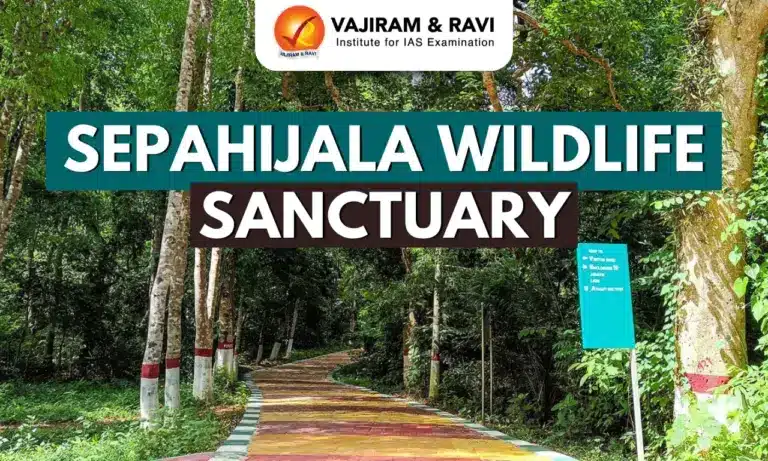
Sepahijala Wildlife Sanctuary Latest News
The Tripura Forest Minister recently announced that the state has received over Rs 57 crore for the modernization and further development of the Sepahijala Wildlife Sanctuary in the Sepahijala district.
About Sepahijala Wildlife Sanctuary
- It is located around 25 km from Agartala, Tripura.
- It is divided into five sections, basically to segregate the different types of animals living here.
- They are the carnivore section, primate section, ungulate section, reptile section, and aviary section.
- It also has two natural lakes, namely Abasarika and Amrit Sagar.
- Clouded Leopard National Park, established in 2007, is a part of SWL.
- Vegetation: Moist deciduous forest
- Flora:
- It has 456 plant species. There are trees of Sal, Chamal, Garjan, and Kanak.
- The secondary species consist of Pichla, Kurcha, Awla, Bahera, Hargaja, Amlaki, Bamboos and grasses, are also found here.
- Fauna:
- It is the habitat of different species of primates like the Rhesus macaque, Pigtailed macaque, Capped langur, Spectacled monkey, Slow loris and several other wild animals like Leopard, Clouded leopard, Jungle fowl, Civets, Barking, Deer, Wild pig, etc.
- The crab-eating mongoose (which was last seen in the 1930s) has also been revived here.
- The avian population of the sanctuary is also rich, with a variety of winged stork, Whistling teal, and the White ibis.
Source: MSN






 Last updated on April, 2026
→ UPSC Final Result 2025 is now out.
→ UPSC has released UPSC Toppers List 2025 with the Civil Services final result on its official website.
→ Anuj Agnihotri secured AIR 1 in the UPSC Civil Services Examination 2025.
→ UPSC Marksheet 2025 is now out.
→ UPSC Notification 2026 & UPSC IFoS Notification 2026 is now out on the official website at upsconline.nic.in.
→ UPSC Calendar 2026 has been released.
→ Check out the latest UPSC Syllabus 2026 here.
→ UPSC Prelims 2026 will be conducted on 24th May, 2026 & UPSC Mains 2026 will be conducted on 21st August 2026.
→ The UPSC Selection Process is of 3 stages-Prelims, Mains and Interview.
→ Prepare effectively with Vajiram & Ravi’s UPSC Prelims Test Series 2026 featuring full-length mock tests, detailed solutions, and performance analysis.
→ Enroll in Vajiram & Ravi’s UPSC Mains Test Series 2026 for structured answer writing practice, expert evaluation, and exam-oriented feedback.
→ Join Vajiram & Ravi’s Best UPSC Mentorship Program for personalized guidance, strategy planning, and one-to-one support from experienced mentors.
→ Shakti Dubey secures AIR 1 in UPSC CSE Exam 2024.
→ Also check Best UPSC Coaching in India
Sepahijala Wildlife Sanctuary FAQs
Q1. Where is Sepahijala Wildlife Sanctuary located?+
Q2. Which natural lakes are found within Sepahijala Wildlife Sanctuary?+
Q3. Which national park forms a part of Sepahijala Wildlife Sanctuary?+
Q4. What type of forest vegetation is found in Sepahijala Wildlife Sanctuary?+
Tags: prelims pointers sepahijala wildlife sanctuary upsc current affairs upsc prelims current affairs