The Sevottam Service Delivery Excellence Model is a quality management framework developed to improve public service delivery in India by promoting citizen-centric governance. It focuses on the establishment of clear service standards, effective grievance redress mechanisms, and organizational capacity building to ensure accountability, transparency, and responsiveness in public administration. In this article, we are going to cover the Sevottam Delivery Excellence Model, its objectives, structure, implementation and importance of the Sevottam framework in efficient and citizen focused governance.
Sevottam Service Delivery Excellence Model
Derived from the words “Seva” (service) and “Uttam” (excellence), the Sevottam model aims to improve the quality of public services through a systematic and measurable approach. It is designed to ensure that public organizations operate transparently, are accountable to citizens, and prioritize service excellence. Formulated as IS 15700:2005 by the Quality Council of India on behalf of the Department of Administrative Reforms, the model was officially adopted in 2006. Sevottam applies to both central and state government services, providing a structured methodology for defining, monitoring, and enhancing service delivery, while empowering public organizations to achieve operational excellence.
Sevottam Framework Objectives
The Sevottam model is guided by three primary objectives:
- Effective Implementation of Citizen’s Charters: Citizen’s Charters define service entitlements, timelines, and quality benchmarks. By integrating citizen feedback, organizations can align services with expectations, fostering trust and transparency.
- Service Delivery Preparedness and Performance: Public organizations are required to identify services, establish efficient processes, and build capacity to meet standards. Preparedness ensures services are delivered reliably and consistently, meeting citizen expectations.
- Robust Public Grievance Redress Mechanism: A transparent and accessible grievance system ensures complaints are addressed effectively, enhancing citizen satisfaction and reinforcing accountability.





Sevottam Service Delivery Excellence Model Principles
The Sevottam framework emphasizes three core principles:
- Defining Service Standards: Clear and measurable standards help citizens understand what they can expect from public services.
- Citizen Feedback: Inputs from users highlight discrepancies in service delivery, providing actionable insights for improvement.
- Capacity Building: Developing the organizational and human resource capacity ensures consistent delivery of high-quality services.
Sevottam Service Delivery Excellence Model Framework
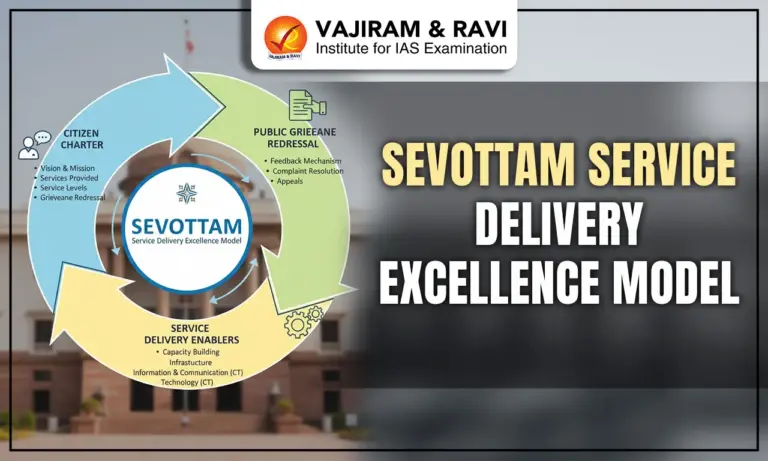
The Sevottam Service Delivery Excellence framework consists of three main modules:
- Citizen’s Charter: It communicates service standards and entitlements, serving as a reference point for evaluating service quality.
- Grievance Redress Mechanism: Ensures an effective system for addressing complaints whenever services fall short of the defined standards.
- Capability Building: Focuses on training, process improvement, and organizational development to consistently meet service delivery benchmarks.
Seven-Step Approach to Citizen-Centric Governance
The Administrative Reforms Commission (ARC) proposed a seven-step approach to make governance more citizen-oriented, based on Sevottam principles:
- Define Services: Identify and categorize services according to citizen needs and organizational priorities.
- Set Standards: Establish realistic, measurable benchmarks with citizen inputs.
- Develop Capacity: Improve organizational capacity through training, value-building, and promoting a customer-centric culture.
- Perform: Implement performance management systems to ensure standards are met.
- Monitor: Track adherence to service standards and identify gaps.
- Evaluate: Conduct external assessments through citizen feedback and report cards to evaluate service quality.
- Continuous Improvement: Regularly upgrade services, standards, and processes to meet evolving expectations.
Sevottam Service Delivery Excellence Model Importance
The Sevottam framework plays an important role in improving governance in India:
- Self-Assessment: Organizations can evaluate internal gaps in service delivery and take corrective actions.
- Benchmarking: Provides a quality standard for public services, facilitating comparisons and encouraging improvements.
- Recognition and Reward: Acts as a rating system to acknowledge organizations excelling in citizen-centric governance.
- Sustainability: Promotes the integration of service excellence into routine practices, ensuring long-term impact.
Sevottam Certification Process
Organizations seeking Sevottam certification undertake a self-assessment aligned with IS 15700 standards, focusing on citizen’s charters, grievance redress, service delivery, and continuous improvement. Successful applicants can obtain certification from authorized bodies, valid for three years, recognizing them for excellence in public service.
Sevottam Framework Challenges and Way Forward
While the Sevottam model provides a structured approach to citizen-centric governance, its effective implementation faces several challenges:
- Decentralized Implementation: Effective delivery requires focus on field-level interactions and responsiveness.
- Awareness and Training: Both citizens and public officials need greater understanding of Sevottam objectives.
- Bottom-Up Reforms: Sustainable improvements require participatory approaches, engaging frontline staff and beneficiaries.
Despite these challenges, the simplicity and adaptability of the model make it a powerful tool for improving public service delivery in India.
| Also Check Other Posts | |
| Civil Society | FCRA |
| India’s Ranking in Different Indexes | 1st ARC Report |

 Last updated on March, 2026
→ UPSC Final Result 2025 is now out.
→ UPSC has released UPSC Toppers List 2025 with the Civil Services final result on its official website.
→ Anuj Agnihotri secured AIR 1 in the UPSC Civil Services Examination 2025.
→ UPSC Marksheet 2025 is now out.
→ UPSC Notification 2026 & UPSC IFoS Notification 2026 is now out on the official website at upsconline.nic.in.
→ UPSC Calendar 2026 has been released.
→ Check out the latest UPSC Syllabus 2026 here.
→ UPSC Prelims 2026 will be conducted on 24th May, 2026 & UPSC Mains 2026 will be conducted on 21st August 2026.
→ The UPSC Selection Process is of 3 stages-Prelims, Mains and Interview.
→ Prepare effectively with Vajiram & Ravi’s UPSC Prelims Test Series 2026 featuring full-length mock tests, detailed solutions, and performance analysis.
→ Enroll in Vajiram & Ravi’s UPSC Mains Test Series 2026 for structured answer writing practice, expert evaluation, and exam-oriented feedback.
→ Join Vajiram & Ravi’s Best UPSC Mentorship Program for personalized guidance, strategy planning, and one-to-one support from experienced mentors.
→ Shakti Dubey secures AIR 1 in UPSC CSE Exam 2024.
→ Also check Best UPSC Coaching in India
Sevottam Service Delivery Excellence Model FAQs
Q1. What is the Sevottam model of public service delivery?+
Q2. What is the Sevottam model?+
Q3. What are the seven steps of Sevottam?+
Q4. What is the Sevottam Certification Process?+
Q5. What are the principles of Sevottam Model?+
Tags: sevottam service delivery excellence model