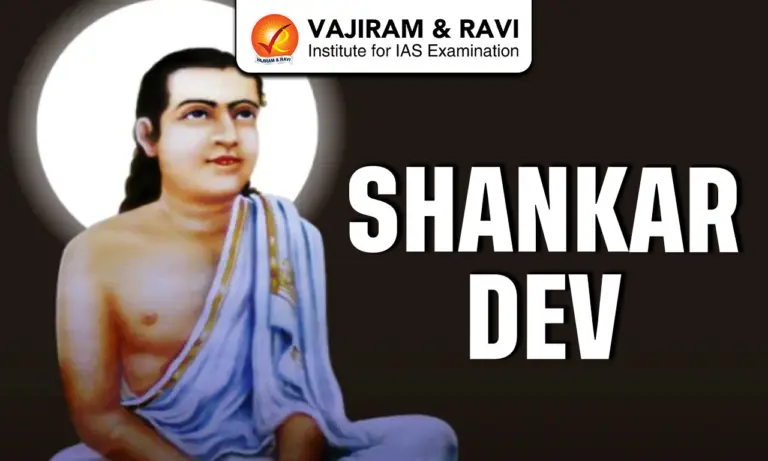
Sankar Dev was a 15th-16th century saint, social reformer, and cultural icon of Assam. He was one of the most important propagators of Vaishnavism in Northeast India and the founder of Ekasarana Dharma (Neo-Vaishnavism). Through his teachings, he emphasized devotion to one God, social equality, and cultural unity. His contributions led to a religious and cultural transformation in Assam, often described as a golden phase in its history.
Shankar Dev Early Life
The early life of Shankar Dev reflects his intellectual brilliance and early spiritual inclination.
- Shankar Dev was born in 1449 at Alipukhuri near Bordowa in present-day Nagaon district of Assam.
- He lost his parents at a young age and was raised by his grandmother Khersuti, who ensured his upbringing and education.
- He studied at the tol (traditional school) of Mahendra Kandali, where he displayed exceptional talent and is believed to have composed early verses like Karatala Kamala.
- During his student life, he also composed his early work Harishchandra Upakhyan, showing his literary and philosophical abilities.
- He later assumed the responsibilities of Shiromani Bhuyan (a local chief), though he gradually shifted towards a spiritual path.
Shankar Dev Spiritual Journey and Pilgrimage
Shankar Dev’s spiritual philosophy was deeply shaped by his extensive travels across India.
- In 1481, he began his first major pilgrimage, which lasted for about 12 years, covering important centres such as Puri, Mathura, Vrindavan, and Dwarka.
- These travels exposed him to various Bhakti traditions, particularly Vaishnavism, which influenced his later teachings.
- After returning in 1493, he briefly resumed administrative responsibilities but soon renounced them to focus on spiritual reform.
- He later undertook a second pilgrimage around 1550, accompanied by many disciples including Madhavdev.






Shankar Dev Philosophy and Teachings (Ekasarana Dharma / Neo-Vaishnavism)
Shankar Dev propounded a distinct religious philosophy known as Ekasarana Dharma, also called Mahapurushiya Dharma.
- His philosophy was based on texts like the Bhagavata Purana and the Bhagavad Gita, emphasizing devotion to Lord Krishna as the supreme reality.
- He advocated Eka-Sarana-Nam-Dharma, which means complete surrender to one God (Krishna), rejecting the worship of multiple deities.
- He opposed ritualism, sacrifices, and priestly dominance, promoting a direct and personal relationship with God.
- He emphasized naam-kirtan (chanting of God’s name) as the primary mode of devotion.
- His teachings promoted equality and rejected caste distinctions, making religion accessible to all sections of society.
- He integrated religion with art, music, and literature, making Bhakti a mass movement.
Shankar Dev Literary and Cultural Contributions
Shankar Dev made immense contributions to literature, art, and culture, playing a foundational role in Assamese identity.
- He composed important works such as Kirtan Ghosa, Gunamala, and Bhakti Pradipa, which explained Vaishnav philosophy in a simple manner.
- His literary works include Rukmini Haran, Parijat Haran, Kaliya Daman, Keli Gopal, and Rama Vijaya, reflecting devotion and moral teachings.
- He translated and adapted parts of the Bhagavata Purana into Assamese, making sacred knowledge accessible to common people.
- He composed devotional songs known as Borgeet; although he composed around 240, only a few survive today.
- He introduced Ankiya Naat (one-act plays), which combined drama, music, and dance to spread religious messages.
- He is credited with the development of Sattriya dance, now recognized as a classical dance form of India.
- Under royal patronage, he supervised the creation of the famous Vrindavani Vastra, a large woven cloth depicting scenes from Krishna’s life.
Institutional Contributions: Satras and Namghars:
Shankar Dev institutionalized his teachings through innovative socio-religious structures.
- He established Satras (monastic institutions) which served as centres of religious, cultural, and educational activities.
- He introduced Namghars (community prayer halls), which became the focal point of village life in Assam.
These institutions helped in spreading Neo-Vaishnavism and played a key role in shaping community identity and cohesion.
Shankar Dev Patronage and Later Life
The later phase of Srimanta Sankardev’s life reflects both the consolidation of his religious movement and its interaction with contemporary political authority.
- He received patronage from Koch rulers such as King Naranarayana and Prince Chilarai, which significantly aided the expansion of his Neo-Vaishnavite movement.
- Despite facing resistance from orthodox Brahmanical groups, he continued to propagate his teachings of devotion, equality, and simplicity.
- After the death of his first wife, he remarried, but gradually devoted himself entirely to spiritual and social reform.
- He spent his later years actively spreading Ekasarana Dharma across Assam and strengthening institutions such as Satras and Namghars.
- Shankar Dev passed away in 1568, leaving behind a well-organized and deeply rooted religious and cultural movement.
Legacy of Shankar Dev
The legacy of Srimanta Sankardev is deeply rooted in the cultural and religious life of Assam.
- His Neo-Vaishnavism movement brought a socio-cultural transformation, often described as a golden age in Assamese history.
- The Satras and Namghars continue to function as centres of spirituality, culture, and community life.
- His contributions to literature, music, dance, and drama laid the foundation of Assamese cultural identity.
- His teachings reduced social inequalities and promoted inclusiveness and unity.
Shankar Dev Relevance in Contemporary India
The teachings of Srimanta Sankardev remain highly relevant today.
- His emphasis on unity and inclusiveness is important for maintaining harmony in a diverse society.
- His institutional innovations like Namghars promote community participation and grassroots democracy.
- His cultural contributions continue to influence art, identity, and heritage in Northeast India.
- His message of ethical living and devotion provides guidance in modern life.

 Last updated on April, 2026
→ UPSC Final Result 2025 is now out.
→ UPSC has released UPSC Toppers List 2025 with the Civil Services final result on its official website.
→ Anuj Agnihotri secured AIR 1 in the UPSC Civil Services Examination 2025.
→ UPSC Marksheet 2025 is now out.
→ UPSC Notification 2026 & UPSC IFoS Notification 2026 is now out on the official website at upsconline.nic.in.
→ UPSC Calendar 2026 has been released.
→ Check out the latest UPSC Syllabus 2026 here.
→ UPSC Prelims 2026 will be conducted on 24th May, 2026 & UPSC Mains 2026 will be conducted on 21st August 2026.
→ The UPSC Selection Process is of 3 stages-Prelims, Mains and Interview.
→ Prepare effectively with Vajiram & Ravi’s UPSC Prelims Test Series 2026 featuring full-length mock tests, detailed solutions, and performance analysis.
→ Enroll in Vajiram & Ravi’s UPSC Mains Test Series 2026 for structured answer writing practice, expert evaluation, and exam-oriented feedback.
→ Join Vajiram & Ravi’s Best UPSC Mentorship Program for personalized guidance, strategy planning, and one-to-one support from experienced mentors.
→ Shakti Dubey secures AIR 1 in UPSC CSE Exam 2024.
→ Also check Best UPSC Coaching in India
Shankar Dev FAQs
Q1. Who was Shankar Dev?+
Q2. What were the main teachings of Shankar Dev?+
Q3. What is Ekasarana Dharma founded by Shankar Dev?+
Q4. What are the contributions of Shankar Dev to Assamese culture?+
Q5. Why is Shankar Dev important in modern India?+
Tags: shankar dev