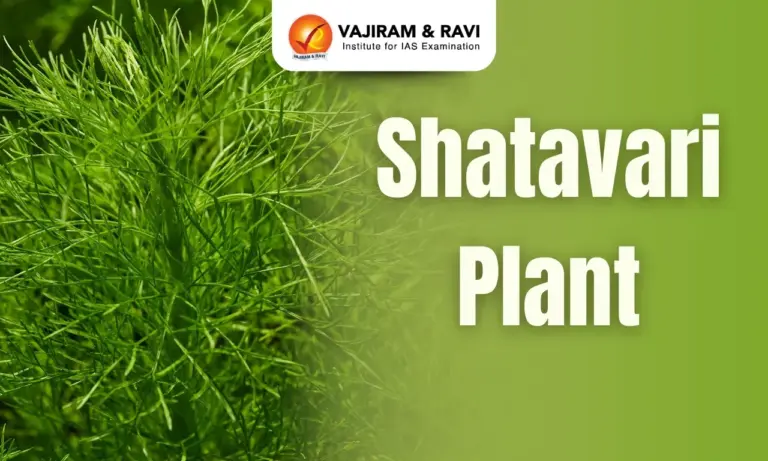
Shatavari Plant Latest News
In a bid to raise awareness about the health benefits of medicinal plants, a species-specific campaign titled “Shatavari –For Better Health” was launched by the Minister of State (Independent Charge), Ministry of Ayush.
About Shatavari Plant
- Asparagus racemosus (family Asparagaceae) also known by the name Shatavari is one of the well-known drugs in Ayurveda.
- Shatavari means “acceptable to many”.
- It belongs to the family Liliaceae and is commonly known as Satawar or Satamuli.
- Appearance of Shatavari Plant: It is a woody climber growing to 1-2 m in height. The leaves are like pine needles, small and uniform and the flowers are white and have small spikes.
- Habitat and Distribution of Shatavari Plant: Its habitat is common at low altitudes in shade and in tropical climates throughout Asia, Australia and Africa.
- In Ayurveda, this amazing herb is known as the “Queen of herbs”, because it promotes love and devotion.
- Charak Samhita written by Charak and Ashtang Hridyam written by Vagbhata, the two main texts on Ayurvedic medicines, list Asparagus racemosus (A. racemosus) as part of the formulas to treat women’s health disorder.
- Uses of Shatavari Plant:
- The dried roots of the plant are used as drug. The roots are said to be tonic and diuretic and galactgogue, the drug has ulcer healing effect probably via strenthening the mucosal resistance or cytoprotection.
- This herb is highly effective in problems related with female reproductive system.





Shatavari Plant FAQs
Q1: What is the main use of Shatavari?
Ans: Shatavari powder treats gastric ulcers and might prevent future ulcers from forming. Supports lactation.
Q2: What is the English name for the Shatavari plant?
Ans: Asparagus racemosus (A. racemosus) belongs to family Liliaceae and commonly known as Satawar, Satamuli,
Q3: Where is Shatavari found in India?
Ans: In India it is found in Arunachal Pradesh, Assam, Chhattisgarh, Delhi, Gujarat, Haryana, Himachal Pradesh, Jharkhand, Kerala and Punjab.
Source: PIB

 Last updated on March, 2026
→ UPSC Final Result 2025 is now out.
→ UPSC has released UPSC Toppers List 2025 with the Civil Services final result on its official website.
→ Anuj Agnihotri secured AIR 1 in the UPSC Civil Services Examination 2025.
→ UPSC Marksheet 2025 is now out.
→ UPSC Notification 2026 & UPSC IFoS Notification 2026 is now out on the official website at upsconline.nic.in.
→ UPSC Calendar 2026 has been released.
→ Check out the latest UPSC Syllabus 2026 here.
→ UPSC Prelims 2026 will be conducted on 24th May, 2026 & UPSC Mains 2026 will be conducted on 21st August 2026.
→ The UPSC Selection Process is of 3 stages-Prelims, Mains and Interview.
→ Prepare effectively with Vajiram & Ravi’s UPSC Prelims Test Series 2026 featuring full-length mock tests, detailed solutions, and performance analysis.
→ Enroll in Vajiram & Ravi’s UPSC Mains Test Series 2026 for structured answer writing practice, expert evaluation, and exam-oriented feedback.
→ Join Vajiram & Ravi’s Best UPSC Mentorship Program for personalized guidance, strategy planning, and one-to-one support from experienced mentors.
→ Shakti Dubey secures AIR 1 in UPSC CSE Exam 2024.
→ Also check Best UPSC Coaching in India