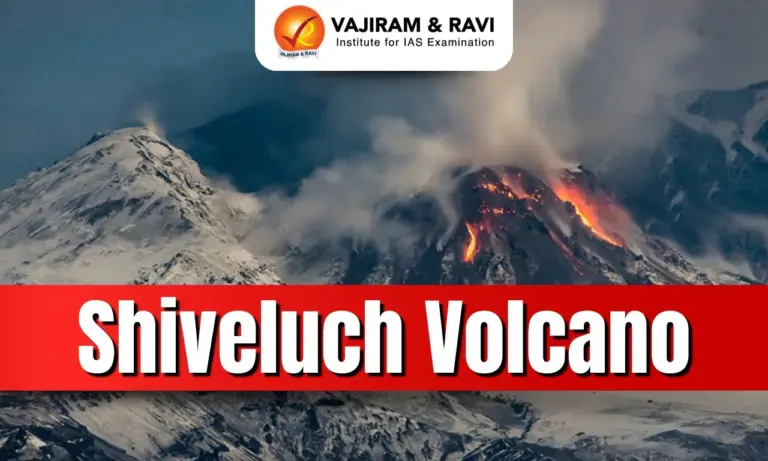
Shiveluch Volcano Latest News
The Shiveluch volcano on Russia’s Kamchatka Peninsula erupted twice recently, sending ash plumes up to 8 kilometres above sea level.
About Shiveluch Volcano
- It is one of the largest and most active volcanoes located on Russia’s Kamchatka Peninsula, one of the most intense volcanic regions in the world.
- It’s estimated to be between 60,000-70,000 years old.
- It is a stratovolcano—a steep-sloped volcano composed of alternating layers of solidified ash, hardened lava, and volcanic rocks.
- It sports a summit reaching 3,283 meters (10,771 feet).
- Many lava domes dot its outer flanks.
- It has had more major eruptions than any other volcano in our current period of geologic time, with an estimated 60 substantial eruptions in the past 10,000 years.
- The volcano has been continuously erupting since August 1999, but occasionally undergoes powerful explosive events, including in 2007.
- It has been spewing ash and steam intermittently—with occasional dome collapses, pyroclastic flows, and lava flows, as well—for the past decade.
Key Facts about Kamchatka Peninsula
- It lies in far eastern Russia, between the Sea of Okhotsk on the west and the Pacific Ocean and Bering Sea on the east.
- About the size of New Zealand, it is one of the largest peninsulas in the world.
- It is one of the world’s most concentrated areas of geothermal activity.
- Of the 127 volcanoes on the peninsula, 22 are still active, as are a number of geysers and hot springs.
- Climate: Severe, with prolonged, cold, and snowy winters and wet, cool summers.
- Most of Kamchatka is tundra.
- The main center is the city and port of Petropavlovsk-Kamchatsky.
- The Kuril Island chain runs from the southern tip of the peninsula to a short distance from Japan’s northern Hokkaido Island.
- The volcanoes of Kamchatka have been a UNESCO World Heritage Site since 1996.
Source: MSN






 Last updated on March, 2026
→ UPSC Final Result 2025 is now out.
→ UPSC has released UPSC Toppers List 2025 with the Civil Services final result on its official website.
→ Anuj Agnihotri secured AIR 1 in the UPSC Civil Services Examination 2025.
→ UPSC Marksheet 2025 is now out.
→ UPSC Notification 2026 & UPSC IFoS Notification 2026 is now out on the official website at upsconline.nic.in.
→ UPSC Calendar 2026 has been released.
→ Check out the latest UPSC Syllabus 2026 here.
→ UPSC Prelims 2026 will be conducted on 24th May, 2026 & UPSC Mains 2026 will be conducted on 21st August 2026.
→ The UPSC Selection Process is of 3 stages-Prelims, Mains and Interview.
→ Prepare effectively with Vajiram & Ravi’s UPSC Prelims Test Series 2026 featuring full-length mock tests, detailed solutions, and performance analysis.
→ Enroll in Vajiram & Ravi’s UPSC Mains Test Series 2026 for structured answer writing practice, expert evaluation, and exam-oriented feedback.
→ Join Vajiram & Ravi’s Best UPSC Mentorship Program for personalized guidance, strategy planning, and one-to-one support from experienced mentors.
→ Shakti Dubey secures AIR 1 in UPSC CSE Exam 2024.
→ Also check Best UPSC Coaching in India
Shiveluch Volcano FAQs
Q1. What is the location of Shiveluch Volcano?+
Q2. What type of volcano is Shiveluch?+
Tags: shiveluch volcano