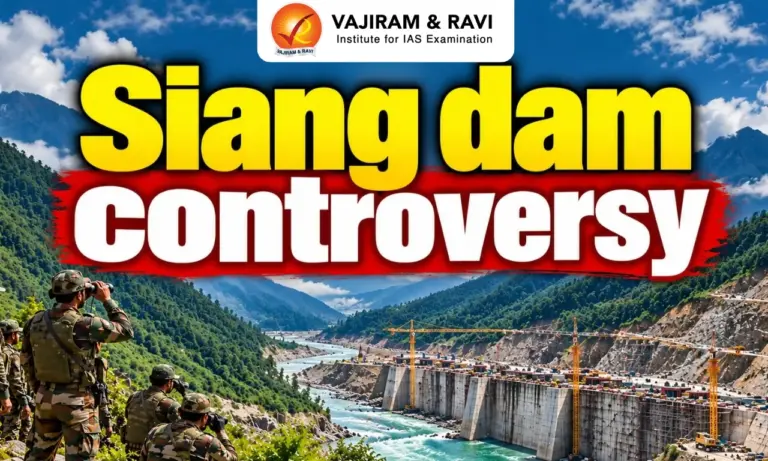
Siang Dam Controversy Latest News
- Tensions are escalating in Arunachal Pradesh’s Siang belt, where sections of the indigenous Adi community, youth leaders, and riverbank residents are opposing the proposed Siang Upper Multipurpose Project (SUMP).
- While the state government defends the project as essential to counter China’s upstream dam and as a national security imperative, locals fear economic, social, and cultural losses tied to their ancestral land.
What Is the Siang Upper Multipurpose Project?
- At 11,200 MW, the SUMP would be India’s largest hydropower project.
- Historical Origins: Plans to harness the Siang and Subansiri rivers date back to 1982, when the Brahmaputra Board proposed three smaller projects — countering China was not the original concern then.
- 2013: The central government raised concerns over Chinese projects on the Yarlung Tsangpo (as the Siang is known upstream in Tibet), expressing interest in India’s position as a downstream user.
- 2017: The proposed Siang Upper Stage-I and Stage-II were merged into one project, eventually becoming the SUMP.
- December 2024: The project gained renewed prominence after China approved its 60,000 MW lower Yarlung Tsangpo hydropower project — significantly larger than India’s proposed response.


The Counter China Argument
- Supporters defend the project as a matter of national interest: What if China purposely releases water and uses it [its dam] as a water bomb? We need checks and balances in place.
- However, experts question this reasoning:
- Water experts point out: We don’t even know the basic dimensions of the Chinese project. Only when we know the operational SOP, will we know what kind of impact it will have on India.
- They argue India, as a downstream country, has the right to seek public details of China’s project from Beijing.
- They stress India is pushing for the project by just assuming it will counter China’s dam — and that even if India proceeds, it cannot succeed without full cooperation of the local community.
Current Status of the Project
- SUMP is currently at the pre-feasibility survey (PFR) stage.
- Arunachal Pradesh CM Pema Khandu stated that the project would “not be rushed beyond the feasibility stage,” and that if experts find it not feasible, there will be no further progress.
- He assured extensive consultations with affected communities if the project advances further — including a social impact assessment, environmental assessment, and a detailed project report (DPR).
- The govt officials claim that if villagers reject the project even after the PFR, it will not be done.
Local Scepticism
- Local leaders expressed deep distrust: It is unlikely that the PFR will say that the project is not feasible. When has it ever happened?
- They demanded authorities give it in writing that the dam won’t be built post-PFR, declaring: Even if the PFR is done, we will not allow the construction of the dam.
- They fear that they will be refugees in their own land.
- What’s at Stake for Local Communities
- The core concern is loss of ancestral land and livelihood.
- Water experts emphasise that for indigenous communities, the river holds deep significance — functioning as a “mother” culturally, economically, socially, and religiously.
Conclusion
- The Siang dam controversy encapsulates a recurring dilemma in India’s border infrastructure strategy: balancing legitimate national security concerns against China’s massive upstream hydropower ambitions with the rights, livelihoods, and cultural heritage of indigenous communities who call the river basin home.
- While the government’s counter China rationale carries strategic weight — especially given China’s approved 60,000 MW project — experts rightly question whether India is proceeding on assumption rather than verified information about the Chinese project’s actual impact.
- With trust between authorities and local communities visibly strained, the real test for the Siang project’s future lies not just in its feasibility studies, but in whether the government can deliver genuine, binding consultation that local residents believe in — rather than a process many already suspect is a formality before construction proceeds regardless.
Source: IE

 Last updated on Oct, 2026
→ UPSC 2027 Notification will be released on 13 January 2027 at upsconline.nic.in.
→ Check Nobel Prize 2026 Winners List here.
→ Download PIB PRiSM Monthly Magazine 2026 here.
→ Check UPSC Monthly Current Affairs Magazine The Recitals here.
→ Check out the latest UPSC Syllabus here.
→ Download UPSC Model Answers for Mains 2026
→ UPSC Mains Question Paper 2026 is out now for Essay & GS Paper 1, 2, 3 & 4.
→ UPSC Calendar 2027 has been released.
→ Enroll in Vajiram & Ravi’s UPSC Mains Test Series 2027 for structured answer writing practice, expert evaluation, and exam-oriented feedback.
→ Join Vajiram & Ravi’s UPSC Mentorship Program 2027 for personalized guidance, strategy planning, and one-to-one support from experienced mentors.
→ Go through the UPSC Mains Previous Year Papers to enhance your preparation.
→ UPSC has released UPSC Toppers List 2025 with the Civil Services final result on its official website.
→ Also check Best UPSC Coaching in India
Siang Dam Controversy FAQs
Q1. What is the Siang Upper Multipurpose Project? +
Q2. Why does India consider the Siang dam strategically important? +
Q3. hy are indigenous communities opposing the Siang dam project? +
Q4. What is the current status of the Siang Upper Multipurpose Project? +
Q5. How can the government address concerns surrounding the Siang dam controversy? +
Tags: mains articles Siang dam controversy upsc current affairs upsc mains current affairs