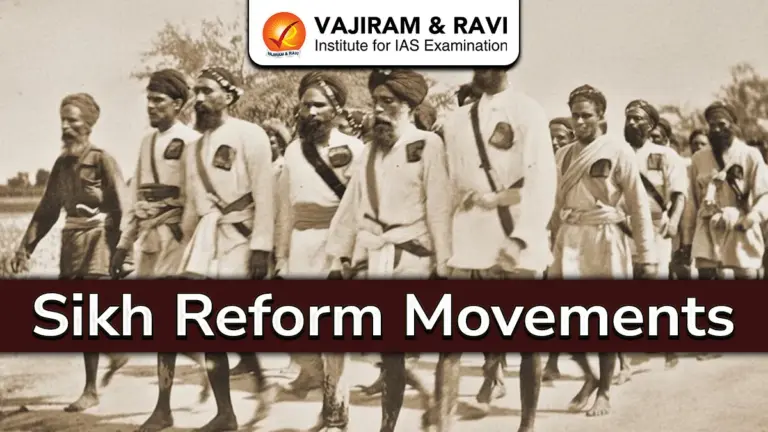
Sikh Reform Movements emerged mainly during the nineteenth and early twentieth centuries to revive Sikh religious purity, strengthen community identity and reform social and institutional practices. These movements developed after the decline of the Sikh Empire and under British colonial rule, when Sikh institutions faced internal corruption, ritual dilution and external religious influences. Reformers focused on restoring core teachings of Guru Nanak, promoting monotheism, rejecting superstition and idolatry, strengthening Punjabi and Gurmukhi education and reclaiming control of Gurdwaras from hereditary mahants. Collectively, these movements reshaped modern Sikh religious, social and political life in a lasting and institutionalized manner.
Sikh Reform Movements Historical Timeline
Sikh Reform Movements evolved gradually from religious revival to organized institutional and political reform, especially between the mid nineteenth century and the 1920s.
- Early Nineteenth Century: After the fall of Maharaja Ranjit Singh’s empire in 1849, Sikh institutions weakened, allowing ritualism, caste practices and Udasi control over Gurdwaras to expand steadily.
- 1840s: Baba Dayal Das initiated early reform by stressing nirankar, the formless God, marking the first organized attempt to restore Guru Nanak’s teachings.
- 1857: Baba Ram Singh launched a disciplined socio-religious movement combining moral reform with symbolic resistance against British authority.
- 1873: Establishment of Singh Sabha at Amritsar and Lahore institutionalized reform through education, print culture and theological clarification of Sikh doctrines.
- Post 1920: Mass mobilization freed Gurdwaras from mahants, leading to the formation of SGPC in 1920 and legal recognition under the Gurdwara Act, 1925.
Read about: Akali Movement
Sikh Reform Movements List
The Sikh Reform Movements addressed religious purification, institutional control and community identity, each contributing distinctively to Sikh revival. The list of major Socio-Religious Movements by Sikh include the following movements as listed below:
- Nirankari Movement
- Kuka Movement or Namdhari Movement
- Singh Sabha Movement
- Gurudwara Reform or Akali Movement
- Babbar Akali Movement





Nirankari Movement
The Nirankari Movement focused on restoring the original teachings of Guru Nanak by emphasizing monotheism, moral conduct and rejection of ritualism.
- Founded by Baba Dayal Das (1783-1855) in the 1840s at Rawalpindi, it became one of the earliest organized Sikh Reform Movements.
- The movement stressed belief in Nirankar, the formless God, rejecting idol worship, caste distinctions and empty rituals.
- It highlighted Guru Nanak’s teachings over later ritual practices and emphasized simplicity in worship.
- Followers were advised to avoid alcohol, meat consumption, lying, cheating and moral corruption.
- The movement created awareness for doctrinal purity and prepared the ground for later Sikh reform initiatives.
Kuka Movement (Namdhari Movement)
The Namdhari Movement or Kuka Movement was a socio-religious Sikh Reform Movement that combined religious purification with disciplined living and early resistance to British colonial policies.
- Founded by Baba Ram Singh (1816-1885) in 1857 after discipleship under Balak Singh of the Kuka sect.
- It followed Khalsa inspired rituals, five Sikh symbols, white attire and use of a stick instead of a sword.
- Followers were required to abstain from alcohol, theft, falsehood, slander and immoral behavior.
- Idol worship, tomb worship and superstition were strictly rejected to preserve Sikh purity.
- The movement opposed British policies, especially cow slaughter, leading to harsh colonial repression.
Singh Sabha Movement
The Singh Sabha Movement institutionalized Sikh reform through education, literature and theological clarification to protect Sikh identity.
- Established in 1873 at Amritsar by Thakur Singh Sandhawalia and Giani Gian Singh.
- It aimed to restore Sikhism’s original purity, promote Gurmukhi, Punjabi language and Sikh history.
- Schools, colleges and journals were opened, including Khalsa College Amritsar in 1892.
- Sikh beliefs were clearly distinguished from Hindu rituals and Christian missionary interpretations.
- Lahore Singh Sabha adopted a more democratic approach and expanded reform across Punjab.
- It laid the intellectual base for the Gurdwara and Akali reform movements.
Gurdwara Reform Movement (Akali Movement)
The Gurdwara Reform Movement aimed to free Sikh shrines from corrupt hereditary mahants and restore democratic Sikh control.
- Before 1920, Gurdwaras were controlled by Udasi mahants who treated shrine income as private property.
- British support to mahants and incidents like honoring General Dyer intensified Sikh resentment.
- Nonviolent agitations, divans and marches mobilized rural Sikh masses across Punjab.
- Shiromani Gurdwara Prabandhak Committee was formed in November 1920.
- The Gurdwara Act of 1925 legally transferred shrine control to the Sikh community.
- It linked religious reform with political awakening and nationalist consciousness.
Babbar Akali Movement
The Babbar Akali Movement represented a militant response to colonial repression and failures of peaceful reform strategies.
- Active mainly between 1921 and 1925 during the peak of the Akali Movement.
- It comprised largely of returned Sikh immigrants from Canada, many associated with the Ghadar movement.
- It rejected Gandhian nonviolence and supported armed resistance against British authority.
- The Nankana Sahib massacre radicalized sections of Sikhs towards militancy.
- Targeted British officials and collaborators seen as betraying Sikh interests.
- Though suppressed by colonial force, it strengthened revolutionary nationalism among Sikhs.
Sikh Reform Movements Leaders
Leadership played a central role in shaping ideology, mobilizing followers and institutionalizing reforms across different Sikh Reform Movements.
- Baba Dayal Das: Founder of the Nirankari Movement, he emphasized monotheism, moral conduct, rejection of idolatry and return to Guru Nanak’s original teachings during the mid nineteenth century.
- Baba Ram Singh: Leader of the Namdhari Movement, he promoted disciplined living, Khalsa inspired rituals, vegetarianism and early resistance to British authority through social and religious reform.
- Thakur Singh Sandhawalia: A key initiator of the Amritsar Singh Sabha, he worked to revive Sikh education, identity and religious purity during the late nineteenth century.
- Giani Gian Singh: Prominent scholar associated with Singh Sabha, he contributed to Sikh historiography and dissemination of religious literature in Gurmukhi.
- Kartar Singh Jhabbar: An influential leader of the Akali Movement, he mobilized Sikhs for Gurdwara liberation and played a role in establishing democratic shrine management.

 Last updated on March, 2026
→ UPSC Final Result 2025 is now out.
→ UPSC has released UPSC Toppers List 2025 with the Civil Services final result on its official website.
→ Anuj Agnihotri secured AIR 1 in the UPSC Civil Services Examination 2025.
→ UPSC Marksheet 2025 is now out.
→ UPSC Notification 2026 & UPSC IFoS Notification 2026 is now out on the official website at upsconline.nic.in.
→ UPSC Calendar 2026 has been released.
→ Check out the latest UPSC Syllabus 2026 here.
→ UPSC Prelims 2026 will be conducted on 24th May, 2026 & UPSC Mains 2026 will be conducted on 21st August 2026.
→ The UPSC Selection Process is of 3 stages-Prelims, Mains and Interview.
→ Prepare effectively with Vajiram & Ravi’s UPSC Prelims Test Series 2026 featuring full-length mock tests, detailed solutions, and performance analysis.
→ Enroll in Vajiram & Ravi’s UPSC Mains Test Series 2026 for structured answer writing practice, expert evaluation, and exam-oriented feedback.
→ Join Vajiram & Ravi’s Best UPSC Mentorship Program for personalized guidance, strategy planning, and one-to-one support from experienced mentors.
→ Shakti Dubey secures AIR 1 in UPSC CSE Exam 2024.
→ Also check Best UPSC Coaching in India
Sikh Reform Movements FAQs
Q1. What were Sikh Reform Movements?+
Q2. Which was the earliest Sikh Reform Movements?+
Q3. What was the main aim of the Singh Sabha Movement?+
Q4. What was the Gurdwara Reform or Akali Movement?+
Q5. How did Sikh Reform Movements impact Indian nationalism?+
Tags: sikh reform movements