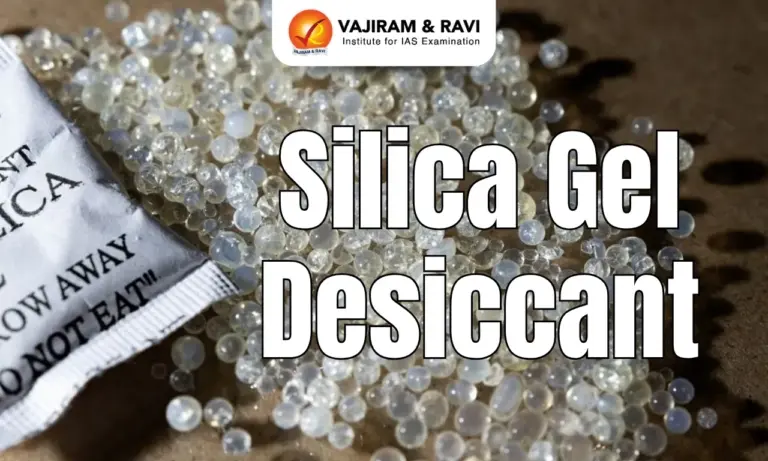
Silica Gel Desiccant Latest News
According to health professionals most silica beads found in silica gel desiccant sachets are non-toxic and don’t present the same risk as silica dust.
About Silica Gel Desiccant
- Silica gel desiccants are common moisture adsorbing agents used throughout many industries worldwide.
- The silica gel desiccant removes excess moisture from the air.





Composition of Silica Gel Desiccant
- It is made of silicon dioxide (like most sands or quartz) which is a hydrophilic or water-loving material.
- Some variants of silica gel contain a moisture-sensitive dye. One particular variant is based on cobalt chloride.
Working of Silica Gel Desiccant
- The beads are porous on the nano-scale with pore sizes only 15 times larger than the radius of their atoms.
- These pores have a capillary effect, meaning they condense and draw moisture into the bead similar to how trees transport water through the channelled structures in wood.
- In addition, sponge-like porosity makes their surface area very large. A single gram of silica gel can have an area of up to 700 square metres.
Application of Silica Gel Desiccant
- It can be used in safeguarding sensitive and effective raw materials like electronics, pharmaceuticals, food, or precision instruments.
- It is used as a drying agent in industrial gases, and dehydration processes
- It is very useful in the control of moisture levels in the manufacturing, packaging, or storage of automotive parts and vehicles.
- It prevents the formation of rust and corrosion.
- It is used in air conditioning systems i.e one can use silica gel in automotive air conditioning systems to soak up excess moisture and keep your humidity levels at optimal levels.
Source: DTE

 Last updated on April, 2026
→ UPSC Final Result 2025 is now out.
→ UPSC has released UPSC Toppers List 2025 with the Civil Services final result on its official website.
→ Anuj Agnihotri secured AIR 1 in the UPSC Civil Services Examination 2025.
→ UPSC Marksheet 2025 is now out.
→ UPSC Notification 2026 & UPSC IFoS Notification 2026 is now out on the official website at upsconline.nic.in.
→ UPSC Calendar 2026 has been released.
→ Check out the latest UPSC Syllabus 2026 here.
→ UPSC Prelims 2026 will be conducted on 24th May, 2026 & UPSC Mains 2026 will be conducted on 21st August 2026.
→ The UPSC Selection Process is of 3 stages-Prelims, Mains and Interview.
→ Prepare effectively with Vajiram & Ravi’s UPSC Prelims Test Series 2026 featuring full-length mock tests, detailed solutions, and performance analysis.
→ Enroll in Vajiram & Ravi’s UPSC Mains Test Series 2026 for structured answer writing practice, expert evaluation, and exam-oriented feedback.
→ Join Vajiram & Ravi’s Best UPSC Mentorship Program for personalized guidance, strategy planning, and one-to-one support from experienced mentors.
→ Shakti Dubey secures AIR 1 in UPSC CSE Exam 2024.
→ Also check Best UPSC Coaching in India
Silica Gel Desiccant FAQs
Q1. What happens if you put silica gel in water?+
Q2. What is the chemical name for silica gel?+
Q3. Why are silica gels used?+
Tags: prelims pointers silica gel desiccant upsc current affairs upsc prelims current affairs