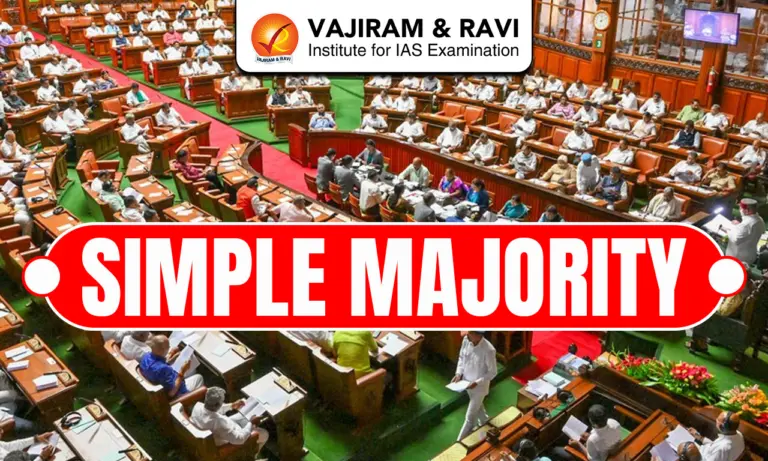
Majority in a parliamentary system refers to the numerical strength required for members of a legislative body to approve decisions through voting. In India, majorities guide how laws are enacted, governments function, and constitutional actions are taken in the Lok Sabha and Rajya Sabha. Different types such as Simple Majority, Absolute Majority, Effective Majority and Special Majority operate depending on the importance of the decision. These voting requirements ensure democratic decision making while balancing routine legislative work with major constitutional actions in Parliament.
Simple Majority
A Simple Majority refers to a voting situation in which the number of members supporting a Motion or bill is greater than those opposing it among members present and voting. It is also called a working or functional majority and forms the basic decision making rule for most parliamentary activities. Since it requires only more votes in favour than against, it is widely used to pass ordinary legislation, financial proposals, and several parliamentary motions.
Simple Majority Calculation
Simple Majority is calculated based only on members present and voting during a parliamentary decision.
- Voting Principle: Simple Majority counts only members who actually cast votes during a division. Members absent from the House or those abstaining from voting are excluded from the calculation, making it a flexible and commonly used legislative voting requirement.
- Basic Numerical Formula: The rule requires more than 50% of members present and voting. Mathematically it is calculated as 50% of votes cast plus one additional vote to ensure majority support.
- Lok Sabha Example Calculation: Suppose the Lok Sabha has its current strength of 543 elected members. If 40 members are absent and 60 members abstain from voting, then only 443 members are present and voting in the House. In this situation, the simple majority required will be 222 votes, which is calculated as 50% of 443 plus one vote. If the votes in favour of a bill or motion reach 222 or more, the proposal is considered passed by simple majority.
- Voting Outcome Principle: Any motion or bill is considered approved once favourable votes exceed opposing votes among participating members, even if many members remain absent or abstain.





Simple Majority Constitutional Applications
Simple Majority is applied in several legislative and constitutional matters where the Constitution does not prescribe a higher voting requirement.
- Ordinary Bills Passage: Most legislation introduced in Parliament, known as ordinary bills, is approved through Simple Majority voting in both the Lok Sabha and the Rajya Sabha before becoming law.
- Financial Legislation Approval: Money Bills and Financial Bills dealing with taxation, expenditure, and government finances are passed with a Simple Majority in the House where they are voted upon.
- Parliamentary Motions: Important parliamentary devices such as No Confidence Motions, Confidence Motions, Censure Motions, Adjournment Motions, and the Motion of Thanks are adopted through Simple Majority voting.
- Emergency Declarations: Parliamentary approval for proclamations like President’s Rule in a state or declaration of financial emergency requires passage through Simple Majority voting in Parliament.
- Election of Presiding Officers: The Speaker and Deputy Speaker of the Lok Sabha, as well as the Deputy Chairman of the Rajya Sabha, are elected by members through a Simple Majority vote.
- Ratification by State Legislatures: Certain constitutional amendment bills under Article 368 require ratification by state legislatures, and these legislatures approve such ratification through Simple Majority voting.
- Constitutional Amendments Outside Article 368: Several provisions of the Constitution such as creation or alteration of states, citizenship matters, parliamentary procedures, and legislative council creation or abolition can be modified through Simple Majority legislation.

 Last updated on March, 2026
→ UPSC Final Result 2025 is now out.
→ UPSC has released UPSC Toppers List 2025 with the Civil Services final result on its official website.
→ Anuj Agnihotri secured AIR 1 in the UPSC Civil Services Examination 2025.
→ UPSC Marksheet 2025 is now out.
→ UPSC Notification 2026 & UPSC IFoS Notification 2026 is now out on the official website at upsconline.nic.in.
→ UPSC Calendar 2026 has been released.
→ Check out the latest UPSC Syllabus 2026 here.
→ UPSC Prelims 2026 will be conducted on 24th May, 2026 & UPSC Mains 2026 will be conducted on 21st August 2026.
→ The UPSC Selection Process is of 3 stages-Prelims, Mains and Interview.
→ Prepare effectively with Vajiram & Ravi’s UPSC Prelims Test Series 2026 featuring full-length mock tests, detailed solutions, and performance analysis.
→ Enroll in Vajiram & Ravi’s UPSC Mains Test Series 2026 for structured answer writing practice, expert evaluation, and exam-oriented feedback.
→ Join Vajiram & Ravi’s Best UPSC Mentorship Program for personalized guidance, strategy planning, and one-to-one support from experienced mentors.
→ Shakti Dubey secures AIR 1 in UPSC CSE Exam 2024.
→ Also check Best UPSC Coaching in India
Simple Majority FAQs
Q1. What is the Simple Majority in Parliament? +
Q2. Why is the Simple Majority called a functional majority? +
Q3. How is the Simple Majority calculated in the Lok Sabha? +
Q4. Which types of bills require a Simple Majority? +
Q5. Which parliamentary motions require a Simple Majority? +
Tags: indian polity simple majority