About Singhbhum Craton
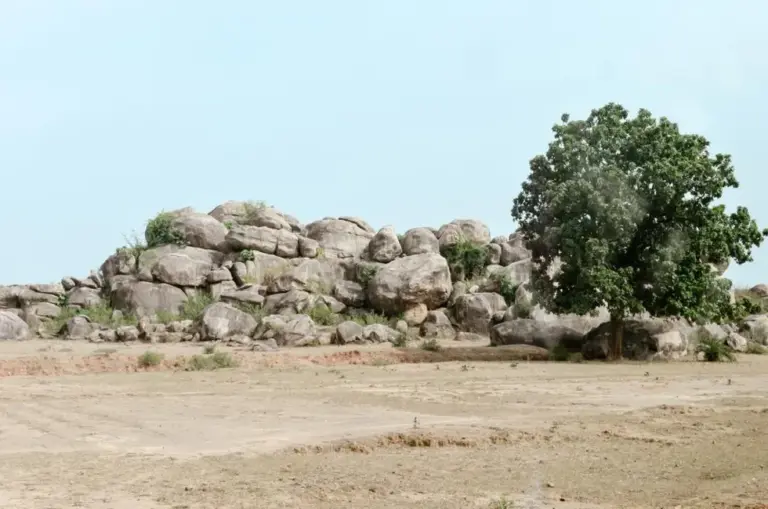
- It is a vast swathe of rocky land that stretches mainly across parts of Jharkhand and Odisha, between the Chhota Nagpur plateau and the Eastern Ghats.
- This ancient part of the Earth’s crust has been found in previous research to date back to 3.5 billion years ago.
- The craton’s oldest rock assemblages are largely volcanic and sedimentary rocks also known as greenstone successions.
- Greenstones are rock assemblages made up mostly of sub-marine volcanic rocks with minor sedimentary rocks.
- The geology of this area shares stark similarity with the greenstone belts documented in South Africa’s Barberton and Nondweni areas and the Pilbara Craton in western Australia.
- All these areas experienced widespread submarine mafic — meaning high in magnesium oxide — volcanic eruptions between 3.5 and 3.3 billion years ago, preserved as pillowed lava and komatiites.
- Significance
- They offer a clearer picture of Earth’s early tectonic activities during the Archaean times, contributing to our understanding of the planet’s formative years.
- The Singhbhum Craton’s unique geological features, including its greenstone belts, provide invaluable information about Earth’s surface and atmospheric processes.
- This is crucial for hypothesising early habitable conditions and the emergence of life on Earth.
What are Cratons?
- Cratons are the oldest and most stable parts of the Earth’s crust, acting as the bedrock of continents.
- These are pieces of ancient continents that formed billions of years ago.
- Studying them offers a window into how processes within and on the surface of Earth operated in the past.
- They host a variety of different groups of rocks, including greenstones and granites.
Q1) What is Geology?
Geology is the study of the Earth, the materials of which it is made, the structure of those materials, and the processes acting upon them. It includes the study of organisms that have inhabited our planet. An important part of geology is the study of how Earth’s materials, structures, processes and organisms have changed over time.
Source: Earth’s early evolution: Fresh insights from rocks formed 3.5 billion years ago






 Last updated on March, 2026
→ UPSC Final Result 2025 is now out.
→ UPSC has released UPSC Toppers List 2025 with the Civil Services final result on its official website.
→ Anuj Agnihotri secured AIR 1 in the UPSC Civil Services Examination 2025.
→ UPSC Marksheet 2025 is now out.
→ UPSC Notification 2026 & UPSC IFoS Notification 2026 is now out on the official website at upsconline.nic.in.
→ UPSC Calendar 2026 has been released.
→ Check out the latest UPSC Syllabus 2026 here.
→ UPSC Prelims 2026 will be conducted on 24th May, 2026 & UPSC Mains 2026 will be conducted on 21st August 2026.
→ The UPSC Selection Process is of 3 stages-Prelims, Mains and Interview.
→ Prepare effectively with Vajiram & Ravi’s UPSC Prelims Test Series 2026 featuring full-length mock tests, detailed solutions, and performance analysis.
→ Enroll in Vajiram & Ravi’s UPSC Mains Test Series 2026 for structured answer writing practice, expert evaluation, and exam-oriented feedback.
→ Join Vajiram & Ravi’s Best UPSC Mentorship Program for personalized guidance, strategy planning, and one-to-one support from experienced mentors.
→ Shakti Dubey secures AIR 1 in UPSC CSE Exam 2024.
→ Also check Best UPSC Coaching in India