The Sir Creek dispute between India and Pakistan is one of the long-standing territorial disagreements between the two neighbours, with its origins tracing back to pre-independence India. While it often takes a backseat in the broader India-Pakistan relationship, the dispute is important due to its strategic, economic, and ecological implications. Understanding the issue is important for UPSC aspirants, particularly in the International Relations segment.
Sir Creek Dispute in News
Defence Minister Rajnath Singh recently issued a stern warning to Pakistan over its military build-up near the Sir Creek region, stating that any misadventure would invite a response so strong that it could “change both history and geography.” Speaking at a public event on the occasion of Shastra Pujan, he accused Pakistan of deliberately stirring up the long-standing Sir Creek dispute despite India’s repeated efforts to resolve it through dialogue. Singh discussed that the recent expansion of Pakistani military infrastructure in areas adjoining Sir Creek, a strategically sensitive zone along the Gujarat coastline, indicates Pakistan’s unclear intentions and provocative posture.
Sir Creek
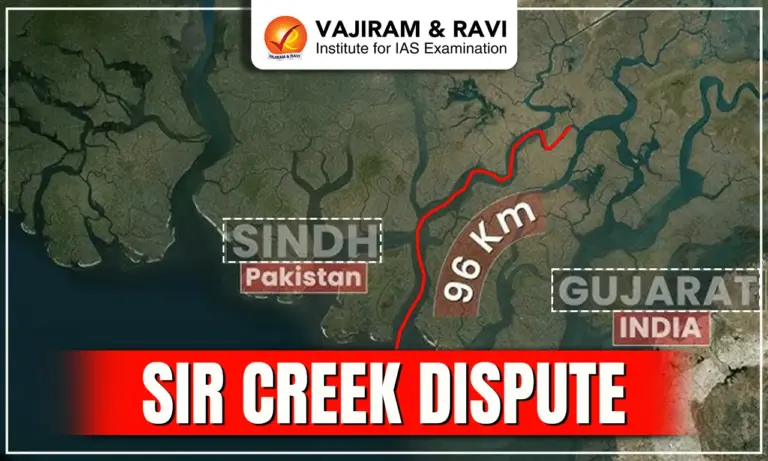
Sir Creek is a 96-kilometre strip of water located in the marshlands of the Rann of Kutch in Gujarat. Geographically, it forms a boundary between India’s Kutch region and Pakistan’s Sindh province before opening into the Arabian Sea. Historically, it was known as Ban Ganga and acquired the name “Sir Creek” during the colonial era, named after a British official.





Sir Creek Map
Here is geographical representation of Sir Creek:
Sir Creek Nature of the Dispute
- The core of the Sir Creek Dispute lies in the differing interpretations of the maritime boundary between India and Pakistan. Before India’s independence, the region was part of the Bombay Presidency. Post-partition in 1947, Kutch remained with India while Sindh became part of Pakistan.
- Pakistan claims the entirety of Sir Creek based on the Bombay Government Resolution of 1914, signed between the Rao of Kutch and the Sindh provincial government. According to Pakistan, the eastern flank of the creek forms the boundary. India, however, considers this green line indicative rather than definitive. Instead, India relies on a 1925 map, along with the mid-channel pillars constructed in 1924, to argue that the boundary lies along the mid-channel of the creek (red line on the map).
- India invokes the Thalweg Principle of international law, which stipulates that the boundary between two political entities along a waterway should follow the center of the principal navigable channel. Pakistan rejects this argument, claiming that Sir Creek is non-navigable, whereas India maintains that the creek is navigable during high tides, and fishing trawlers regularly use it to reach the Arabian Sea.
Sir Creek Dispute Origin
The Sir Creek Dispute dates back to 1908, when disagreements arose between the ruler of Kutch and the Sindh government over firewood collection in the creek area. To settle the issue, the Bombay Government Resolution of 1914 was issued. The resolution contained conflicting provisions:
- Paragraph 9 said that the boundary should be to the east of the creek, implying the entire creek would belong to Pakistan.
- Paragraph 10, however, applied the Thalweg Principle, noting that Sir Creek is navigable most of the year, making the mid-channel the effective boundary.
This inherent contradiction has been the basis of prolonged disagreement between the two countries.
Sir Creek Importance
Sir Creek holds strategic, economic, and ecological significance:
- Strategic Importance: The creek lies near the Rann of Kutch, an area where India and Pakistan clashed during the 1965 war. Control over this region influences maritime security and surveillance.
- Economic Significance: It is one of the largest fishing grounds in Asia, supporting the livelihoods of thousands of fishermen. Furthermore, potential oil and gas reserves under the seabed could provide significant economic benefits, though exploration remains stalled due to the dispute.
- Ecological Value: Sir Creek is an ecologically sensitive area, home to flamingoes and other migratory birds during winter, making it important for biodiversity conservation.
Sir Creek Attempts at Resolution
Several attempts have been made to resolve the Sir Creek issue:
- After the 1965 war, British Prime Minister Harold Wilson intervened, leading to the establishment of a tribunal. The 1968 verdict granted Pakistan only 10% of its claim.
- During the 1997 composite dialogue, Sir Creek was discussed as a part of broader efforts to improve bilateral relations.
- Tensions increased in 1999 when an Indian fighter plane shot down a Pakistani surveillance aircraft over the creek. India alleged an airspace violation, while Pakistan denied it.
- Between 2005 and 2007, joint surveys were conducted to assess the area for potential resolution.
Despite these efforts, a final agreement has remained elusive, largely due to differing interpretations of historical maps and legal principles.
Way Forward
Resolving the Sir Creek dispute is important for many reasons:
- Humanitarian Aspect: Fishermen from both countries are frequently detained for accidentally crossing perceived borders, creating tensions and disrupting livelihoods.
- Strategic and Economic Gains: A resolution would allow exploration of oil and gas reserves and better control of maritime boundaries.
- Low-Hanging Fruit: Among the numerous Indo-Pakistan disputes, Sir Creek is often considered a simpler, less politically charged issue, making it a potential candidate for early resolution.

 Last updated on March, 2026
→ UPSC Final Result 2025 is now out.
→ UPSC has released UPSC Toppers List 2025 with the Civil Services final result on its official website.
→ Anuj Agnihotri secured AIR 1 in the UPSC Civil Services Examination 2025.
→ UPSC Marksheet 2025 is now out.
→ UPSC Notification 2026 & UPSC IFoS Notification 2026 is now out on the official website at upsconline.nic.in.
→ UPSC Calendar 2026 has been released.
→ Check out the latest UPSC Syllabus 2026 here.
→ UPSC Prelims 2026 will be conducted on 24th May, 2026 & UPSC Mains 2026 will be conducted on 21st August 2026.
→ The UPSC Selection Process is of 3 stages-Prelims, Mains and Interview.
→ Prepare effectively with Vajiram & Ravi’s UPSC Prelims Test Series 2026 featuring full-length mock tests, detailed solutions, and performance analysis.
→ Enroll in Vajiram & Ravi’s UPSC Mains Test Series 2026 for structured answer writing practice, expert evaluation, and exam-oriented feedback.
→ Join Vajiram & Ravi’s Best UPSC Mentorship Program for personalized guidance, strategy planning, and one-to-one support from experienced mentors.
→ Shakti Dubey secures AIR 1 in UPSC CSE Exam 2024.
→ Also check Best UPSC Coaching in India
Sir Creek Dispute FAQs
Q1. What is the Sir Creek issue between Pakistan and India?+
Q2. Where is Sir Creek in India?+
Q3. Is Sir Creek the westernmost point of India?+
Q4. What is the Sir Creek Dispute?+
Q5. When did the Sir Creek Dispute begin?+
Tags: sir creek dispute