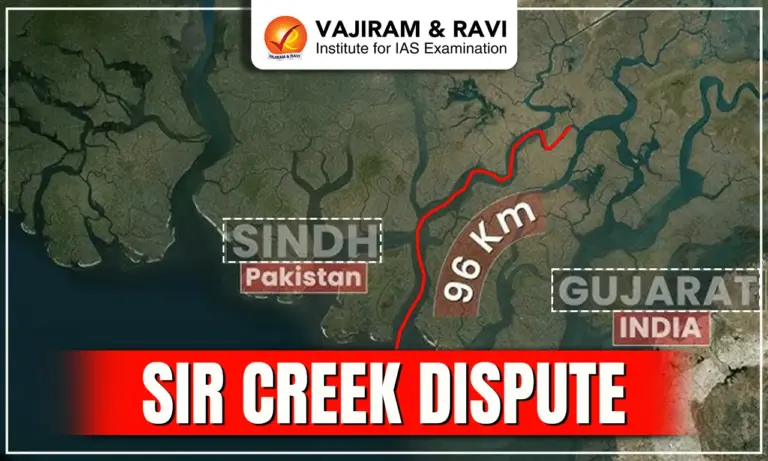
Sir Creek Dispute Latest News
- During Vijaya Dashami celebrations at the Bhuj Military Station in Gujarat, Defence Minister Rajnath Singh issued a strong warning to Pakistan, stating that “any misadventure in the Sir Creek sector will invite a decisive response.”
- Referring to the strategic location, he remarked that “the road to Karachi passes through the Creek,” signalling India’s readiness to counter any provocation.
The Sir Creek Dispute: A Legacy of Colonial-Era Boundaries
- Sir Creek is a narrow, less than 100 km-long tidal estuary located between Gujarat’s Rann of Kutch (India) and Sindh (Pakistan).
- It forms the westernmost border between the two countries, but control over it remains unresolved due to conflicting interpretations of maritime boundaries.
Colonial Roots of the Dispute
- The origins of the dispute trace back to pre-Independence India, when the Maharaja of Kutch ruled the region.
- Differing interpretations of colonial-era maps and agreements led to overlapping territorial claims after Partition, sowing the seeds of the present conflict.
- India claims that the boundary should lie along the mid-channel of Sir Creek, effectively dividing the creek and adjacent marshlands equally.
- This claim is supported by a 1925 map and the Thalweg principle, which defines the border along the deepest navigable channel of a waterway.
- Pakistan, however, cites a 1914 resolution between the Rao of Kutch and the Sindh government, asserting that the eastern bank of the creek marks the boundary—giving it greater access toward Gujarat’s coastal region.
- Pakistan also disputes India’s reliance on the Thalweg principle, arguing that Sir Creek is non-navigable and hence exempt from that rule.
An Unresolved Boundary
- Despite multiple rounds of talks, the Sir Creek dispute remains unsettled, largely because resolving it would directly influence the maritime boundary and exclusive economic zone (EEZ) claims in the Arabian Sea.





Why Sir Creek Matters: Strategic and Economic Stakes for India and Pakistan
- Though small in size, Sir Creek lies at the heart of an unresolved border dispute between India and Pakistan.
- Its strategic location and economic potential make it vital for both nations, preventing a lasting settlement despite decades of dialogue.
Strategic Importance: A Gateway to Karachi and Beyond
- Defence Minister Rajnath Singh underscored Sir Creek’s strategic value, calling it critical to Pakistan’s defence of Karachi, the country’s economic and naval hub.
- Following Operation Sindoor, Pakistan has strengthened its military presence in the region by constructing bunkers, radars, and forward bases capable of launching drones and infantry operations.
- India has responded by maintaining a strong defensive deployment to deter any misadventure.
- Beyond military concerns, Sir Creek poses a terrorism risk — the 2008 Mumbai attacks exposed vulnerabilities in coastal surveillance, as the attackers infiltrated India via sea routes from Pakistan.
Economic Importance: Energy, Fishing, and Maritime Rights
- Sir Creek’s economic value further complicates the dispute.
- The region is believed to contain untapped oil and gas reserves, which could be crucial for both economies.
- For India, currently diversifying away from Russian oil, such reserves represent a strategic energy alternative.
- The creek also supports rich fishing grounds, sustaining communities in Gujarat and Sindh.
- However, the absence of a defined boundary leads to frequent arrests of fishermen who unintentionally cross into each other’s waters, creating humanitarian and diplomatic tensions.
Impact on Maritime Claims
- The definition of the Sir Creek boundary directly affects the delimitation of the Exclusive Economic Zones (EEZs) of both nations in the Arabian Sea.
- EEZs, extending 200 nautical miles (370 km) from a country’s coast, determine control over marine resources and seabed minerals.
- Hence, settling the Sir Creek dispute is not merely a territorial issue—it is key to defining sovereign maritime rights and accessing significant energy and resource wealth in the northern Arabian Sea.

 Last updated on March, 2026
→ UPSC Final Result 2025 is now out.
→ UPSC has released UPSC Toppers List 2025 with the Civil Services final result on its official website.
→ Anuj Agnihotri secured AIR 1 in the UPSC Civil Services Examination 2025.
→ UPSC Marksheet 2025 is now out.
→ UPSC Notification 2026 & UPSC IFoS Notification 2026 is now out on the official website at upsconline.nic.in.
→ UPSC Calendar 2026 has been released.
→ Check out the latest UPSC Syllabus 2026 here.
→ UPSC Prelims 2026 will be conducted on 24th May, 2026 & UPSC Mains 2026 will be conducted on 21st August 2026.
→ The UPSC Selection Process is of 3 stages-Prelims, Mains and Interview.
→ Prepare effectively with Vajiram & Ravi’s UPSC Prelims Test Series 2026 featuring full-length mock tests, detailed solutions, and performance analysis.
→ Enroll in Vajiram & Ravi’s UPSC Mains Test Series 2026 for structured answer writing practice, expert evaluation, and exam-oriented feedback.
→ Join Vajiram & Ravi’s Best UPSC Mentorship Program for personalized guidance, strategy planning, and one-to-one support from experienced mentors.
→ Shakti Dubey secures AIR 1 in UPSC CSE Exam 2024.
→ Also check Best UPSC Coaching in India
Sir Creek Dispute FAQs
Q1. Where is Sir Creek located?+
Q2. What is the origin of the Sir Creek dispute?+
Q3. Why is Sir Creek strategically important?+
Q4. What is the economic significance of Sir Creek?+
Q5. How does the dispute affect maritime boundaries? +
Tags: mains articles sir creek dispute upsc current affairs upsc mains current affairs