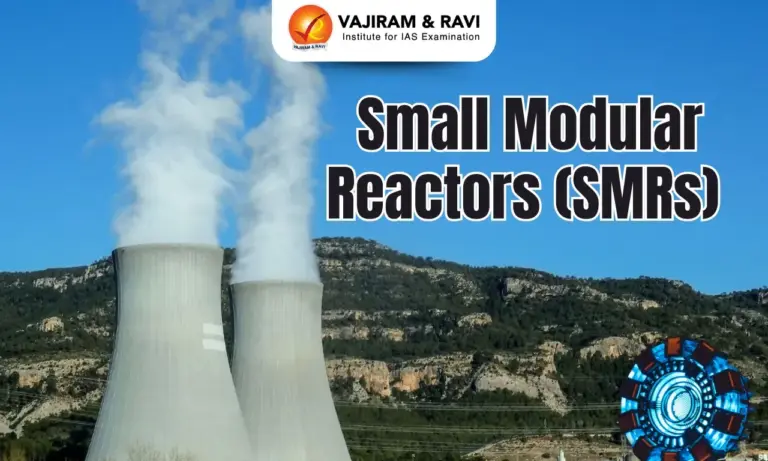
Small Modular Reactors Latest News
The Finance Minister recently announced a ₹20,000 crore ‘Nuclear Energy Mission’ to develop indigenous Small Modular Reactors (SMR).
About Small Modular Reactors
- SMRs are defined as small nuclear reactors with a maximum output of 300 Megawatt electric (MWe) and can produce 7.2 million kWh per day.
- By comparison, large-size nuclear power plants have an output of over 1,000 MWe and can produce 24 million kWh per day.
- SMRs, which can produce a large amount of low-carbon electricity, are:
- Small – physically a fraction of the size of a conventional nuclear power reactor.
- Modular – making it possible for systems and components to be factory-assembled and transported as a unit to a location for installation.
- Reactors – harnessing nuclear fission to generate heat to produce energy.





Small Modular Reactors Advantages
- Relatively small physical footprints;
- Reduced capital investment;
- Can be factory-built, unlike the conventional nuclear reactors that are built on-site;
- Ability to be sited in locations not possible for larger nuclear plants;
- Provisions for incremental power additions;
- It also offers distinct safeguards, security, and non-proliferation advantages.
- They are well suited to be integrated into energy hubs in combination with other sources of energy.
- They are adapted to supply electricity and additionally capable of supplying heat for industrial applications, district heating, as well as for the production of hydrogen.
Small Modular Reactors FAQs
Q1. Where are small modular reactors used?
Ans. SMRs can be used for power generation, process heat, desalination, or other industrial uses.
Q2. What are the benefits of small modular reactors?
Ans. SMRs offer enhanced safety, lower costs, faster deployment, scalability, reduced environmental impact, and flexibility for diverse applications.
Q3. What is the working principle of SMR?
Ans. SMRs nuclear fission reactions to generate heat that can be used directly or for generating electricity.
Source: TH

 Last updated on April, 2026
→ UPSC Final Result 2025 is now out.
→ UPSC has released UPSC Toppers List 2025 with the Civil Services final result on its official website.
→ Anuj Agnihotri secured AIR 1 in the UPSC Civil Services Examination 2025.
→ UPSC Marksheet 2025 is now out.
→ UPSC Notification 2026 & UPSC IFoS Notification 2026 is now out on the official website at upsconline.nic.in.
→ UPSC Calendar 2026 has been released.
→ Check out the latest UPSC Syllabus 2026 here.
→ UPSC Prelims 2026 will be conducted on 24th May, 2026 & UPSC Mains 2026 will be conducted on 21st August 2026.
→ The UPSC Selection Process is of 3 stages-Prelims, Mains and Interview.
→ Prepare effectively with Vajiram & Ravi’s UPSC Prelims Test Series 2026 featuring full-length mock tests, detailed solutions, and performance analysis.
→ Enroll in Vajiram & Ravi’s UPSC Mains Test Series 2026 for structured answer writing practice, expert evaluation, and exam-oriented feedback.
→ Join Vajiram & Ravi’s Best UPSC Mentorship Program for personalized guidance, strategy planning, and one-to-one support from experienced mentors.
→ Shakti Dubey secures AIR 1 in UPSC CSE Exam 2024.
→ Also check Best UPSC Coaching in India