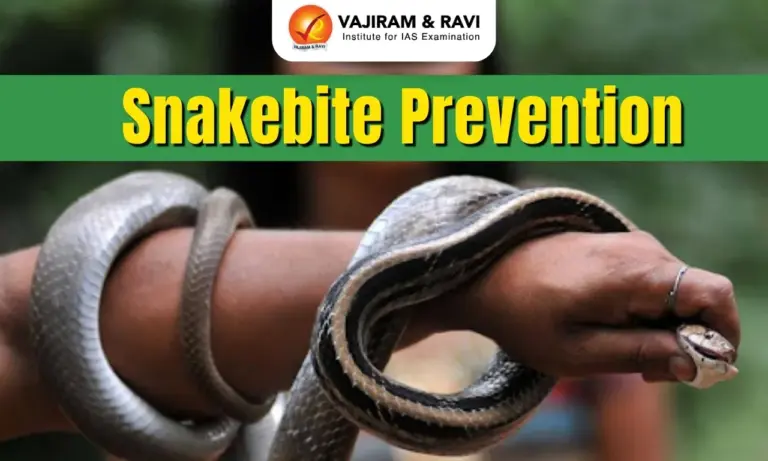
Snakebite Prevention Latest News
- The Indian Council of Medical Research (ICMR) has approved a Rs. 13.5 crore, four-year multi-state implementation research project to develop a comprehensive national model to reduce snakebite deaths.
- The initiative recognises the Assam-based Demow Model as a successful community-led framework and aims to scientifically validate and scale it nationwide.
India’s High Burden of Snakebite Deaths
- Snakebite envenoming (SBE) remains a major yet under-addressed public health issue in India.
- The country accounts for nearly 58,000 deaths annually, the highest in the world.
- Snakebites primarily affect rural communities, agricultural workers, and tribal populations, especially in states such as Assam, West Bengal, Odisha, Maharashtra, and Jharkhand.
- Despite being a preventable cause of death, India faces persistent challenges:
- Delayed access to treatment
- Lack of community awareness
- Inadequate referral systems
- Limited use of digital monitoring tools
- Insufficient pre-hospital care
- ICMR’s latest national initiative seeks to bridge these systemic gaps.





Overview of the ICMR National Snakebite Research Project
- The new ICMR-backed project, titled “Zero Snakebite Death Initiative: Community Empowerment & Engagement for Mitigation of Snakebite Envenoming,” aims to formulate a replicable community-based model for reducing mortality.
- It will be implemented across seven states: Assam, West Bengal, Odisha, Kerala, Himachal Pradesh, Maharashtra, and Jharkhand.
- The research will be coordinated under SARPA (Snakebite Awareness, Response, Prevention & Action).
- Key aspects:
- Multi-state implementation research
- Community empowerment and education
- Improvement of pre-hospital and hospital care
- Creation of a real-time digital dashboard for surveillance
- Standardised data collection by appointed researchers and technical staff in each state
- Research is scheduled to begin in January 2026.
About Demow Model
- The selection of Assam’s Demow Model marks a significant recognition of grassroots innovation.
- The model has shown notable success in Assam’s Sivasagar district through strong community mobilisation and rapid referral systems.
- Core Features of the Demow Model
- High community participation with local volunteers acting as first responders
- A robust referral network to ensure that patients reach health centres within the “golden hour”
- Awareness campaigns on preventing snakebites and first-aid dos and don’ts
- Training of ASHA workers, schoolteachers, and village leaders
- Collaboration with local hospitals such as Demow Hospital
- Because of its strong outcomes, the model will now undergo scientific evaluation and may be scaled across multiple states.
Integration of Other State Models
- ICMR aims to create a composite national-level model by integrating successful practices from different regions. The research will evaluate and merge the strengths of:
- Maharashtra Model – Use of Protective Equipment
- Distribution of gumboots and protective gear to high-risk agricultural communities.
- Himachal Pradesh Model – Pre-hospital Anti-Snake Venom (ASV)
- Administration of ASV in ambulances during transport is a breakthrough in early treatment.
- Kerala Model – Digital Coordination Platforms
- Use of real-time digital tools to track cases, guide referrals, and coordinate health services.
- Together with the Demow Model, these elements form the backbone of a potential national strategy.
Project Objectives
- Primary Objective
- Develop, pilot, and implement a nationally replicable community engagement model to prevent and manage snakebite envenoming.
- Secondary Objectives
- Increase awareness and capacity among community members, health workers, and doctors.
- Improve early referral and treatment-seeking behaviour.
- Establish a digital snakebite dashboard for high-quality surveillance.
- Generate evidence to support national policies on snakebite management.
Public Health Significance
- Snakebite was officially recognised by the WHO as a high-priority neglected tropical disease, and India carries the largest global burden.
- A national framework can help the country:
- Reduce preventable deaths
- Improve rural health systems
- Strengthen emergency preparedness
- Enhance community resilience
- Given India’s varied ecosystems and agricultural practices, a multi-state, adaptable model is essential for long-term mitigation.

 Last updated on March, 2026
→ UPSC Final Result 2025 is now out.
→ UPSC has released UPSC Toppers List 2025 with the Civil Services final result on its official website.
→ Anuj Agnihotri secured AIR 1 in the UPSC Civil Services Examination 2025.
→ UPSC Marksheet 2025 is now out.
→ UPSC Notification 2026 & UPSC IFoS Notification 2026 is now out on the official website at upsconline.nic.in.
→ UPSC Calendar 2026 has been released.
→ Check out the latest UPSC Syllabus 2026 here.
→ UPSC Prelims 2026 will be conducted on 24th May, 2026 & UPSC Mains 2026 will be conducted on 21st August 2026.
→ The UPSC Selection Process is of 3 stages-Prelims, Mains and Interview.
→ Prepare effectively with Vajiram & Ravi’s UPSC Prelims Test Series 2026 featuring full-length mock tests, detailed solutions, and performance analysis.
→ Enroll in Vajiram & Ravi’s UPSC Mains Test Series 2026 for structured answer writing practice, expert evaluation, and exam-oriented feedback.
→ Join Vajiram & Ravi’s Best UPSC Mentorship Program for personalized guidance, strategy planning, and one-to-one support from experienced mentors.
→ Shakti Dubey secures AIR 1 in UPSC CSE Exam 2024.
→ Also check Best UPSC Coaching in India
Snakebite Prevention FAQs
Q1. What is the ICMR’s new snakebite initiative?+
Q2. Why was the Demow Model selected for the project?+
Q3. Which states are included in the research?+
Q4. What is SARPA?+
Q5. When will the research begin?+
Tags: mains articles snakebite prevention upsc current affairs upsc mains current affairs