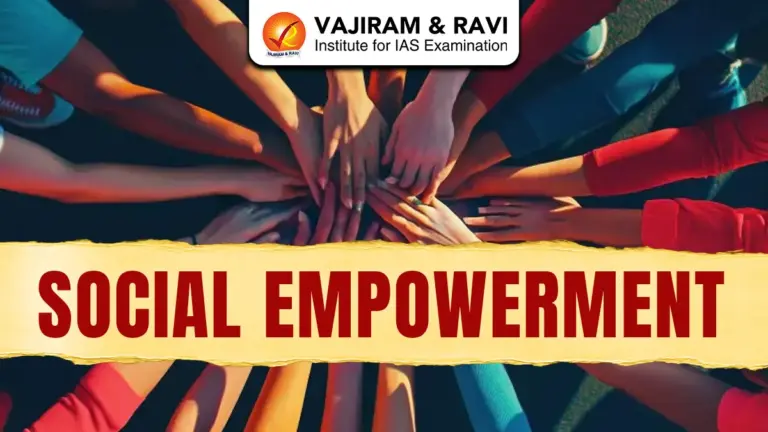
Social Empowerment means removing all existing inequalities and disparities created by society. It also involves providing easy access to basic services. Social Empowerment helps individuals and disadvantaged groups participate fully in social, economic, and political life. This is done by eliminating structural inequalities and ensuring dignity, equality, and social justice.
Constitutional Basis of Social Empowerment in India
The Indian Constitution provides a robust framework for Social Empowerment through:
- The Preamble, which guarantees justice, equality, and fraternity.
- Fundamental Rights (Articles 14–18), ensuring equality before law and abolition of social discrimination.
- The Directive Principles of State Policy mandate the State to promote the welfare of weaker sections under Article 46 of the Indian Constitution.
- Special provisions for Scheduled Castes, Scheduled Tribes, women, minorities, and socially and educationally backward classes are provided under Articles 15(3), 15(4), 15(5), 16(4), 29, 30, 46, and 340 of the Indian Constitution.
Social Empowerment Dimensions
Social Empowerment is a multi-dimensional process. Key dimensions include:
- Economic Empowerment: Access to resources, income, employment, and the ability to make financial decisions. Access to jobs, credit, and entrepreneurship opportunities.
- Political Empowerment: Ability to participate in political processes and decision-making.
- Example: Voting rights, Representation in local bodies, legislatures, and governance structures.
- Social Empowerment: Ability to participate in social life without discrimination.
- Cultural Empowerment: Ability to practice one’s culture, language, and traditions, Protection from cultural assimilation or suppression etc
- Educational Empowerment: Access to knowledge, education, and awareness of rights.
- Health and Nutritional Empowerment: Enhances access to healthcare, nutrition, and sanitation, thereby improving quality of life





Social Empowerment Need
Social Empowerment is vital for creating an inclusive, just, and democratic society, especially in India, which has significant social diversity and historical inequalities. Social Empowerment is necessary:
- To address historical injustices and social exclusion
- Example: Reservation policies for SCs and STs help overcome centuries of caste-based exclusion
- To ensure equality of opportunity and dignity for all citizens.
- Example: Abolition of untouchability (Article 17) and the SC/ST (Prevention of Atrocities) Act protect dignity of marginalized communities.
- To strengthen democratic participation
- Example: Reservation of seats for women in Panchayati Raj Institutions has increased women’s political participation at the grassroots level.
- To promote inclusive development
- Example: Tribal welfare schemes and the Forest Rights Act, 2006 integrate tribal communities into development while protecting their rights.
- To improve access to education and opportunities
- Example: Scholarship schemes for minorities and backward classes reduce educational inequality.
- To empower women socially and economically
- Example: Beti Bachao Beti Padhao and Self-Help Groups (SHGs) enhance women’s education, awareness, and income.
- To integrate persons with disabilities into society
- Example: The Rights of Persons with Disabilities Act, 2016 ensures accessibility, education, and employment.
- To promote social harmony and national integration: Policies promoting social justice and affirmative action reduce social conflict and foster unity in diversity.
Social Empowerment Challenges
- Deep-rooted social prejudices and stereotypes: Persistence of caste discrimination and manual scavenging despite constitutional abolition.
- Poverty and economic deprivation: Poor households are often unable to access quality education and healthcare.
- Low access to quality education
- Example: High dropout rates among SC/ST and tribal children.
- Gender norms and patriarchy
- Example: Low female labour force participation due to social restrictions and unpaid care work.
- Inadequate implementation of welfare schemes
- Example: Leakages and exclusion errors in scholarship and social security schemes.
- Lack of awareness about rights and entitlements
- Example: Beneficiaries not claiming benefits under the Forest Rights Act due to poor awareness.
- Digital divide and technological exclusion
- Example: Marginalized groups facing difficulty in accessing online services and e-governance platforms.
- Weak institutional capacity and governance gaps
- Example: Shortage of staff and slow justice delivery in cases under the SC/ST (PoA) Act
Way Forward
- Effective Implementation of Policies and Schemes: Focuses on data-driven monitoring, convergence of schemes, and competitive federalism etc
- Strengthen Legal and Institutional Frameworks
- Example: Effective implementation of SC/ST (Prevention of Atrocities) Act, 1989 and Rights of Persons with Disabilities Act, 2016.
- Leverage Technology for Empowerment
- Example: e-SHRAM portal for unorganized sector workers ensures coverage of social security benefits.
- Encourage Community Participation and Civil Society Involvement
- Example: Community-led sanitation drives by Sulabh International have empowered women and improved social dignity.
- Promote Awareness and Social Attitudinal Change: Awareness campaigns on gender equality and anti-discrimination laws promote a culture of inclusion.

 Last updated on April, 2026
→ UPSC Final Result 2025 is now out.
→ UPSC has released UPSC Toppers List 2025 with the Civil Services final result on its official website.
→ Anuj Agnihotri secured AIR 1 in the UPSC Civil Services Examination 2025.
→ UPSC Marksheet 2025 is now out.
→ UPSC Notification 2026 & UPSC IFoS Notification 2026 is now out on the official website at upsconline.nic.in.
→ UPSC Calendar 2026 has been released.
→ Check out the latest UPSC Syllabus 2026 here.
→ UPSC Prelims 2026 will be conducted on 24th May, 2026 & UPSC Mains 2026 will be conducted on 21st August 2026.
→ The UPSC Selection Process is of 3 stages-Prelims, Mains and Interview.
→ Prepare effectively with Vajiram & Ravi’s UPSC Prelims Test Series 2026 featuring full-length mock tests, detailed solutions, and performance analysis.
→ Enroll in Vajiram & Ravi’s UPSC Mains Test Series 2026 for structured answer writing practice, expert evaluation, and exam-oriented feedback.
→ Join Vajiram & Ravi’s Best UPSC Mentorship Program for personalized guidance, strategy planning, and one-to-one support from experienced mentors.
→ Shakti Dubey secures AIR 1 in UPSC CSE Exam 2024.
→ Also check Best UPSC Coaching in India
Social Empowerment FAQs
Q1. What is social Empowerment?+
Q2. Why is social empowerment important?+
Q3. What are the main dimensions of social Empowerment?+
Q4. What are the major challenges to social empowerment in India?+
Q5. What are the key government schemes for social empowerment in India?+
Tags: indian society indian society notes social empowerment