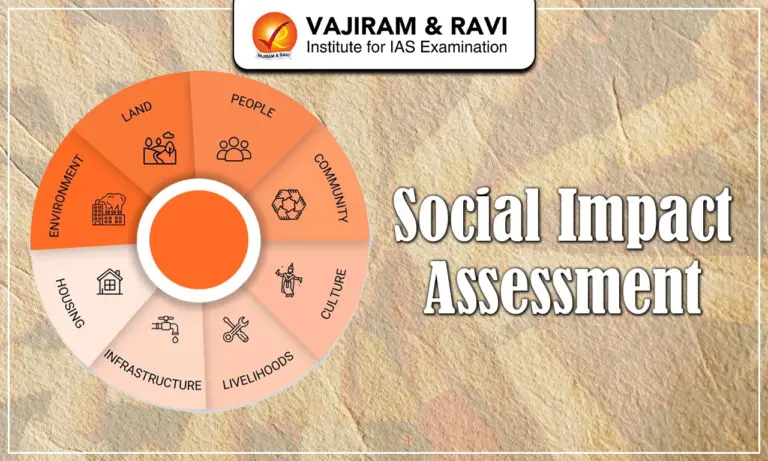
The Social Impact Assessment (SIA) has become an essential tool in evaluating how development projects, public policies, and major infrastructure plans influence people, communities, and social systems. It examines changes in living conditions, cultural practices, health, livelihoods, demographic patterns, and community relationships. It emerged in the 1970s alongside environmental assessment frameworks, today it helps governments and organizations ensure that economic development does not harm social well-being. It also provides mechanisms to identify long-term effects, guide mitigation, and protect vulnerable groups.
Social Impact Assessment
Social Impact Assessment systematic methodology used to identify, analyze, and manage the social effects of planned and unplanned interventions. While traditionally applied to large infrastructure and industrial projects, SIA is also used to study the impacts of disasters, epidemics, demographic transitions, and policy reforms. SIA also links closely with applied anthropology, drawing on cultural and social analysis pioneered by scholars like Franz Boas and Ruth Benedict.
Social Impact Assessment Historical Background
The historical evolution of the Social Impact Assessment is discussed below:
- The roots of Social Impact Assessment lie in Environmental Impact Assessment (EIA), first mandated under the U.S. National Environmental Policy Act (1970).
- By the mid-1990s, several countries, especially in Europe and North America, integrated SIA into their planning processes.
- Today, new integrated models such as Environmental Social Impact Assessment (ESIA) give equal weight to environmental and social dimensions.





Social Impact Assessment Process
A Social Impact Assessment uses structured steps to identify effects, collect data, assess risks, and propose solutions. SIA methodology relies on systematic procedures that identify stakeholder groups, evaluate present conditions, predict future impacts, and recommend mitigation measures for sustainable outcomes, as detailed below:
- Formulating a public plan or policy that involves all affected parties, ensuring early participation.
- Describing the proposal clearly, including its objectives, scale, and expected outcomes.
- Profiling the project area, covering demographic data, cultural setting, land use, economic conditions, and existing social institutions.
- Communicating expected changes to affected people through transparent consultations.
- Identifying potential social impacts, such as displacement, livelihood changes, cultural disruption, or access to services.
- Determining consequences by assessing who benefits, who loses, and the scale and duration of impacts.
- Forecasting future and cumulative impacts, especially on vulnerable groups, workers, and indigenous communities.
- Exploring alternative plans or policies to reduce negative impacts while achieving development goals.
- Developing mitigation strategies, including compensation, livelihood restoration, or community-strengthening measures.
- Setting up monitoring systems to track implementation and adjust plans in response to changing needs.
- Use of additional tools such as the IMMPACT Model, OECD guidelines, and Seedkit for structured evaluation and data-driven analysis.
Social Impact Assessment Significance
Social Impact Assessment provides critical insights for designing responsible development that balances growth with societal well-being. The significance of SIA lies in its ability to protect communities, enhance social benefits, minimize risks, and support long-term sustainable and equitable development.
- Prevention of negative impacts: Helps identify displacement risks, livelihood disruption, social conflicts, and public health issues before they occur.
- Enhancing project acceptability: Projects with strong SIA processes gain higher community trust and smoother implementation.
- Protection of vulnerable groups: Ensures marginalized groups, indigenous communities, and workers receive safeguards and compensation.
- Improved decision-making: Provides evidence-based insights for policymakers, planners, and industries.
- Promoting cultural preservation: Helps protect heritage, traditions, and community relationships that may be disturbed by large projects.
- Strengthening governance: Encourages participatory planning, transparency, and accountability in public decision-making.
- Facilitating sustainable development: Ensures long-term benefits outweigh short-term economic gains by balancing social, environmental, and economic factors.
- Better monitoring and evaluation: Establishes clear indicators for tracking outcomes over the project lifecycle.
- Supporting conflict resolution: Early identification of social tensions prevents disputes and enhances cooperation.
- Legal compliance: Helps governments and institutions meet national and international regulatory requirements.
Social Impact Assessment Recent Developments
Recent global research shows growing interest in expanding the scope, tools, and ethical foundations of Social Impact Assessment. New trends in SIA focus on resilience building, technology-enabled measurement, climate vulnerability assessment, and social dimensions of circular economy transitions.
- Community-based and regional planning approaches: SIA is now used in regional development and urban planning to reduce risks, strengthen governance, and build resilience. Research by Imperiale and Vanclay (2024) emphasizes shifting SIA from a project-management tool to a resilience-enhancement framework.
- Technological innovations: AI-driven tools improve measurement quality, reduce biases, and enhance scalability in assessing social outcomes. They also strengthen Social Return on Investment (SROI) calculations.
- Climate vulnerability integration: Studies emphasize incorporating exposure, sensitivity, and adaptive capacity into SIA. A 2023 coastal community study highlights how vulnerability indices can reflect political, historical, and socioeconomic factors for equitable planning.
- Circular economy transitions: A review of 60 studies shows that while worker safety and wages are addressed, aspects such as community acceptance, transition support, and impacts on marginalized groups remain underrepresented. There is also a need for harmonized indicators for Social Life Cycle Assessment (S-LCA).
- Growing use in disaster impact studies: SIA is increasingly applied to examine the social effects of epidemics, pandemics, earthquakes, and large-scale displacement.
- Shift toward integrated ESIA frameworks: Equal emphasis on environment and society ensures balanced development decision-making.
- Higher global policy acceptance: More nations now legally mandate SIA for large-scale industrial, mining, and energy-sector projects.

 Last updated on April, 2026
→ UPSC Final Result 2025 is now out.
→ UPSC has released UPSC Toppers List 2025 with the Civil Services final result on its official website.
→ Anuj Agnihotri secured AIR 1 in the UPSC Civil Services Examination 2025.
→ UPSC Marksheet 2025 is now out.
→ UPSC Notification 2026 & UPSC IFoS Notification 2026 is now out on the official website at upsconline.nic.in.
→ UPSC Calendar 2026 has been released.
→ Check out the latest UPSC Syllabus 2026 here.
→ UPSC Prelims 2026 will be conducted on 24th May, 2026 & UPSC Mains 2026 will be conducted on 21st August 2026.
→ The UPSC Selection Process is of 3 stages-Prelims, Mains and Interview.
→ Prepare effectively with Vajiram & Ravi’s UPSC Prelims Test Series 2026 featuring full-length mock tests, detailed solutions, and performance analysis.
→ Enroll in Vajiram & Ravi’s UPSC Mains Test Series 2026 for structured answer writing practice, expert evaluation, and exam-oriented feedback.
→ Join Vajiram & Ravi’s Best UPSC Mentorship Program for personalized guidance, strategy planning, and one-to-one support from experienced mentors.
→ Shakti Dubey secures AIR 1 in UPSC CSE Exam 2024.
→ Also check Best UPSC Coaching in India
Social Impact Assessment FAQs
Q1. What is Social Impact Assessment?+
Q2. Why is Social Impact Assessment important in project planning?+
Q3. How is Social Impact Assessment different from EIA?+
Q4. What are examples of impacts assessed in Social Impact Assessment?+
Q5. Who uses Social Impact Assessment?+
Tags: social impact assessment