Social Media Addiction Trial Latest News
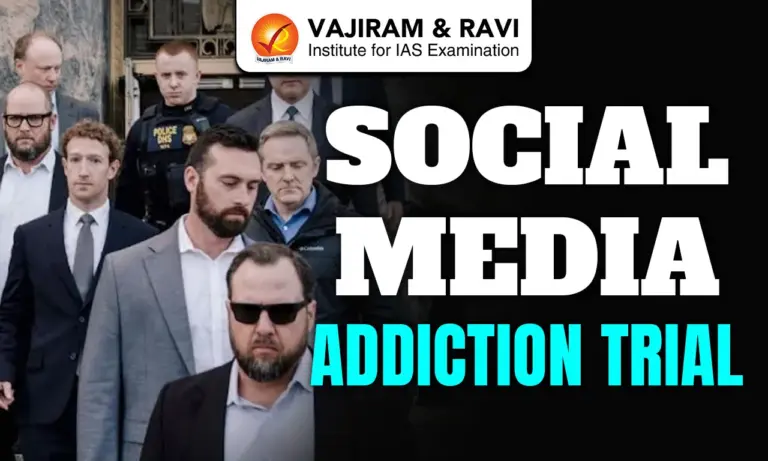
- A U.S. jury in Los Angeles found Meta and YouTube guilty of designing addictive platforms that harmed a young user.
- The companies were deemed negligent and accused of malice and fraud, with $6 million in damages awarded—Meta liable for 70% and YouTube 30%.
Background: Landmark Case Links Social Media Design to Youth Harm
- The case highlights allegations that Meta (Facebook, Instagram) and YouTube intentionally designed addictive platforms that harmed young users.
- A 20-year-old plaintiff argued that early exposure led to anxiety, depression, and body dysmorphia.
- The lawsuit treats social media as a product, comparing its design to “digital casinos” that exploit dopamine-driven engagement.





Overcoming Section 230: The Legal Shift in Social Media Liability
- Past lawsuits against social media companies often failed due to Section 230 of the Communications Decency Act, which protects platforms from liability for user-generated content.
- Plaintiffs bypassed Section 230 by focusing on product design, arguing that harm arose from platform architecture—such as feeds and engagement mechanisms—rather than specific content.
- The jury examined whether harm stemmed from platform design (not third-party content) and whether companies met negligence criteria: duty of care, breach, causation, and harm.
- Despite arguments about external factors, the jury applied the “substantial factor” test and concluded that platform design significantly contributed to the harm.
- The jury found evidence of conscious disregard for user safety, supported by internal research showing companies were aware of risks but continued harmful design practices.
Parallel Verdict Highlights Platform Safety Concerns
- A New Mexico jury found Meta liable under consumer protection law for misleading users about platform safety, awarding $375 million in damages.
- The case focused on decisions like expanding end-to-end encryption despite internal warnings about child exploitation risks.
- Together with the Los Angeles verdict, it signals a broader shift toward holding platforms accountable for design choices and safety practices, not just user content.
India’s regulatory framework for children on the internet
- Information Technology Act, 2000
- Prohibits harmful and explicit content involving children.
- Mandates quick removal (within 2–3 hours) of unlawful content.
- Requires reporting offences under relevant laws like POCSO.
- Digital Personal Data Protection Act, 2023
- Requires verifiable parental consent for processing children’s data.
- Prohibits tracking, behavioural monitoring, and targeted advertising directed at children.
- Information Technology (Reasonable Security Practices and Procedures and Sensitive Personal Data or Information) Rules, 2011, (SPDI Rules)
- Ensure data is collected for specific purposes with consent.
- Restrict disclosure of sensitive personal data.
- Awareness and Capacity Building
- CERT-In Initiatives – Provides safety advisories, awareness campaigns, and cybersecurity guidance.
- Information Security Education and Awareness (ISEA) – Conducted thousands of workshops covering lakhs of participants. Trained teachers, police personnel, and volunteers as cybersecurity trainers.
- Technical and Enforcement Measures
- Blocking of child sexual abuse material (CSAM) through global databases.
- Collaboration with international agencies like NCMEC (USA).
- Promotion of parental control filters and cyber safety awareness.
- Overall Significance
- India has adopted a multi-layered approach combining legal provisions, regulatory frameworks, awareness programmes, and institutional mechanisms to mitigate risks from AI and protect children in the digital ecosystem.

 Last updated on March, 2026
→ UPSC Final Result 2025 is now out.
→ UPSC has released UPSC Toppers List 2025 with the Civil Services final result on its official website.
→ Anuj Agnihotri secured AIR 1 in the UPSC Civil Services Examination 2025.
→ UPSC Marksheet 2025 is now out.
→ UPSC Notification 2026 & UPSC IFoS Notification 2026 is now out on the official website at upsconline.nic.in.
→ UPSC Calendar 2026 has been released.
→ Check out the latest UPSC Syllabus 2026 here.
→ UPSC Prelims 2026 will be conducted on 24th May, 2026 & UPSC Mains 2026 will be conducted on 21st August 2026.
→ The UPSC Selection Process is of 3 stages-Prelims, Mains and Interview.
→ Prepare effectively with Vajiram & Ravi’s UPSC Prelims Test Series 2026 featuring full-length mock tests, detailed solutions, and performance analysis.
→ Enroll in Vajiram & Ravi’s UPSC Mains Test Series 2026 for structured answer writing practice, expert evaluation, and exam-oriented feedback.
→ Join Vajiram & Ravi’s Best UPSC Mentorship Program for personalized guidance, strategy planning, and one-to-one support from experienced mentors.
→ Shakti Dubey secures AIR 1 in UPSC CSE Exam 2024.
→ Also check Best UPSC Coaching in India
Social Media Addiction Trial FAQs
Q1. Why were Meta and YouTube found liable in the social media addiction trial?+
Q2. How did plaintiffs overcome Section 230 protections?+
Q3. What role did platform design play in the verdict?+
Q4. What is the significance of the parallel Meta verdict in New Mexico?+
Q5. What does this trial mean for future tech regulation?+
Tags: mains articles Social Media Addiction Trial upsc current affairs upsc mains current affairs