Solar Cycles Latest News
Recently, the IIT-Kanpur team developed a new way to predict solar cycles.
About Solar Cycles
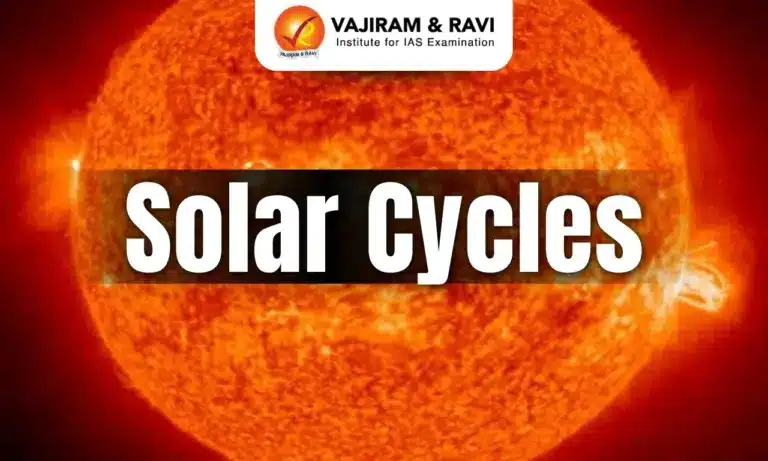
- The solar cycle describes an approximately 11-year cycle of solar activity driven by the sun’s magnetic field.
- It is indicated by the frequency and intensity of sunspots visible on the surface.
- Every 11 years or so, the Sun’s magnetic field completely flips.
- This means that the Sun’s north and south poles switch places. Then it takes about another 11 years for the Sun’s north and south poles to flip back again.
- The solar cycle affects activity on the surface of the Sun, such as sunspots, which are caused by the Sun’s magnetic fields.
- As the magnetic fields change, so does the amount of activity on the Sun’s surface.
- It can be tracked by counting the number of sunspots.
- Cycle Stages
-
- Solar minimum: It is the beginning of a solar cycle or when the Sun has the least sunspots.
- Over time, solar activity—and the number of sunspots—increases.
- Solar maximum: It is the middle of the solar cycle or when the Sun has the most sunspots.
- As the cycle ends, it fades back to the solar minimum, and then a new cycle begins.
- Solar minimum: It is the beginning of a solar cycle or when the Sun has the least sunspots.
- Impact: The solar cycle has the potential to impact Earth’s climatic conditions through changes in solar radiation, cosmic rays, and ozone distribution.
Source: TH






 Last updated on March, 2026
→ UPSC Final Result 2025 is now out.
→ UPSC has released UPSC Toppers List 2025 with the Civil Services final result on its official website.
→ Anuj Agnihotri secured AIR 1 in the UPSC Civil Services Examination 2025.
→ UPSC Marksheet 2025 is now out.
→ UPSC Notification 2026 & UPSC IFoS Notification 2026 is now out on the official website at upsconline.nic.in.
→ UPSC Calendar 2026 has been released.
→ Check out the latest UPSC Syllabus 2026 here.
→ UPSC Prelims 2026 will be conducted on 24th May, 2026 & UPSC Mains 2026 will be conducted on 21st August 2026.
→ The UPSC Selection Process is of 3 stages-Prelims, Mains and Interview.
→ Prepare effectively with Vajiram & Ravi’s UPSC Prelims Test Series 2026 featuring full-length mock tests, detailed solutions, and performance analysis.
→ Enroll in Vajiram & Ravi’s UPSC Mains Test Series 2026 for structured answer writing practice, expert evaluation, and exam-oriented feedback.
→ Join Vajiram & Ravi’s Best UPSC Mentorship Program for personalized guidance, strategy planning, and one-to-one support from experienced mentors.
→ Shakti Dubey secures AIR 1 in UPSC CSE Exam 2024.
→ Also check Best UPSC Coaching in India
Solar Cycles FAQs
Q1. What is the primary driver of the solar cycle?+
Q2. What is the term for the period of maximum sunspot activity?+
Tags: prelims pointers solar cycles upsc current affairs upsc prelims current affairs