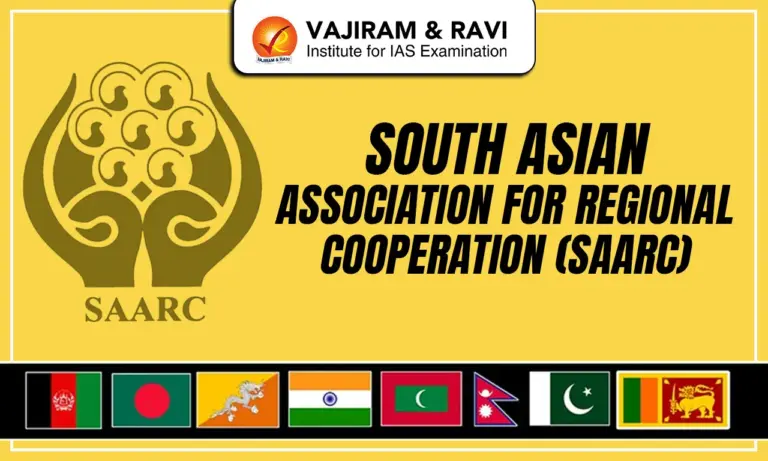
The South Asian Association for Regional Cooperation (SAARC) is a regional organisation established on 8th December 1985 in Dhaka, Bangladesh, to promote economic, social, cultural, and technical cooperation among South Asian countries. It comprises 8 member states: India, Pakistan, Bangladesh, Sri Lanka, Nepal, Bhutan, the Maldives, and Afghanistan, with its headquarters in Kathmandu, Nepal. SAARC has launched initiatives like the SAARC Development Fund, South Asian University, and SAARC Satellite to strengthen regional collaboration. Despite achievements in trade, education, and disaster management, the organisation faces challenges due to political tensions and low intra-regional trade.
South Asian Association for Regional Cooperation (SAARC) Overview
The South Asian Association for Regional Cooperation (SAARC), established on 8th December 1985 in Dhaka, is a regional organisation. The table gives an overview of the SAARC organisation.
| South Asian Association for Regional Cooperation (SAARC) Overview | |
| Information | Details |
|
SAARC Established |
1985 (December 8), Dhaka, Bangladesh |
|
Number of Member Countries |
8 – India, Bangladesh, Nepal, Sri Lanka, Maldives, Bhutan, Afghanistan, Pakistan |
|
Number of Observers |
9 – Australia, European Union (E.U), Iran, Japan, Mauritius, South Korea, USA, China, Myanmar |
|
SAARC Headquarters |
Kathmandu, Nepal |
|
Launch of SAARC Satellite for South Asia |
2017 |
|
SAARC Specialised Bodies |
|
|
1st Secretary General of SAARC |
Abul Ahsan (Bangladesh) |
|
Current Secretary-General of SAARC |
Golam Sarwar (Bangladesh) – Took office on 4th March 2023 |
|
Last Member to Join SAARC |
Afghanistan (April 2007) |
|
Last SAARC Summit |
19th SAARC Summit in Pakistan (Cancelled) |
Also Read: United Nations Environment Programme
SAARC Historical background
- Formation Idea (1980s): The idea of a South Asian regional organisation was first proposed by Ziaur Rahman (Bangladesh), Indira Gandhi (India), and other leaders to promote regional cooperation.
- Treaty Signed (1985): The SAARC Charter was signed on 8 December 1985 in Dhaka, Bangladesh, officially establishing the organisation.
- Founding Members: The original members were Bangladesh, Bhutan, India, the Maldives, Nepal, Pakistan, and Sri Lanka. Afghanistan joined later in 2007.
- Objectives: The main aim was to promote economic, social, cultural, and technical cooperation among South Asian countries and to strengthen regional integration.
- Headquarters and Secretariat: The SAARC Secretariat was established in Kathmandu, Nepal, in 1987 to coordinate activities and implement programs.
- Early Initiatives: Initially, SAARC focused on health, population, agriculture, rural development, and education, laying the groundwork for later economic and trade cooperation.





SAARC Principles
- All member countries are equal in status, regardless of their size or power.
- Cooperation is aimed at economic, social, and cultural development for all members.
- Decisions are taken jointly by all members to ensure a collective agreement.
- The main focus is on strengthening regional resources and reducing dependence on external powers.
- Encouragement of collaboration in trade, technology, education, and culture.
- Respect for each country’s internal affairs, and there is no interference in domestic matters.
Also Read: International Labour Organisation
SAARC Objectives
- To promote cooperation in economic, social, cultural, technical, and scientific fields among member countries.
- To enhance economic growth and trade within the region.
- To strengthen social development in areas like health, education, and poverty alleviation.
- To ensure regional peace and stability through dialogue and cooperation.
- To encourage cultural exchange and knowledge-sharing among member states.
- To promote regional self-reliance by efficiently utilising shared resources.
South Asian Association for Regional Cooperation (SAARC) Countries List
There are 8 member nations in the South Asian Association for Regional Cooperation (SAARC) organisation. Here is the list of all the SAARC member countries along with their capital, population and area.
| South Asian Association for Regional Cooperation (SAARC) Countries List | ||||
| S.No | Country | Capital | Population | Area (sq km) |
|
1 |
Afghanistan |
Kabul |
42 million |
652,230 |
|
2 |
Bangladesh |
Dhaka |
170 million |
147,570 |
|
3 |
Bhutan |
Thimphu |
0.8 million |
38,394 |
|
4 |
India |
New Delhi |
1.42 billion |
3,287,263 |
|
5 |
Maldives |
Malé |
0.5 million |
298 |
|
6 |
Nepal |
Kathmandu |
31 million |
147,516 |
|
7 |
Pakistan |
Islamabad |
240 million |
881,913 |
|
8 |
Sri Lanka |
Colombo / Sri Jayawardenepura Kotte |
22 million |
65,610 |
Structure & Composition of SAARC
SAARC’s structure consists of the Secretariat in Kathmandu, the Council of Ministers, and various Technical Committees, and its composition includes eight member states: Afghanistan, Bangladesh, Bhutan, India, Maldives, Nepal, Pakistan, and Sri Lanka.
- SAARC Summit – The highest decision-making body, comprising the Heads of State or Government of member countries, which meets biennially to set policies and priorities.
- Council of Ministers (COM) – Composed of Foreign Ministers of member states, responsible for implementing Summit decisions and reviewing progress of SAARC programs.
- Standing Committee – Consists of Foreign Secretaries of member countries; monitors and coordinates activities of various SAARC bodies.
- SAARC Secretariat – Headquartered in Kathmandu, Nepal, led by the Secretary-General, it coordinates and implements programs and maintains records of decisions.
- Observers: SAARC has nine observers: Australia, China, the European Union, Iran, Japan, Mauritius, Myanmar, South Korea, and the United States.
SAARC’s Specialised Bodies
The specialised bodies of SAARC are given below:
- SAARC Arbitration Council (SARCO) – Pakistan: The SAARC Arbitration Council (SARCO), based in Pakistan, was established to resolve commercial and investment disputes among member countries. It aims to promote regional trade and economic cooperation by providing a fair and efficient arbitration mechanism.
- SAARC Development Fund (SDF) – Bhutan: The SAARC Development Fund (SDF), headquartered in Bhutan, finances social, economic, and infrastructure projects across member states. Its goal is to reduce regional disparities and promote sustainable development in South Asia.
- South Asian University (SAU) – India: The South Asian University (SAU), located in India, was set up to provide postgraduate education and research for students from SAARC countries. It fosters regional integration and knowledge exchange in higher education and research.
- South Asian Regional Standards Organisation (SARSO) – Dhaka: The South Asian Regional Standards Organisation (SARSO) in Dhaka develops regional standards and quality assurance for products and services. It helps facilitate trade and technical cooperation among SAARC member countries.
Also Read: United Nations Development Programme
SAARC Significance
- South Asian Association for Regional Cooperation (SAARC) comprises of 21% of world’s population, 3% of the world’s area and 3.8% (US$2.9 trillion) of the world economy.
- Neighbourhood First Policy: India gives primacy to its immediate South Asian neighbours through initiatives in trade, connectivity, and development projects, strengthening regional ties.
- Act East Policy Integration: Linking South Asian economies with Southeast Asia through SAARC-driven projects promotes economic integration, especially in the services sector, IT, tourism, and trade.
- Global Leadership Role: Active participation in SAARC allows India to assert regional leadership, take on development and humanitarian responsibilities, and influence policy-making in South Asia.
- Regional Stability: SAARC provides a platform for political dialogue and conflict resolution, helping to build mutual trust, peace, and cooperation among South Asian nations historically affected by disputes.
SAARC Achievements
- SAFTA (South Asian Free Trade Area) came into effect in 2006, which aims to reduce tariffs and promote intra-regional trade.
- Intra-SAARC trade, low compared to global trade, increased from $1 billion in 1995 to around $23 billion in 2020.
- SAARC also launched the SAARC Development Fund (SDF) in 2010, with a total capital of $300 million, to finance social, economic, and infrastructure projects.
- Initiatives like the SAARC Motor Vehicles Agreement (2010) and SAARC Railway Cooperation aim to improve transport links.
- SAARC established several specialised bodies, e.g., SAARC Tuberculosis and HIV/AIDS Centre (Bangladesh) and SAARC Agriculture Centre (Bhutan).
- Launched programs like the SAARC Food Bank (2013) to help member countries in times of food shortages.
- The SAARC Disaster Management Centre (SDMC), based in India, coordinates disaster preparedness and emergency response.
- Established the SAARC Cultural Centre (Sri Lanka) and SAARC Documentation Centre (India) to promote regional culture and knowledge sharing.
SAARC Challenges
- The relation between India and Pakistan has escalated tensions and conflicts which hamper the prospects of SAARC.
- Geopolitical factors and the influence of external powers like China create additional complications for regional dynamics.
- SAARC operates on the consensus of all members which means that a single member’s opposition can block reforms and policies.
- SAARC has often struggled to effectively implement agreements and regional projects due to limited authority and coordination.
- Trade among SAARC countries remains limited due to similar export products, high tariffs, and investment barriers, restricting regional economic integration.
- Addressing environmental issues is a common challenge for member nations.
SAARC Way Forward
- Boost Intra-Regional Trade: Intra-SAARC trade is only 5% of the total trade of member countries; reducing tariffs, removing non-tariff barriers, and diversifying exports can significantly increase regional economic integration.
- Enhance Connectivity: Only 50% of South Asian countries are well-connected via transport and digital networks; improving roads, railways, energy grids, and internet infrastructure will facilitate trade and mobility.
- Strengthen Institutions: SAARC Secretariat and specialised bodies like SDF ($300 million fund) need greater authority and efficiency to implement regional projects effectively.
- Support Less-Developed Members: Countries like Afghanistan, Bhutan, and the Maldives lag in development; targeted programs can reduce regional disparities and ensure inclusive growth.
- Promote Peace and Political Dialogue: Regular SAARC summits and councils can help build trust among India, Pakistan, and other members, ensuring regional stability.
- Collaborate on Emerging Challenges: Focus on climate change, health, technology, disaster management, and sustainable development, areas where joint action can yield significant regional benefits.

 Last updated on April, 2026
→ UPSC Final Result 2025 is now out.
→ UPSC has released UPSC Toppers List 2025 with the Civil Services final result on its official website.
→ Anuj Agnihotri secured AIR 1 in the UPSC Civil Services Examination 2025.
→ UPSC Marksheet 2025 is now out.
→ UPSC Notification 2026 & UPSC IFoS Notification 2026 is now out on the official website at upsconline.nic.in.
→ UPSC Calendar 2026 has been released.
→ Check out the latest UPSC Syllabus 2026 here.
→ UPSC Prelims 2026 will be conducted on 24th May, 2026 & UPSC Mains 2026 will be conducted on 21st August 2026.
→ The UPSC Selection Process is of 3 stages-Prelims, Mains and Interview.
→ Prepare effectively with Vajiram & Ravi’s UPSC Prelims Test Series 2026 featuring full-length mock tests, detailed solutions, and performance analysis.
→ Enroll in Vajiram & Ravi’s UPSC Mains Test Series 2026 for structured answer writing practice, expert evaluation, and exam-oriented feedback.
→ Join Vajiram & Ravi’s Best UPSC Mentorship Program for personalized guidance, strategy planning, and one-to-one support from experienced mentors.
→ Shakti Dubey secures AIR 1 in UPSC CSE Exam 2024.
→ Also check Best UPSC Coaching in India
South Asian Association for Regional Cooperation (SAARC) FAQs
Q1. What is SAARC?+
Q2. When and where was SAARC established?+
Q3. How many member countries are in SAARC?+
Q4. How many observer countries does SAARC have?+
Q5. Where is the SAARC Secretariat located?+
Tags: south asian association for regional cooperation