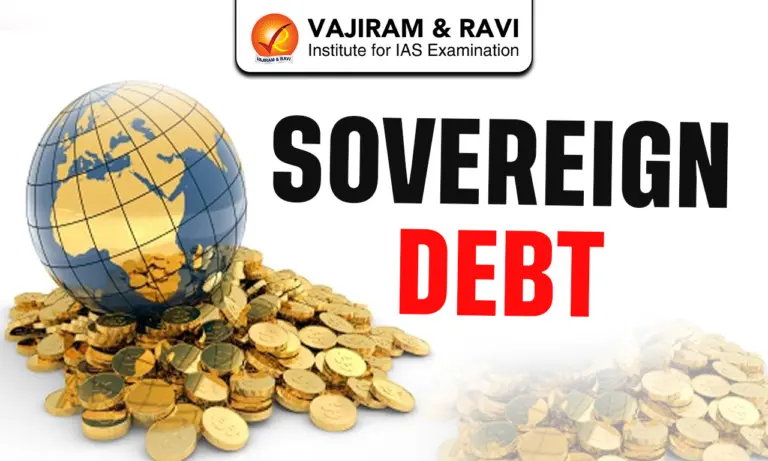
Sovereign debt, also called public debt, is the total borrowing undertaken by a government to finance fiscal deficits, developmental projects, and other expenditures. In India, sovereign debt plays a pivotal role in funding infrastructure, social welfare, and growth initiatives. While it enables economic development, unsustainable borrowing can threaten fiscal stability, increase debt-servicing burdens, and slow long-term development.
Meaning and Nature of Sovereign Debt
Sovereign debt refers to funds borrowed by a national government from domestic or foreign sources. It can be in the form of bonds, loans, or securities. Governments can issue debt in local currency (domestic debt) or foreign currency (external debt). External debt in India is always recorded in the name of the Government of India, even if it is on behalf of a state government.
Sovereign Debt Constitutional and Legal Framework
The borrowing powers of governments in India are constitutionally governed.
- Article 292 empowers the Union Government to borrow upon the security of the Consolidated Fund of India, subject to limits set by Parliament.
- Article 293 governs state borrowing, permitting states to borrow within India, subject to conditions imposed by the Centre, particularly if a state has outstanding loans from the Centre.
- The Fiscal Responsibility and Budget Management (FRBM) Act, 2003 was enacted to institutionalise fiscal discipline. It mandates reduction of fiscal deficit and debt to sustainable levels. The N.K. Singh Committee (2017) recommended a formal debt rule, targeting a general government debt-to-GDP ratio of 60% (40% for Centre, 20% for states) by 2022-23, alongside a fiscal deficit target of 2.5% of GDP for the Centre.





Types of Sovereign Debt
- Domestic Debt: Borrowed within the country, denominated in the Indian Rupee. Sources include treasury bills, government securities (G-secs), and small savings instruments. Domestic debt is less exposed to currency risk and often considered safer than external debt.
- External Debt (GoI Debt): External sovereign debt includes borrowing from foreign governments, multilateral institutions, or international capital markets. In India, all external debt is recorded in the name of the Government of India, even if raised for state governments. The main components include:
- Foreign Portfolio Investments (FPI/FII) in Government Securities: Non-resident investors such as foreign institutional investors (FIIs) invest in G-securities, providing capital inflows while exposing the country to global market volatility.
- Loans under Bilateral Assistance: Borrowing directly from foreign governments under bilateral agreements. These loans may have concessional terms, low interest rates, or long maturities.
- Loans under Multilateral Assistance: Borrowing from international financial institutions like the World Bank, Asian Development Bank (ADB), or IMF. Such loans are often tied to specific development projects or structural reforms and come with guidance on fiscal management.
- Short-term vs Long-term Debt: Short-term debt matures within a year and finances immediate fiscal needs. Long-term debt is used for infrastructure, strategic projects, or structural reforms.
Risks Associated with Sovereign Debt
- Debt Sustainability: High debt relative to GDP strains public finances, increasing interest payments and reducing funds available for development. Persistent debt accumulation can heighten vulnerability to economic shocks.
- Currency Risk: External debt in foreign currency becomes costlier if the rupee depreciates, raising repayment burdens and pressuring foreign exchange reserves.
- Crowding Out of Private Investment: Heavy government borrowing can push up interest rates, making credit expensive for the private sector and slowing economic growth.
- Fiscal and Credit Risks: Rising debt may lead to lower sovereign credit ratings, higher borrowing costs, and reduced investor confidence, limiting fiscal flexibility.
- Economic Vulnerability: Excessive debt reduces the government’s ability to respond to crises, slowing growth, constraining fiscal space, and potentially leading to debt distress.
Is Rising Sovereign Debt Always Bad?
Rising sovereign debt is not always bad, but its implications depend on how the debt is used, its sustainability, and the economy’s capacity to service it.
- If debt finances productive investments such as infrastructure, education, health, and technology, it can stimulate economic growth, increase future revenues, and improve development outcomes. For example, borrowing to build highways or power plants can enhance productivity, attract private investment, and expand the tax base.
- However, if debt rises without productive use, financing unproductive subsidies, inefficient projects, or recurring fiscal deficits, it can strain public finances, raise interest payments, and increase vulnerability to economic shocks.

 Last updated on March, 2026
→ UPSC Final Result 2025 is now out.
→ UPSC has released UPSC Toppers List 2025 with the Civil Services final result on its official website.
→ Anuj Agnihotri secured AIR 1 in the UPSC Civil Services Examination 2025.
→ UPSC Marksheet 2025 is now out.
→ UPSC Notification 2026 & UPSC IFoS Notification 2026 is now out on the official website at upsconline.nic.in.
→ UPSC Calendar 2026 has been released.
→ Check out the latest UPSC Syllabus 2026 here.
→ UPSC Prelims 2026 will be conducted on 24th May, 2026 & UPSC Mains 2026 will be conducted on 21st August 2026.
→ The UPSC Selection Process is of 3 stages-Prelims, Mains and Interview.
→ Prepare effectively with Vajiram & Ravi’s UPSC Prelims Test Series 2026 featuring full-length mock tests, detailed solutions, and performance analysis.
→ Enroll in Vajiram & Ravi’s UPSC Mains Test Series 2026 for structured answer writing practice, expert evaluation, and exam-oriented feedback.
→ Join Vajiram & Ravi’s Best UPSC Mentorship Program for personalized guidance, strategy planning, and one-to-one support from experienced mentors.
→ Shakti Dubey secures AIR 1 in UPSC CSE Exam 2024.
→ Also check Best UPSC Coaching in India
Sovereign Debt FAQs
Q1. What is sovereign debt?+
Q2. Why is sovereign debt important for India?+
Q3. What are the risks of high sovereign debt?+
Q4. Is rising sovereign debt always harmful?+
Q5. How does sovereign debt affect economic growth?+
Tags: economics fiscal policy international finance sovereign debt