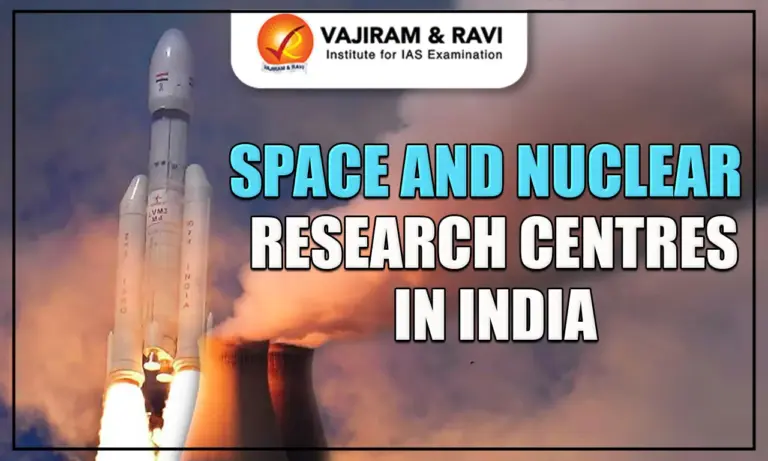
India has shown its glory in various fields of science specifically in space and nuclear research. The achievements in this specific domain reflects the focused efforts and innovation. Space and Nuclear Research Centres in India have played an important role in positioning India as a scientific power. Indian Space Research Organisation (ISRO), which launched 104 satellites in a mission on January 15, 2017, a world record at the time for deploying sun-synchronous satellites. In the nuclear sector, a bulletin reported in 2015 that India had developed approximately 120 warheads, marking significant advancement in its strategic capabilities.
Space and Nuclear Research Centres in India
The space journey of India began in the early 1960s, at a time when satellite-based applications were still in their experimental phase in the United States. The live telecast of the Tokyo Olympics through the American satellite ‘Syncom-3’, which demonstrated the potential of communication satellites. This event influenced Dr. Vikram Sarabhai, known as the father of India’s space programme and underscored the value of space technology for national development.
To lay the groundwork for future advancements, the Indian National Committee for Space Research (INCOSPAR) was established in 1962 under the leadership of Dr. Sarabhai and Dr. P.R. Ramanathan. This initiative eventually led to the formation of the Indian Space Research Organisation (ISRO) on August 15, 1969, with a mission to discover space technology for national progress. On June 1, 1972, ISRO was brought under the newly created Department of Space (DOS), strengthening its institutional framework. Today, ISRO ranks among the 6th Largest Space Agency in the World. Since its establishment, India’s space programme has focused on three key areas:
- Development of satellites for communication and remote sensing
- Creation of reliable space transportation systems
- Implementation of application-driven programmes for national development
List of Space and Nuclear Research Centres in India
Space and Nuclear Research Centres in India initiatives are overseen by the Department of Atomic Energy (DAE), which plays an important role in promoting the peaceful use of nuclear energy across the country. Established in 1954, the DAE is responsible for setting up and managing various high-level research centres dedicated to atomic energy, nuclear science, and related technologies. Among the most prominent institutions under its purview are the Bhabha Atomic Research Centre (BARC) in Mumbai, the Indira Gandhi Centre for Atomic Research (IGCAR) in Kalpakkam, and the Variable Energy Cyclotron Centre (VECC) in Kolkata. These centres contribute significantly to advancements in nuclear power generation, medical applications, and strategic research of India. Below is a List of Space and Nuclear Research Centres in India:
| List of Space and Nuclear Research Centres in India | |||
| S.No | Name | Location | Year |
|
1. |
Physical Research Laboratory |
Ahmedabad |
1947 |
|
2. |
Atomic Energy Commission |
Mumbai |
1948 |
|
3. |
Center of Earth Science’s Studies |
Trivendrum |
1978 |
|
4. |
Saha Institute of Nuclear Physics |
Kolkata |
1949 |
|
5. |
Nuclear Fuel Complex |
Hyderabad |
1971 |
|
6. |
Bhabha Atomic Research Center |
Trombay (Mumbai) |
1957 |
|
7. |
Electronics Corporation of India |
Hyderabad |
1967 |
|
8. |
Uranium Corporation of India |
Jadugoda |
1967 |
|
9. |
Atomic Minerals Directorate for Exploration and Research |
Hyderabad |
1948 |
|
10. |
Indian Rare Earths Limited |
Alwaye (Kerala) |
1950 |
|
11. |
National Chemical Laboratory |
Pune |
1950 |
|
12. |
Indira Gandhi Centre for Atomic Research |
Tamil Nadu |
1971 |
|
13. |
High Altitude Research Laboratory |
Gulmarg |
1963 |
|
14. |
Central Mining Research Institution |
Dhanbad |
1956 |
|
15. |
Central Mechanical Engineering Research Institute |
Durgapur |
1958 |
|
16. |
Radio Astronomy Center |
Tamil Nadu |
1968 |
|
17. |
Variable Energy Cyclotron Center |
Mumbai |
1977 |





Top 8 Space and Nuclear Research Centres in India
Space and Nuclear Research Centres in India are staffed by highly skilled scientists, engineers, and technicians who are dedicated to advancing nuclear science and technology through sustained research and innovation.
Bhabha Atomic Research Centre (BARC)
Bhabha Atomic Research Centre (BARC) is a nuclear research facility, engaged in diverse fields such as engineering, nuclear science, and technology. It plays a critical role in the design and construction of India’s nuclear reactors, and leads cutting-edge research in nuclear fuel, materials science, and radiation protection.
- Located in Trombay, Mumbai, BARC holds the distinction of being the First Nuclear Research Centre in India. In 1967, it was renamed in honour of the renowned physicist Dr. Homi Jehangir Bhabha.
- Dr. Ajit Kumar Mohanty currently serves as the 13th Director of BARC, having assumed the position in 2019.
- BARC is committed to exploring peaceful applications of nuclear energy and power. It operates eight research reactors: Apsara, Cirus, Dhruva, Zerline, and Purnima I, II, and III.
Atomic Energy Commission of India
The Atomic Energy Commission (AEC) of India serves as the apex body responsible for the formulation and implementation of policies related to nuclear energy. It oversees the planning, development, and regulation of India’s nuclear power programs, with a focus on peaceful applications of nuclear energy in sectors such as agriculture, power generation, healthcare, industry, and scientific research.
- Established in August 1948 under the Department of Atomic Energy, the AEC is headquartered in Mumbai. Dr. Homi Jehangir Bhabha was the first Chairman of the Commission and played a foundational role in shaping India’s nuclear landscape.
- As of 2019, K.N. Vyas serves as the Chairman of AEC. The Commission is also responsible for training atomic scientists and promoting nuclear research across its laboratories and affiliated institutions throughout the country.
Electronics Corporation of India Limited
Electronics Corporation of India Limited (ECIL) plays an important role in designing, developing, and manufacturing a wide range of electronic systems and solutions for sectors such as nuclear energy, space, defense, security, and public infrastructure.
The organization maintains a strong emphasis on research and development and has worked with both national and international partners to advance high-end technologies.
- ECIL was founded in April 1967 by Dr. A.S. Rao and functions under the Department of Atomic Energy, Government of India.
- Its headquarters is located in Hyderabad.
- Retired Admiral Sanjay Chaubey has been serving as the Chairman and Managing Director since 2018.
- The organization supports the peaceful application of atomic energy through its technological innovations and specialized systems.
Uranium Corporation of India Limited
Uranium Corporation of India Limited (UCIL) is a Public Sector Undertaking (PSU) under the Department of Atomic Energy, established on October 4, 1967. Headquartered in Singhbhum, Jharkhand, the company is primarily engaged in the mining and processing of uranium ore, which is then used as fuel in India’s nuclear power plants.
- UCIL is also involved in the exploration and development of new uranium deposits both within the country and internationally.
- The company is firmly committed to environmental sustainability and has adopted various measures to reduce the ecological impact of its mining and processing operations.
- Shri C.K. Asnani has been serving as the Chairman and Managing Director since March 2020.
India Rare Earths Limited
India Rare Earths Limited (IREL), formerly known as Indian Rare Earths Limited, is a Public Sector Undertaking (PSU) under the Department of Atomic Energy, Government of India. Established on August 18, 1950, IREL’s primary operations include the mining and processing of rare earth minerals, especially monazite, which is a vital source of thorium, an important element for the nuclear industry.
- IREL also manufactures a range of rare earth compounds, metals, and alloys used across diverse sectors including electronics, defense, aerospace, and renewable energy.
- The company’s first operational unit was set up in Aluva, Kochi, and by 1963, IREL evolved into a fully developed Government of India organization, playing a strategic role in India’s atomic energy and high-tech industries.
Tata Institute of Fundamental Research
Tata Institute of Fundamental Research (TIFR) is a national research institution in India, engaged in advanced studies across a wide range of disciplines including mathematics, computer science, physics, chemistry, biology, and several interdisciplinary fields. The institute is dedicated to creating understanding of natural laws and addressing complex scientific challenges through high-impact research.
- TIFR is a Government of India institute operating under the Department of Atomic Energy.
- The institute offers master’s and doctoral programs in various scientific disciplines, including science education and science communication.
- Established in 1945 with the support of the Sir Dorabji Tata Trust and under the visionary leadership of Dr. Homi J. Bhabha, TIFR continues to play a vital role in shaping India’s scientific landscape, particularly in the field of nuclear research.
Saha Institute of Nuclear Physics
Saha Institute of Nuclear Physics (SINP) is a premier research institution with a strong focus on fundamental research in nuclear physics, astrophysics, and allied areas. The institute runs comprehensive programs in both experimental and theoretical physics, with particular emphasis on nuclear astrophysics, high-energy particle physics, and condensed matter physics.
- Located in Bidhannagar, Kolkata, SINP serves as a key center for scientific advancement in India.
- It was originally established as the Institute of Nuclear Physics under the leadership of Professor Meghnad Saha.
- In 1956, the institute was renamed in his honor to commemorate his contributions to science.
- SINP also offers a range of academic programs and degrees in physics and related disciplines.
Nuclear Fuel Complex
The Nuclear Fuel Complex (NFC) is a key industrial unit under the Department of Atomic Energy, Government of India, dedicated to the fabrication of nuclear fuel for the country’s nuclear power reactors. Established in 1971 and headquartered in Hyderabad, the complex manufactures a wide range of nuclear fuel materials, including enriched uranium, zirconium alloy fuel tubes, and mixed oxide (MOX) fuel.
- It also produces heavy water, which serves as a moderator in certain types of nuclear reactors.
- The complex plays a crucial role in achieving self-reliance in nuclear fuel production.
- As of March 2020, Dr. Dinesh Srivastava serves as the Chairman and Chief Executive Officer (CEO) of NFC, leading the organization’s strategic and operational activities.

 Last updated on March, 2026
→ UPSC Final Result 2025 is now out.
→ UPSC has released UPSC Toppers List 2025 with the Civil Services final result on its official website.
→ Anuj Agnihotri secured AIR 1 in the UPSC Civil Services Examination 2025.
→ UPSC Marksheet 2025 is now out.
→ UPSC Notification 2026 & UPSC IFoS Notification 2026 is now out on the official website at upsconline.nic.in.
→ UPSC Calendar 2026 has been released.
→ Check out the latest UPSC Syllabus 2026 here.
→ UPSC Prelims 2026 will be conducted on 24th May, 2026 & UPSC Mains 2026 will be conducted on 21st August 2026.
→ The UPSC Selection Process is of 3 stages-Prelims, Mains and Interview.
→ Prepare effectively with Vajiram & Ravi’s UPSC Prelims Test Series 2026 featuring full-length mock tests, detailed solutions, and performance analysis.
→ Enroll in Vajiram & Ravi’s UPSC Mains Test Series 2026 for structured answer writing practice, expert evaluation, and exam-oriented feedback.
→ Join Vajiram & Ravi’s Best UPSC Mentorship Program for personalized guidance, strategy planning, and one-to-one support from experienced mentors.
→ Shakti Dubey secures AIR 1 in UPSC CSE Exam 2024.
→ Also check Best UPSC Coaching in India
Space and Nuclear Research Centres in India FAQs
Q1. What is ISRO and where is it located?+
Q2. Which is the first space research centre in India?+
Q3. What is the function of BARC?+
Q4. Where is the Vikram Sarabhai Space Centre located?+
Q5. What is the role of SDSC SHAR?+
Tags: space and nuclear research centres in india