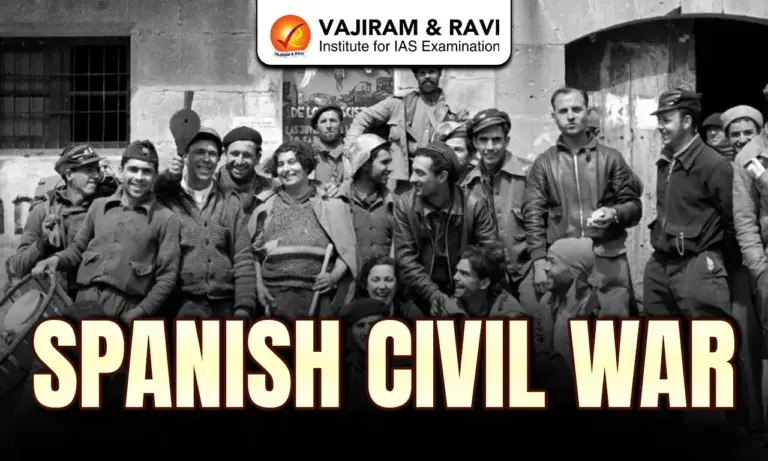
The Spanish Civil War (1936-1939) was fought between the elected Republican government and the Nationalists led by General Franco. It began due to political and ideological divisions in Spain.
Spanish Civil War Background
- The Spanish Civil War was a major conflict in Spain that started in 1936. It was mainly caused by deep political, social and economic divisions in Spanish society.
- On one side were the Nationalists, who included most of the army, wealthy landowners, the Catholic Church and conservative groups. They wanted a strong central government and opposed major social changes.
- On the other side were the Republicans, who included urban workers, farmers, leftist political parties, socialists, anarchists and many members of the educated middle class. They wanted reforms, more equality and protection of workers’ rights.
- Spain had faced years of political instability before 1936, including conflicts between monarchists, conservatives, liberals, socialists and communists. A major crisis in 1934, when miners in Asturias rebelled, showed the growing tension between the left and right.
- The February 1936 elections brought the Popular Front, a coalition of leftist parties, to power. This alarmed the conservatives and military leaders, who feared that Spain was moving toward socialism or communism. This fear led to a military uprising on July 17, 1936, which triggered the civil war.
Course of the Spanish Civil War
- The military revolt was led by conservative officers, including General Francisco Franco, and became known as the Nationalists. The uprising was successful in some parts of Spain, including Spanish Morocco, the Canary Islands and northern Spain, but failed in other regions. The areas under the Republicans resisted the Nationalists, leading to a full-scale civil war.
- Both sides sought help from other countries:
- Nationalists received military support from Nazi Germany and Fascist Italy, including troops, tanks and aircraft.
- Republicans received help from the Soviet Union, the International Brigades (volunteers from Europe and the US) and initially support from France.
- The war was extremely violent, with widespread killings, bombings and repression on both sides. Nationalists under Franco practiced systematic terror, while Republicans also carried out executions during the early stages of the war.
- Key events during the war:
- In late 1936, the Nationalists tried to capture Madrid but were initially held off.
- By 1937, the Nationalists gained control of northern provinces, including the Basque Country and Asturias.
- In 1938, they split the Republican-held territory by reaching the Mediterranean, isolating Republican areas.
- By early 1939, the Republican forces were weakened, many soldiers and civilians fled into France and the Republican government went into exile.
- The war also had an international significance. For Germany and Italy, it was a testing ground for new weapons and military tactics. For artists, writers and intellectuals around the world, it became a symbol of the fight between freedom and tyranny. Famous works inspired by the war include Hemingway’s For Whom the Bell Tolls, Orwell’s Homage to Catalonia and Picasso’s painting Guernica.





Results of the War
- The Nationalists, led by Franco, won the war in 1939. Franco established a dictatorship in Spain that lasted until 1975.
- The war caused massive human losses due to battles, executions, bombings, starvation and disease.
- Politically, the war showed the danger of extreme ideological divisions and became a prelude to World War II, as it involved fascism, communism and international involvement. Spain under Franco remained neutral in World War II but became a symbol of the rise of authoritarianism in Europe.
- The war also left a lasting cultural impact, inspiring novels, memoirs, paintings and photography that depicted the tragedy and human suffering caused by civil conflict.

 Last updated on March, 2026
→ UPSC Final Result 2025 is now out.
→ UPSC has released UPSC Toppers List 2025 with the Civil Services final result on its official website.
→ Anuj Agnihotri secured AIR 1 in the UPSC Civil Services Examination 2025.
→ UPSC Marksheet 2025 is now out.
→ UPSC Notification 2026 & UPSC IFoS Notification 2026 is now out on the official website at upsconline.nic.in.
→ UPSC Calendar 2026 has been released.
→ Check out the latest UPSC Syllabus 2026 here.
→ UPSC Prelims 2026 will be conducted on 24th May, 2026 & UPSC Mains 2026 will be conducted on 21st August 2026.
→ The UPSC Selection Process is of 3 stages-Prelims, Mains and Interview.
→ Prepare effectively with Vajiram & Ravi’s UPSC Prelims Test Series 2026 featuring full-length mock tests, detailed solutions, and performance analysis.
→ Enroll in Vajiram & Ravi’s UPSC Mains Test Series 2026 for structured answer writing practice, expert evaluation, and exam-oriented feedback.
→ Join Vajiram & Ravi’s Best UPSC Mentorship Program for personalized guidance, strategy planning, and one-to-one support from experienced mentors.
→ Shakti Dubey secures AIR 1 in UPSC CSE Exam 2024.
→ Also check Best UPSC Coaching in India
Spanish Civil War FAQs
Q1. What was the Spanish Civil War?+
Q2. What caused the Spanish Civil War?+
Q3. Who were the main groups involved?+
Q4. What was the result of the war?+
Q5. What was the significance of the Spanish Civil War?+
Tags: history history notes Spanish Civil War