Special Drawing Rights (SDR) are an international reserve asset created by the International Monetary Fund (IMF) to enhance global liquidity, support financial stability, and supplement the foreign exchange reserves of member countries.
Special Drawing Rights (SDR) is not a currency, it cannot be used directly for buying goods or services; it functions as an accounting unit for IMF transactions with member countries and a stable asset in countries’ international reserves. It is not a foreign aid, an SDR allocation does not add to any country’s public debt burden.
Special Drawing Rights (SDR) Value
Special Drawing Rights (SDR) Value was initially defined in terms of gold (0.888671 grams), which was equivalent to one US dollar at that time. After the collapse of the Bretton Woods system in 1973, SDR was redefined as a basket of currencies.
- Currently, the value of Special Drawing Rights (SDR) is based on a basket of five currencies – dollar, euro, Japanese yen, pound sterling and the Chinese Renminbi.
- Criteria for Inclusion in SDR Basket: A currency must satisfy two key conditions:
- Export Criterion: A currency meets the export criterion if the issuing country is an IMF member (or a monetary union that includes IMF members) and one of the top five world exporters.
- Freely Usable Criterion: A currency meets the freely usable criterion if it is widely used in payments for international transactions and widely traded in the principal exchange markets.
- The value of Special Drawing Rights (SDR) is decided every day by the International Monetary Fund. It is calculated using the exchange rates of a basket of major currencies, based on market rates around noon in London.
- This value is published daily on the IMF website for transparency.
- The value of Special Drawing Rights (SDR) is denominated in terms of dollars.
- The IMF reviews the SDR basket every five years, or earlier if required, to reflect changes in the global economy.
- For Example: In the 2015 review, the IMF recognized the growing importance of China and included the Chinese Renminbi (RMB) in the SDR basket.
- The IMF fixes the quantity (units) of each currency in the basket for five years. Suppose the SDR basket contains 2 US Dollars and 1 Euro. These quantities remain fixed for 5 years. However, their relative importance (weights) changes daily due to exchange rate movements. For example, if 1 US Dollar equals ₹80 and 1 Euro equals ₹90 today, and the next day the Dollar strengthens to ₹85 while the Euro weakens to ₹88, the overall value composition of the basket changes. As the US Dollar becomes stronger, it contributes more to the total value of the SDR. Consequently, the relative importance or weight of the Dollar in the SDR increases, even though the actual quantity of currencies in the basket remains unchanged.
Who can hold Special Drawing Rights (SDR)
Special Drawing Rights (SDR) are held by countries (through their central banks or governments) that are members of the International Monetary Fund. They can also be held by some international institutions, but not by individuals or private companies.
- All member countries of the International Monetary Fund can hold SDRs as part of their official foreign exchange reserves.
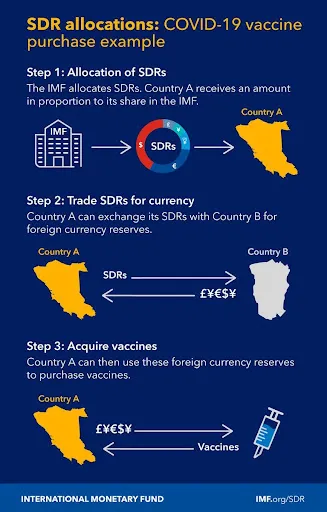
- The IMF allocates SDRs to its members in proportion to their quota.
- For example, If the IMF allocates $650 billion worth of SDRs globally and a country has a 2% quota, it will receive 2% of SDRs (≈ $13 billion).
- IMF quota is the financial contribution (subscription) that each member country makes to the International Monetary Fund when it joins. IMF quota determines subscription, voting power, borrowing limits, and SDR allocation
- IMF quota is determined by indicators like GDP, trade openness, and foreign exchange reserves, hence countries with stronger economies receive a larger share of SDRs.
- India’s share in SDR allocation (quota) is 2.75% and voting power in IMF is 2.63%
- The first allocation was done in 1970-72. The most recent allocation of Special Drawing Rights (SDR) was made in August 2021 by the IMF to SDR 456 billion (approximately $650 billion), the largest allocation in history, to support global liquidity during the COVID-19 crisis. The allocation was distributed among member countries in proportion to their IMF quotas.





Uses and Features of Special Drawing Rights (SDR)
Special Drawing Rights (SDR) serve as an important international reserve asset that provides liquidity, supports financial stability, and facilitates transactions within the global monetary system.
- SDRs do not exist in the form of notes or coins; they are not a physical currency. Hence, they are often referred to as “paper gold” or a notional currency.
- SDRs cannot be held by private individuals or entities; only governments, central banks, and approved international institutions can hold them.
- SDRs cannot be used directly to buy goods and services in international trade.
- Instead, countries exchange SDRs for freely usable currencies such as US Dollar, Euro, Yen, Pound, and Yuan through IMF-facilitated arrangements.
- These exchanges take place through voluntary trading arrangements among IMF member countries, ensuring liquidity in the global system.
- SDRs function as an interest-bearing reserve asset – If a member purchases SDRs and its holdings rise above its allocation, it earns interest on the excess. Conversely if it sells SDRs and holds fewer SDRs than allocated, it pays interest on the shortfall.
Special Drawing Rights (SDR) Significance
Special Drawing Rights (SDR) hold significant importance in the global financial system as they enhance liquidity, strengthen reserves, and support economic stability, especially during times of crisis.
- Special Drawing Rights (SDR) provide non-debt creating liquidity, helping countries strengthen foreign exchange reserves without increasing borrowing.
- They play a key role in managing balance of payments crises, allowing countries to access foreign currency during external shocks.
- SDRs contribute to global financial stability by acting as a safety net, especially during crises like the COVID-19 pandemic.
- Being based on a basket of currencies, SDRs help reduce dependence on a single dominant currency such as the US dollar.
- They support developing countries by providing additional reserves, though allocation remains unequal due to quota-based distribution.

 Last updated on April, 2026
→ UPSC Final Result 2025 is now out.
→ UPSC has released UPSC Toppers List 2025 with the Civil Services final result on its official website.
→ Anuj Agnihotri secured AIR 1 in the UPSC Civil Services Examination 2025.
→ UPSC Marksheet 2025 is now out.
→ UPSC Notification 2026 & UPSC IFoS Notification 2026 is now out on the official website at upsconline.nic.in.
→ UPSC Calendar 2026 has been released.
→ Check out the latest UPSC Syllabus 2026 here.
→ UPSC Prelims 2026 will be conducted on 24th May, 2026 & UPSC Mains 2026 will be conducted on 21st August 2026.
→ The UPSC Selection Process is of 3 stages-Prelims, Mains and Interview.
→ Prepare effectively with Vajiram & Ravi’s UPSC Prelims Test Series 2026 featuring full-length mock tests, detailed solutions, and performance analysis.
→ Enroll in Vajiram & Ravi’s UPSC Mains Test Series 2026 for structured answer writing practice, expert evaluation, and exam-oriented feedback.
→ Join Vajiram & Ravi’s Best UPSC Mentorship Program for personalized guidance, strategy planning, and one-to-one support from experienced mentors.
→ Shakti Dubey secures AIR 1 in UPSC CSE Exam 2024.
→ Also check Best UPSC Coaching in India
Special Drawing Rights FAQs
Q1. What are Special Drawing Rights (SDR)?+
Q2. Why are Special Drawing Rights (SDR) important?+
Q3. How is the value of Special Drawing Rights (SDR) determined?+
Q4. Can Special Drawing Rights (SDR) be used like money?+
Q5. Who can hold and use Special Drawing Rights (SDR)?+
Tags: special drawing rights