Special Intensive Revision Latest News
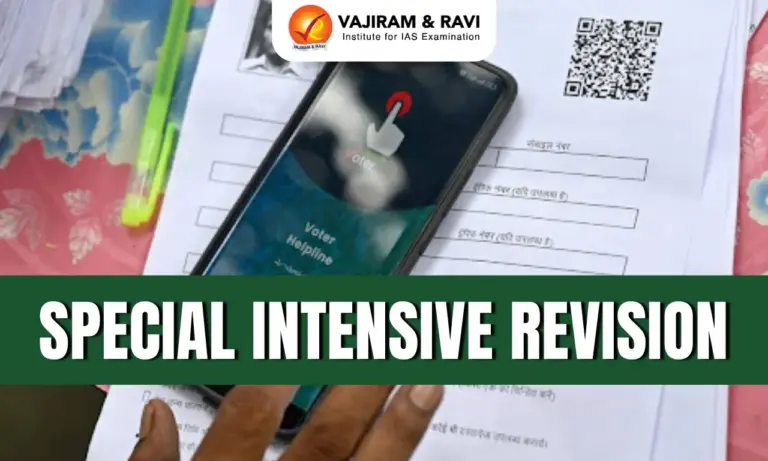
- The Election Commission of India has launched a Special Intensive Revision (SIR) of electoral rolls across the country, beginning with Bihar, to verify voter details and ensure clean and accurate electoral records ahead of upcoming elections.
The Electoral Roll and Its Importance
- The electoral roll is the foundation of India’s democratic process. It ensures that every eligible citizen has the right to vote while preventing duplication and impersonation.
- The Election Commission of India maintains and updates the rolls regularly under the Representation of the People Act, 1950.
- Recently, the ECI conducted a Special Intensive Revision (SIR) of electoral rolls in Bihar, with plans to extend it nationwide in a phased manner.
- The revision aims to improve accuracy in voter records, eliminate duplicates, and update demographic information before major elections.
- The process underscores the need for clean and updated electoral rolls, a key element in ensuring free and fair elections.





The Legal Basis of Electoral Roll Revisions
- Section 21 of the Representation of the People Act, 1950, empowers the ECI to prepare and revise electoral rolls for each constituency.
- Typically, a summary revision occurs before every general or by-election. However, the Act also allows the Commission to carry out a special revision at any time it deems necessary.
- In June 2025, the ECI issued an order launching a Special Intensive Revision across the country, starting with Bihar, where Assembly elections are due in November 2025. The Commission designated July 1, 2025, as the qualifying date for inclusion in the rolls.
Understanding the SIR Process
- The SIR process is more detailed than routine revisions. It involves multiple stages:
- Enumeration Forms Submission:
- All registered voters must fill out the enumeration forms to confirm or update their details.
- Document Verification:
- Voters registered after 2003 must provide valid proof of citizenship. The Supreme Court, in its interim order, directed that Aadhaar be accepted as one of the valid identity proofs for this purpose.
- Draft Roll Publication:
- Based on the forms and verification, a draft electoral roll is published for public review.
- Claims and Objections:
- Citizens are allowed a specified period to file claims for inclusion or raise objections regarding inaccuracies.
- Verification and Final Roll Publication:
- The Electoral Registration Officers (EROs) verify all claims and objections. After this scrutiny, the final electoral roll is published, as was done in Bihar on September 30, 2025.
- The ECI now plans to conduct similar SIR exercises in other states, aligned with their respective election schedules.
Overview of Electoral Forms in India
- The Registration of Electors Rules, 1960 (RER) prescribes various forms for voter registration, correction, deletion, and transfer.
- Awareness of these forms is essential for citizens to participate meaningfully in the electoral process.
- Form 6 – Used by new voters (above 18 years) or those shifting constituencies to apply for inclusion in the electoral roll.
- Form 6A – Used by Overseas Electors (Indian citizens living abroad) to register their names in the electoral rolls of their home constituency.
- Form 7 – Filed for deletion of a name from the electoral roll, for instance, in case of death, duplication, or change of residence.
- Form 8 – Used to correct entries in the existing electoral roll, such as name spelling, address, or age.
- Form 8A – Used for transposition of an elector’s name from one part of a constituency to another (for example, if a voter shifts residence within the same constituency).
- Form 11 to 13D – Used by electoral officers and booth-level agents during verification and publication stages of the electoral roll.
Role of Citizens and Political Stakeholders
- The success of the electoral revision process depends not only on the ECI but also on citizens’ active participation. Voters should:
- Verify their names and details in the published draft rolls.
- Use the correct electoral form to update their information or file claims.
- Ensure that supporting documents, such as Aadhaar, passport, or voter ID, are properly attached to avoid rejections.
- Political parties and civil society organisations play a crucial role in mobilising awareness, especially among marginalised communities, first-time voters, and migrant populations. Their involvement ensures inclusivity in the democratic process.
Significance of Clean Electoral Rolls
- Maintaining accurate electoral rolls is central to the integrity of elections. Outdated or erroneous rolls can lead to disenfranchisement, bogus voting, or manipulation.
- A clean roll ensures that each legitimate vote is counted, and no illegitimate one is cast.
- While critics argue that the SIR process might inconvenience voters due to short timelines, the broader goal remains the creation of a transparent and verifiable electoral base.
- The Supreme Court’s order to include Aadhaar as a valid document aims to strengthen identity verification, though privacy advocates caution against excessive reliance on biometric data.
Way Forward
- The ECI’s move to roll out the SIR nationwide marks a significant effort to modernise and standardise voter registration. Future revisions could be made more efficient through:
- Phased scheduling to prevent administrative overload.
- Digital verification linked with Aadhaar and other databases.
- Enhanced public awareness through local campaigns.
- Ensuring inclusive participation, especially of women, youth, and migrant workers, will be vital to building a comprehensive and accurate electoral roll ahead of the 2029 general elections.
Source: TH

 Last updated on March, 2026
→ UPSC Final Result 2025 is now out.
→ UPSC has released UPSC Toppers List 2025 with the Civil Services final result on its official website.
→ Anuj Agnihotri secured AIR 1 in the UPSC Civil Services Examination 2025.
→ UPSC Marksheet 2025 is now out.
→ UPSC Notification 2026 & UPSC IFoS Notification 2026 is now out on the official website at upsconline.nic.in.
→ UPSC Calendar 2026 has been released.
→ Check out the latest UPSC Syllabus 2026 here.
→ UPSC Prelims 2026 will be conducted on 24th May, 2026 & UPSC Mains 2026 will be conducted on 21st August 2026.
→ The UPSC Selection Process is of 3 stages-Prelims, Mains and Interview.
→ Prepare effectively with Vajiram & Ravi’s UPSC Prelims Test Series 2026 featuring full-length mock tests, detailed solutions, and performance analysis.
→ Enroll in Vajiram & Ravi’s UPSC Mains Test Series 2026 for structured answer writing practice, expert evaluation, and exam-oriented feedback.
→ Join Vajiram & Ravi’s Best UPSC Mentorship Program for personalized guidance, strategy planning, and one-to-one support from experienced mentors.
→ Shakti Dubey secures AIR 1 in UPSC CSE Exam 2024.
→ Also check Best UPSC Coaching in India
Special Intensive Revision FAQs
Q1. What is the Special Intensive Revision (SIR) of electoral rolls?+
Q2. Which law governs the preparation and revision of electoral rolls in India?+
Q3. What is Form 6 used for?+
Q4. What did the Supreme Court direct during the SIR in Bihar?+
Q5. How can citizens verify their electoral details online?+
Tags: mains articles Special Intensive Revision upsc current affairs upsc mains current affairs