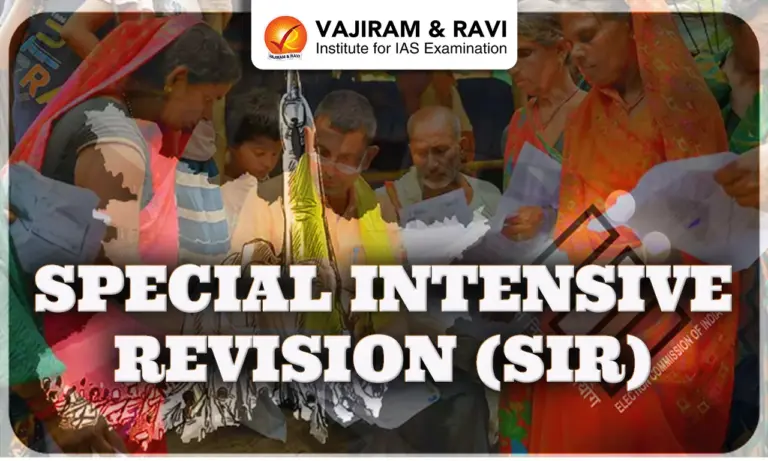
Special Intensive Revision (SIR) Latest News
- The Election Commission of India (ECI) has initiated a Special Intensive Revision (SIR) of electoral rolls in 12 states and Union Territories, covering 51 crore electors, to ensure the purity and accuracy of electoral rolls.
- This is the first nationwide SIR since 2002–2005, aimed at eliminating duplicate, migrated, or ineligible entries and verifying voter eligibility.
Background and Significance
- Evolution of SIR:
- The ECI’s order (June 2025) mandated all registered electors to fill new enumeration forms, while those added after the last intensive revision (2002–2005) must submit eligibility and citizenship-related documents.
- The first phase began in Bihar, where Assembly elections are due, serving as a pilot model for future nationwide implementation.
- Constitutional and legal basis:
- The ECI cites Article 326 of the Constitution — which restricts voting rights to Indian citizens aged 18 and above — to justify verifying eligibility (not citizenship cancellation).
- The process is governed by the Representation of the People Act, 1950.
- This ensures free and fair elections, one of the basic features of the Constitution.
- Need for SIR:
- Political parties have repeatedly complained about the “impurity” in electoral rolls due to –
- Migration and multiple registrations.
- Non-removal of deceased voters.
- Wrongful inclusion of non-citizens.
- The SIR had been conducted 8 times since 1951 and the last intensive revision was conducted between 2002–2005, followed by only summary revisions.
- Political parties have repeatedly complained about the “impurity” in electoral rolls due to –





Coverage and Implementation
- States and UTs involved: The SIR will be conducted in A&N Islands, Chhattisgarh, Goa, Gujarat, Kerala, Lakshadweep, MP, Puducherry, Rajasthan, Tamil Nadu, UP, and West Bengal.
- Key dates:
- Enumeration period: Begins November 4, 2025.
- Draft roll publication: December 9, 2025.
- Final roll publication: February 7, 2026.
- Excluded state: Assam is excluded due to ongoing NRC process and distinct Citizenship Act provisions.
Operational Details
- Enumeration process:
- 5.33 lakh Booth Level Officers (BLOs) to conduct house-to-house verification.
- All electors must submit enumeration forms by December 4 to remain on the draft roll.
- Eligibility proof required for those not traceable to 2002–2005 SIR rolls.
- Documents accepted:
- 13 types of documents, including Aadhaar and extracts from Bihar’s SIR roll.
- Aadhaar to be used only for identity verification, not citizenship proof.
- Electors born after July 1, 1987 must submit proof of parents’ eligibility.
Special Cases and Administrative Coordination
- Bihar’s experience:
- Bihar’s SIR concluded on September 30, 2025, with electors reducing by 6% (to 7.42 crore).
- No appeals were filed against Electoral Registration Officers’ (ERO) decisions.
- This model will guide the second phase of SIR.
- State-specific considerations:
- Urban areas like Delhi and Chandigarh have low linkage with old rolls due to migration.
- Weather conditions and local body elections have also influenced state selection and timelines.
Challenges and Controversies
- Legal challenge: The Supreme Court is hearing petitions questioning –
- ECI’s authority to verify citizenship of registered voters.
- The procedure adopted in Bihar’s SIR.
- Political opposition:
- West Bengal CM termed it an “NRC through the backdoor”.
- However, ECI maintains that constitutional bodies will carry out their respective roles independently.
- Administrative: Tight timelines and document verification may burden BLOs and EROs.
- Social: Risk of disenfranchisement if citizens lack documentary proof.
Way Forward
- Transparency and technology: Use of the Voter Portal to help citizens trace old roll entries.
- Electoral integrity: Purified rolls could reduce bogus voting and increase public trust.
- Awareness campaigns: To ensure mass participation and timely documentation.
- Data synchronization: Integration of digital databases to prevent duplication.
- Periodic SIRs: Institutionalizing regular intensive revisions to maintain credibility.
- Stakeholder engagement: Institutionalised consultations with political parties, civil society, and local administration before rollout.
- Legal clarity: Seek SC guidance to define ECI’s powers under Article 326 and the RPA, 1950.
- Document access facilitation: Simplify and digitise the process of submitting eligibility proofs, especially in rural and migrant-heavy areas.
- Phased implementation: Adopt Bihar’s learnings for gradual state-by-state rollout instead of a single nationwide push.
Conclusion
- The SIR of electoral rolls marks a major administrative reform to restore public trust in the electoral process.
- By verifying eligibility and updating voter lists, the EC aims to strengthen democratic legitimacy.
- However, political concerns and legal scrutiny highlight the delicate balance between ensuring voter purity and protecting voter rights.

 Last updated on March, 2026
→ UPSC Final Result 2025 is now out.
→ UPSC has released UPSC Toppers List 2025 with the Civil Services final result on its official website.
→ Anuj Agnihotri secured AIR 1 in the UPSC Civil Services Examination 2025.
→ UPSC Marksheet 2025 is now out.
→ UPSC Notification 2026 & UPSC IFoS Notification 2026 is now out on the official website at upsconline.nic.in.
→ UPSC Calendar 2026 has been released.
→ Check out the latest UPSC Syllabus 2026 here.
→ UPSC Prelims 2026 will be conducted on 24th May, 2026 & UPSC Mains 2026 will be conducted on 21st August 2026.
→ The UPSC Selection Process is of 3 stages-Prelims, Mains and Interview.
→ Prepare effectively with Vajiram & Ravi’s UPSC Prelims Test Series 2026 featuring full-length mock tests, detailed solutions, and performance analysis.
→ Enroll in Vajiram & Ravi’s UPSC Mains Test Series 2026 for structured answer writing practice, expert evaluation, and exam-oriented feedback.
→ Join Vajiram & Ravi’s Best UPSC Mentorship Program for personalized guidance, strategy planning, and one-to-one support from experienced mentors.
→ Shakti Dubey secures AIR 1 in UPSC CSE Exam 2024.
→ Also check Best UPSC Coaching in India
Special Intensive Revision (SIR) FAQs
Q1. What is the rationale behind the ECI’s decision to conduct a SIR of electoral rolls after two decades?+
Q2. How does the ECI’s power under Article 326 of the Constitution relate to its authority to conduct the SIR?+
Q3. What administrative and political challenges are associated with implementing a nationwide SIR of electoral rolls?+
Q4. What is the significance of involving political parties and CEOs in the preparation for the nationwide SIR?+
Q5. How the SIR of electoral rolls aligns with the principles of free and fair elections in India?+
Tags: Special Intensive Revision