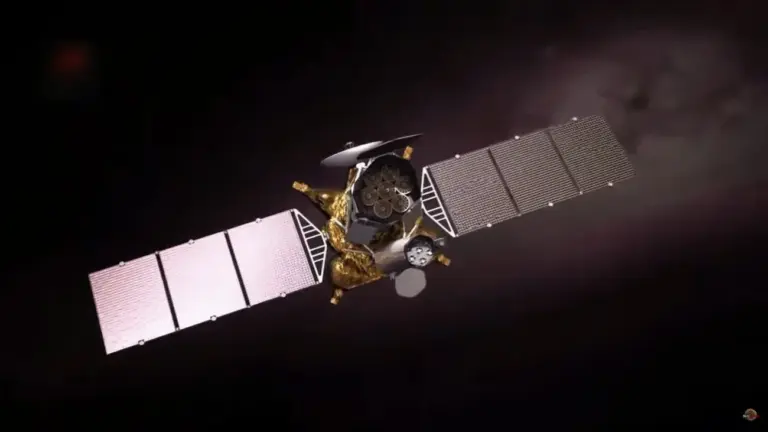
About Spektr-RG(SRG):
- Spektr-Rentgen-Gamma (Spektr-RG, SRG) is a German-Russian high-energy astrophysics space observatory to study the universe in the X-ray range of electromagnetic radiation.
- It was launched on July 13, 2019, on a Proton-M rocket from the cosmo drome in Baikonur, Kazakhstan.
- It moves along a so-called halo orbit around the outer Lagrange point (L2) of the Sun-Earth system at a distance of 1.5 million km from the Earth with a period of about 6 months.
- A Lagrange point is a position in space where the gravitational pull of two large masses precisely equals the centripetal force required for a small object to move with them.
- Instruments:
- The primary instrument of the mission is eROSITA, built by the Max Planck Institute for Extraterrestrial Physics (MPE) in Germany.
- It is designed to conduct a seven-year X-ray survey, the first in the medium X-ray band less than 10 keV energies, and the first to map an estimated 100,000 galaxy clusters.
- This survey may detect new clusters of galaxies and active galactic nuclei.
- The second instrument, ART-XC, is a Russian high-energy X-ray telescope capable of detecting supermassive black holes.
It is intended to replace the Spektr-R, known as the “Russian Hubble”. Spektr-R was launched in 2011 to observe black holes, neutron stars, and magnetic fields, aiding understanding of cosmic expansion.
Q1: What are Pulsars?
Pulsars are rotating neutron stars observed to have pulses of radiation at very regular intervals that typically range from milliseconds to seconds. Pulsars have very strong magnetic fields, which funnel jets of particles out along the two magnetic poles. These accelerated particles produce very powerful beams of light. Often, the magnetic field is not aligned with the spin axis, so those beams of particles and light are swept around as the star rotates. When the beam crosses our line of sight, we see a pulse; in other words, we see pulsars turn on and off as the beam sweeps over Earth.
Source: New accreting millisecond X-ray pulsar discovered






 Last updated on March, 2026
→ UPSC Final Result 2025 is now out.
→ UPSC has released UPSC Toppers List 2025 with the Civil Services final result on its official website.
→ Anuj Agnihotri secured AIR 1 in the UPSC Civil Services Examination 2025.
→ UPSC Marksheet 2025 is now out.
→ UPSC Notification 2026 & UPSC IFoS Notification 2026 is now out on the official website at upsconline.nic.in.
→ UPSC Calendar 2026 has been released.
→ Check out the latest UPSC Syllabus 2026 here.
→ UPSC Prelims 2026 will be conducted on 24th May, 2026 & UPSC Mains 2026 will be conducted on 21st August 2026.
→ The UPSC Selection Process is of 3 stages-Prelims, Mains and Interview.
→ Prepare effectively with Vajiram & Ravi’s UPSC Prelims Test Series 2026 featuring full-length mock tests, detailed solutions, and performance analysis.
→ Enroll in Vajiram & Ravi’s UPSC Mains Test Series 2026 for structured answer writing practice, expert evaluation, and exam-oriented feedback.
→ Join Vajiram & Ravi’s Best UPSC Mentorship Program for personalized guidance, strategy planning, and one-to-one support from experienced mentors.
→ Shakti Dubey secures AIR 1 in UPSC CSE Exam 2024.
→ Also check Best UPSC Coaching in India