Gender Gap in Education Expenditure India Latest News
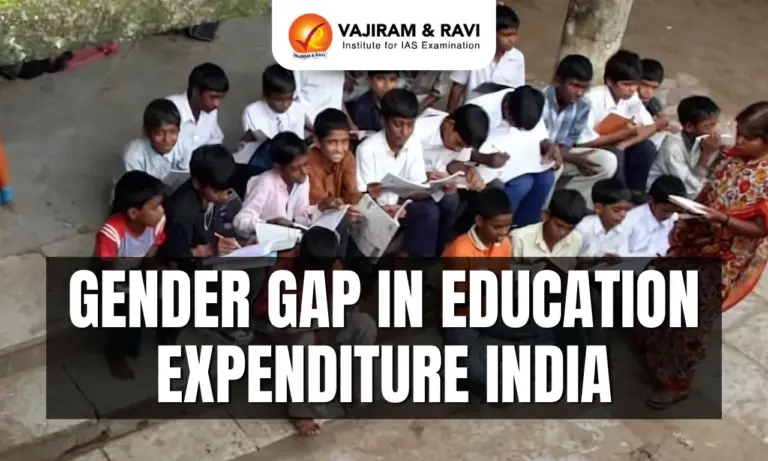
- Despite a recent drop in the World Economic Forum’s gender gap rankings, partly due to the education category, India has increased girls’ school enrolment, with girls now forming 48% of the student population and slightly higher participation in higher education than men.
- However, National Sample Survey data reveal a persisting gender gap: families spend significantly less on daughters’ education compared to sons, highlighting unequal investment despite improved enrolment.
Gender Gaps in Education Expenditure in India
- The Comprehensive Modular Survey on Education (NSS 80th round, April–June) reveals consistent gender disparities in spending on children’s education across India.
- The survey shows that families spend less on girls than boys at every stage of schooling, from pre-primary to higher secondary, in both rural and urban areas.
- In rural India, households spend about ₹1,373 (18%) more on boys, while in urban India, girls receive ₹2,791 less on average.
- By higher secondary school, urban families spend nearly 30% more on boys’ education.
- Considering course fees alone, the gap widens further, with boys receiving 21.5% more spending nationwide.
- Enrollment patterns reflect this bias: 58.4% of girls study in government schools compared to 34% of boys in private unaided schools, highlighting unequal access to costlier private education.
- The disparity extends to tuition classes as well, with 22% more spent on boys’ tuition at the higher secondary level.




State-Level Gaps in School Enrolment
- Gender disparities in school enrolment vary widely across India.
- In Delhi, 65% of girls attend government schools compared to 54% of boys, while 38.8% of boys attend private schools against 26.6% of girls.
- Similar gaps of over 10 percentage points are seen in Madhya Pradesh, Rajasthan, and Punjab.
- In Gujarat, the divide is sharper in urban areas but narrower in rural regions.
- In contrast, Tamil Nadu and Kerala show near-equal ratios for boys and girls across government and private schools, while several northeastern States send more girls to private schools than boys.
Differences in Education Expenditure
- Spending patterns also differ by State, especially at higher classes.
- In Telangana, Tamil Nadu, and West Bengal, families spend far more on boys at the higher secondary level, despite spending more on girls at the secondary level.
- For instance, in Tamil Nadu, average secondary-level spending is ₹23,796 for girls and ₹22,593 for boys, but at the higher secondary level, it jumps to ₹35,973 for boys versus just ₹19,412 for girls.
- Dropouts and subsidies for girls partly explain this reversal.
States Spending More on Girls
- Some States show the opposite trend.
- In Andhra Pradesh, Himachal Pradesh, and Kerala, families spend more on girls in higher secondary education, particularly in urban areas where higher transport costs are linked to parental concerns about girls’ safety.
Private Tuition Expenditure Gaps
- Private coaching costs reveal further inequalities.
- In Himachal Pradesh, families spend ₹9,813 per boy in higher secondary tuition, compared to just ₹1,550 per girl.
- Significant tuition-related gender gaps are also seen in Bihar, Jharkhand, Rajasthan, and Tamil Nadu, underscoring how education spending priorities differ across regions.
Reasons Behind Gender Gaps in Education Expenditure
- Societal Preferences and Gender Bias
- Deep-rooted cultural norms often prioritize sons’ education over daughters, as boys are seen as future breadwinners.
- Daughters are frequently expected to marry early, reducing perceived returns on investing heavily in their education.
- Type of Schools Chosen
- Families disproportionately send boys to private unaided schools, which charge higher fees, while girls are more likely to attend government schools.
- This directly reduces average per-student expenditure on girls.
- Dropouts Among Girls
- Higher dropout rates among girls, especially after secondary school, mean families spend less on their higher secondary education.
- Safety concerns, early marriage, and household responsibilities are key drivers of dropout.
- Access to Private Tuitions
- Although boys and girls enroll in tuition classes at similar rates, families spend significantly more on boys’ coaching, especially at higher classes.
- This reflects a belief that competitive exams and higher education are more important for boys’ futures.
- Economic Considerations and Subsidies
- Government schemes often subsidize girls’ fees, uniforms, and transport, lowering the reported expenditure on them.
Source: TH

 Last updated on March, 2026
→ UPSC Final Result 2025 is now out.
→ UPSC has released UPSC Toppers List 2025 with the Civil Services final result on its official website.
→ Anuj Agnihotri secured AIR 1 in the UPSC Civil Services Examination 2025.
→ UPSC Marksheet 2025 is now out.
→ UPSC Notification 2026 & UPSC IFoS Notification 2026 is now out on the official website at upsconline.nic.in.
→ UPSC Calendar 2026 has been released.
→ Check out the latest UPSC Syllabus 2026 here.
→ UPSC Prelims 2026 will be conducted on 24th May, 2026 & UPSC Mains 2026 will be conducted on 21st August 2026.
→ The UPSC Selection Process is of 3 stages-Prelims, Mains and Interview.
→ Prepare effectively with Vajiram & Ravi’s UPSC Prelims Test Series 2026 featuring full-length mock tests, detailed solutions, and performance analysis.
→ Enroll in Vajiram & Ravi’s UPSC Mains Test Series 2026 for structured answer writing practice, expert evaluation, and exam-oriented feedback.
→ Join Vajiram & Ravi’s Best UPSC Mentorship Program for personalized guidance, strategy planning, and one-to-one support from experienced mentors.
→ Shakti Dubey secures AIR 1 in UPSC CSE Exam 2024.
→ Also check Best UPSC Coaching in India
Gender Gap in Education Expenditure India FAQs
Q1. What does the NSS survey reveal about education expenditure in India?+
Q2. How wide is the rural-urban gap in education spending on girls? +
Q3. Which states show the largest enrolment gender gaps? +
Q4. How does education spending vary by class level? +
Q5. What explains persistent gender gaps in education expenditure?+
Tags: gender gap in education expenditure India mains articles upsc current affairs upsc mains current affairs