About Spiral Galaxy:
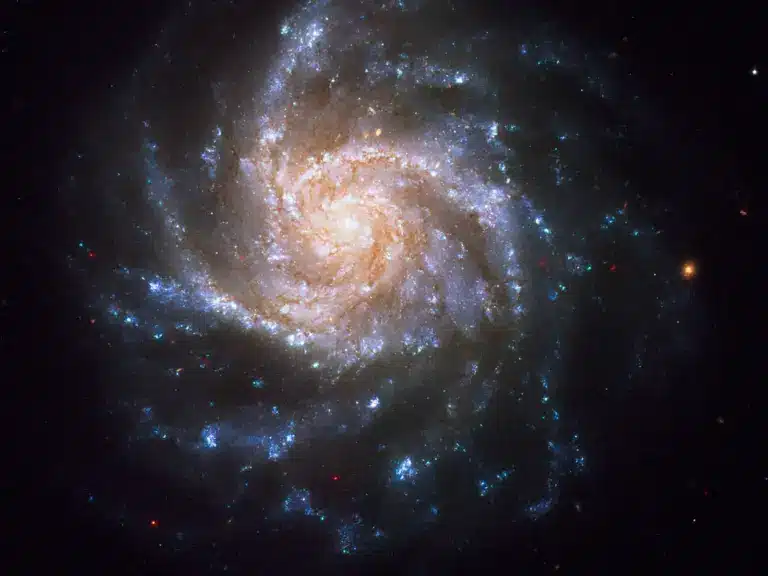
- Spiral galaxies are twisted collections of stars and gas that often have beautiful shapes and are made up of hot, young stars.
- In a spiral galaxy, the stars, gas, and dust are gathered in spiral arms that spread outward from the galaxy’s center.
- Most of the galaxies that scientists have discovered so far are spiral galaxies, as opposed to the other two main categories of galaxy shapes—elliptical and irregular.
- Approximately 60% of all galaxies are thought to be spiral galaxies.
- The Milky Way, the galaxy that includes Earth and our solar system, is an example of a spiral galaxy.
- Structure:
- Most spiral galaxies contain a central bulge surrounded by a flat, rotating disk of stars.
- The bulge in the center is made up of older, dimmer stars and is thought to contain a supermassive black hole.
- Approximately two-thirds of spiral galaxies also contain a bar structure through their center, as does the Milky Way.
- The disk of stars orbiting the bulge separates into arms that circle the galaxy.
- These spiral arms contain a wealth of gas and dust and younger stars that shine brightly before their quick demise.
- The majority of spiral galaxies rotate in the sense that the arms trail the direction of the spin.
- The visible portion of spiral galaxies contains only a small fraction of the total mass of the galaxy, and that spiral galaxies are surrounded by an extensive haloconsisting mostly of dark matter.
- Spiral galaxies are thought to evolve into elliptical galaxies as the spirals get older.
Q1: What is a Black Hole?
A black hole is a region in space where gravity pulls so much that even light cannot get out. The gravity is so strong because matter has been squeezed into a tiny space. This can happen when a star is dying. Because no light can get out, it is difficult to detect a black hole. The largest black holes are called “supermassive.” These black holes have masses that are more than 1 million suns together.






 Last updated on March, 2026
→ UPSC Final Result 2025 is now out.
→ UPSC has released UPSC Toppers List 2025 with the Civil Services final result on its official website.
→ Anuj Agnihotri secured AIR 1 in the UPSC Civil Services Examination 2025.
→ UPSC Marksheet 2025 is now out.
→ UPSC Notification 2026 & UPSC IFoS Notification 2026 is now out on the official website at upsconline.nic.in.
→ UPSC Calendar 2026 has been released.
→ Check out the latest UPSC Syllabus 2026 here.
→ UPSC Prelims 2026 will be conducted on 24th May, 2026 & UPSC Mains 2026 will be conducted on 21st August 2026.
→ The UPSC Selection Process is of 3 stages-Prelims, Mains and Interview.
→ Prepare effectively with Vajiram & Ravi’s UPSC Prelims Test Series 2026 featuring full-length mock tests, detailed solutions, and performance analysis.
→ Enroll in Vajiram & Ravi’s UPSC Mains Test Series 2026 for structured answer writing practice, expert evaluation, and exam-oriented feedback.
→ Join Vajiram & Ravi’s Best UPSC Mentorship Program for personalized guidance, strategy planning, and one-to-one support from experienced mentors.
→ Shakti Dubey secures AIR 1 in UPSC CSE Exam 2024.
→ Also check Best UPSC Coaching in India