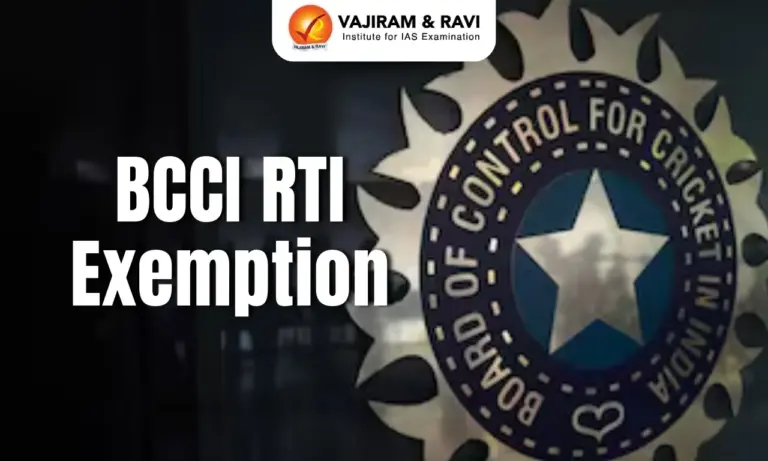
BCCI RTI Exemption Latest News
- The Rajya Sabha passed the National Sports Governance Bill, 2025, a day after its clearance in the Lok Sabha.
- Opposition leaders criticised the legislation, calling it an “extreme centralisation of sports administration”.
- They highlight that the bill grants the Board of Control for Cricket in India (BCCI) most favoured treatment by keeping it outside the scope of national laws like the Right to Information (RTI) Act.
- The Bill specifies that only sports bodies receiving direct financial assistance from the government are deemed “public authorities” under the RTI Act. Since the BCCI does not get such funding, it will remain excluded.
- Over the years, the BCCI has resisted inclusion under the RTI despite recommendations from the Supreme Court, the Law Commission of India, and the Central Information Commission to bring it under the transparency law.
RTI Exemption for BCCI in National Sports Governance Bill
- The National Sports Governance Bill seeks to recognise and regulate national sports bodies, aligning them with Olympic and Paralympic Charters and global best practices to improve transparency, accountability, and international collaboration opportunities.
- Initially, Clause 15(2) of the Bill defined a recognised sports organisation as a “public authority” under the RTI Act, making its operations — including team selection and contract awards — open to public scrutiny.
- This broad definition would have included the Board of Control for Cricket in India (BCCI).
- However, a later amendment narrowed the definition to only cover organisations receiving government grants or financial assistance, and even then, solely regarding the utilisation of those funds.
- This change excluded the BCCI — which does not take direct government funding — from RTI obligations, despite cricket’s impending inclusion in the Olympics and calls for greater transparency in the sport’s administration.





BCCI’s Stance and RTI Debate
- BCCI maintains that it is a private, autonomous body registered under the Tamil Nadu Societies Registration Act, 1975, and not a “public authority” under the RTI Act.
- It does not receive direct government funding, and is not classified as a sports federation under the Union Sports Ministry.
Judicial and Commission Recommendations
- Multiple judicial and quasi-judicial bodies have challenged BCCI’s stance.
- The Law Commission of India’s 275th Report (2018) recommended classifying the BCCI as a public authority.
- It cited indirect financial benefits such as tax exemptions exceeding ₹2,100 crore (1997–2007) and subsidised land allotments by state governments.
Supreme Court Observations
- In 2015, the Supreme Court observed that BCCI performs “public functions” — including selecting India’s national teams, using national symbols, and monopolising cricket with government concurrence.
- The Justice R.M. Lodha Committee called BCCI’s functioning a “closed door and back-room affair” and urged legislative inclusion under the RTI Act.
CIC’s Landmark Order and Legal Challenge
- In 2018, the Central Information Commission declared BCCI a “public authority” and directed it to create an RTI query mechanism.
- The BCCI challenged this order in the Madras High Court, which stayed its implementation, leaving the matter unresolved.
Implications of Bringing BCCI Under RTI
- If the BCCI were brought under the RTI Act, citizens could request comprehensive information about its operations — from team selection criteria and broadcasting contract details to infrastructure tenders, official appointments, and meeting minutes.
- This transparency would compel the board to justify decisions to the public, rather than only to its internal members.
- The Supreme Court, in its 2015 ruling, clarified that while BCCI is not a state body, it is subject to writ jurisdiction under Article 226 of the Constitution because it performs public functions.
- This empowers High Courts to intervene when the board’s actions are arbitrary or against public interest.

 Last updated on March, 2026
→ UPSC Final Result 2025 is now out.
→ UPSC has released UPSC Toppers List 2025 with the Civil Services final result on its official website.
→ Anuj Agnihotri secured AIR 1 in the UPSC Civil Services Examination 2025.
→ UPSC Marksheet 2025 is now out.
→ UPSC Notification 2026 & UPSC IFoS Notification 2026 is now out on the official website at upsconline.nic.in.
→ UPSC Calendar 2026 has been released.
→ Check out the latest UPSC Syllabus 2026 here.
→ UPSC Prelims 2026 will be conducted on 24th May, 2026 & UPSC Mains 2026 will be conducted on 21st August 2026.
→ The UPSC Selection Process is of 3 stages-Prelims, Mains and Interview.
→ Prepare effectively with Vajiram & Ravi’s UPSC Prelims Test Series 2026 featuring full-length mock tests, detailed solutions, and performance analysis.
→ Enroll in Vajiram & Ravi’s UPSC Mains Test Series 2026 for structured answer writing practice, expert evaluation, and exam-oriented feedback.
→ Join Vajiram & Ravi’s Best UPSC Mentorship Program for personalized guidance, strategy planning, and one-to-one support from experienced mentors.
→ Shakti Dubey secures AIR 1 in UPSC CSE Exam 2024.
→ Also check Best UPSC Coaching in India
BCCI RTI Exemption FAQs
Q1. What does the National Sports Governance Bill aim to achieve?+
Q2. Why is the BCCI excluded from RTI under the Bill?+
Q3. What has the Supreme Court said about BCCI’s role?+
Q4. What did the CIC rule in 2018 about BCCI?+
Q5. What would BCCI under RTI mean for the public?+
Tags: BCCI RTI exemption mains articles upsc current affairs upsc mains current affairs