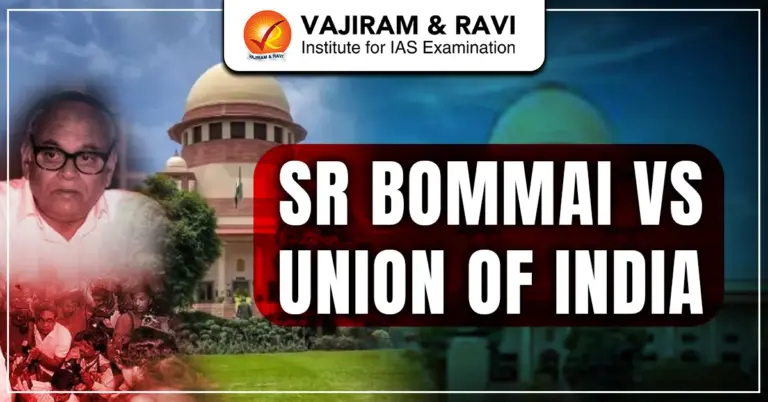
The SR Bommai vs Union of India 1994 Case is one of the most important constitutional judgments in India. Decided by a nine judge bench of the Supreme Court, the case placed strict limits on the misuse of Article 356, which allows the imposition of President’s Rule in states. Before this judgment, Article 356 was frequently used to dismiss elected state governments for political reasons. The ruling clarified that federalism, democracy, and constitutional morality are part of India’s basic structure. It strengthened judicial review, ensured Assembly floor tests for majority, and significantly reshaped Centre-State relations.
SR Bommai vs Union of India
The SR Bommai vs Union of India (1994) judgment is a cornerstone of Indian constitutional law. It decisively curbed the political misuse of Article 356, reaffirmed federalism, strengthened judicial review, and restored democratic accountability. By mandating floor tests, limiting Governor discretion, and enforcing Parliamentary oversight, the Supreme Court ensured that President’s Rule remains a last resort, as envisioned by Dr. B.R. Ambedkar.
SR Bommai vs Union of India Background
The SR Bommai vs Union of India arose from the dismissal of Karnataka’s elected government using Article 356 after political defections raised questions over majority.
- In 1985, Janata Party formed the Karnataka government under Ramakrishna Hegde
- SR Bommai became Chief Minister in 1988
- A legislator defected along with 19 MLAs, withdrawing support
- Governor reported loss of majority without allowing a floor test
- President imposed Article 356, dismissing the Bommai government
- Karnataka High Court upheld the dismissal
- Bommai appealed to the Supreme Court of India
- The case raised major constitutional questions as:
- Is a Presidential Proclamation under Article 356 justiciable?
- Does the President have absolute discretion under Article 356?
- Can courts review the material behind Presidential satisfaction?
- Can a dissolved Assembly be revived if the proclamation is invalid?
- Is Parliamentary approval mandatory before irreversible actions?
- Can the Governor’s subjective opinion replace Assembly floor tests?





SR Bommai vs Union of India Judgment
In the SR Bommai vs Union of India Case, the Supreme Court ruled that Article 356 is an extraordinary power subject to strict constitutional limitations and judicial scrutiny.
- Article 356 is not absolute and is subject to judicial review
- Courts can examine the relevance and legality of material
- Floor test is the only valid method to prove majority
- Governor cannot decide majority subjectively
- Parliament must approve the proclamation within two months
- Without approval, the proclamation automatically lapses
- Assembly cannot be dissolved before Parliamentary approval
- Dissolved legislatures can be revived if proclamation is invalid
- Judgment aligned with Sarkaria Commission recommendations
SR Bommai vs Union of India Legal Aspects
The SR Bommai vs Union of India interpreted multiple constitutional provisions to prevent misuse of emergency powers and protect federal balance.
- Article 356: Breakdown of constitutional machinery
- Article 356(3): Mandatory Parliamentary approval
- Article 174(2): Governor’s power to dissolve Assembly
- Article 74(2): Advice to President not reviewable, but material is
- Basic Structure Doctrine: Federalism and secularism protected
- Judicial review limited to material, relevance, and mala fide intent
- Centre must issue prior warning except in emergencies
President Rule
President’s Rule refers to the suspension of an elected state government when constitutional machinery fails. Under Article 356, the President governs the state through the Governor, Parliament assumes legislative powers, and the Council of Ministers is dismissed. It initially lasts six months, extendable up to three years with Parliamentary approval and constitutional safeguards introduced by the 44th Amendment 1978.
SR Bommai vs Union of India Criticism
Despite the constitutional significance of the SR Bommai vs Union of India Case, the judgment also attracted criticism regarding delay and practical limitations in restoring democracy.
- Verdict came years after dismissal, limiting immediate relief
- Illegal dismissals in Karnataka and Meghalaya continued meanwhile
- Citizens remained deprived of elected governments temporarily
- Judicial remedies could not fully undo political damage
- Dependence on future courts for enforcement remains challenging

 Last updated on March, 2026
→ UPSC Final Result 2025 is now out.
→ UPSC has released UPSC Toppers List 2025 with the Civil Services final result on its official website.
→ Anuj Agnihotri secured AIR 1 in the UPSC Civil Services Examination 2025.
→ UPSC Marksheet 2025 is now out.
→ UPSC Notification 2026 & UPSC IFoS Notification 2026 is now out on the official website at upsconline.nic.in.
→ UPSC Calendar 2026 has been released.
→ Check out the latest UPSC Syllabus 2026 here.
→ UPSC Prelims 2026 will be conducted on 24th May, 2026 & UPSC Mains 2026 will be conducted on 21st August 2026.
→ The UPSC Selection Process is of 3 stages-Prelims, Mains and Interview.
→ Prepare effectively with Vajiram & Ravi’s UPSC Prelims Test Series 2026 featuring full-length mock tests, detailed solutions, and performance analysis.
→ Enroll in Vajiram & Ravi’s UPSC Mains Test Series 2026 for structured answer writing practice, expert evaluation, and exam-oriented feedback.
→ Join Vajiram & Ravi’s Best UPSC Mentorship Program for personalized guidance, strategy planning, and one-to-one support from experienced mentors.
→ Shakti Dubey secures AIR 1 in UPSC CSE Exam 2024.
→ Also check Best UPSC Coaching in India
SR Bommai vs Union of India FAQs
Q1. What is the SR Bommai vs Union of India case?+
Q2. Why is the SR Bommai Case important?+
Q3. Which constitutional provision was examined in the SR Bommai vs Union of India?+
Q4. What did the Supreme Court say about the Governor's role in the SR Bommai vs Union of India Case?+
Q5. How did the SR Bommai vs Union of India Judgment affect Centre-State relations?+
Tags: sr bommai vs union of india