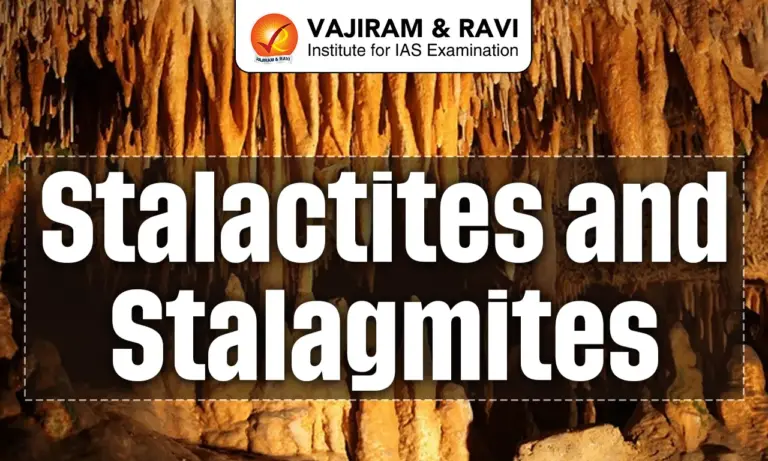
Stalactites and stalagmites are natural mineral formations found inside caves, especially in limestone regions. They are formed when water carrying dissolved minerals slowly drips and deposits material over thousands of years. These formations are part of cave deposits called Speleothems.
Stalactites hang from the ceiling, while stalagmites grow upward from the ground. Both are formed through Chemical Weathering and deposition.
Stalactites
A stalactite is a formation that hangs from the ceiling of caves, mines, and even man-made structures like bridges. These structures form due to dripping water carrying minerals that get deposited over time. Stalactites are not limited to limestone caves. They may be composed of different materials such as:
- Sand
- Lava
- Mud
- Peat
- Pitch
- Minerals
- Amberat and sinter
Any material that is soluble, can melt, or can remain suspended in water (colloidal form) has the potential to form stalactites. However, the most common type of stalactites are found in limestone caves because limestone dissolves easily in water. These are known as speleothem stalactites.
Also Read: Lightning Formation
Stalagmites
Stalagmites are natural mineral formations that rise from the floor of caves due to the gradual accumulation of minerals deposited by dripping water. They are most commonly found in limestone caves and are mainly composed of calcium carbonate.
- Formation Process: Stalagmites form when water droplets containing dissolved minerals fall from cave ceilings. As the water hits the ground, it loses carbon dioxide and deposits calcium carbonate, leading to gradual buildup.
- Growth Direction: They always grow upward from the cave floor, unlike stalactites which hang downward.
- Material Composition: Mainly composed of calcium carbonate, but can also include materials like sand, lava, mud, peat, pitch, and other mineral deposits.
- Shape and Structure: Typically thick, rounded, or dome-shaped because the mineral spreads out as it accumulates on the ground.
- Growth Rate: Extremely slow growth, usually less than 1 mm per year, depending on water supply and mineral content.
Source of Formation: Directly linked to stalactites, as the dripping water from stalactites above leads to the formation of stalagmites below. - Types of Stalagmites: Include limestone stalagmites, lava stalagmites, ice stalagmites, and concrete-derived stalagmites.
- Joining with Stalactites: Over long periods, stalagmites may grow tall enough to meet stalactites, forming a column or pillar.
- Occurrence: Found mainly in karst regions, where limestone rocks are easily dissolved by water, leading to cave formation.





Karst Topography
Karst topography is a unique type of landscape formed due to the dissolution of soluble rocks such as limestone, dolomite, and gypsum by slightly acidic water. This process creates underground drainage systems, caves, sinkholes, and other distinctive landforms. Stalactites and stalagmites develop within these karst caves, making karst regions very important for understanding cave formations and geological processes.
Main Process: Formed by Chemical Weathering, where carbonic acid in water dissolves calcium carbonate in rocks.
Rock Types Involved:
- Limestone (most common)
- Dolomite
- Gypsum
Key Landforms:
- Sinkholes (Dolines): Depressions formed due to collapse of underground cavities
- Caves and Caverns: Formed by continuous dissolution of rock
- Disappearing Streams: Rivers that flow underground
- Limestone Pavements: Flat surfaces with cracks (clints and grikes)
- Underground Drainage Systems: Lack of surface rivers
Drainage Pattern: Water mainly flows underground, making surface water bodies rare.
Soil and Vegetation: Thin soil cover and limited vegetation due to poor water retention.
Also Read: Hailstorm Formation
Karst Topography Role
Karst topography plays a very important role in shaping underground landscapes and in the formation of cave features like stalactites and stalagmites.
- Formation of Caves: Karst processes dissolve limestone rocks and create caves and caverns, which act as the natural environment where stalactites and stalagmites form.
- Underground Drainage System: Water flows below the surface through cracks and fissures, carrying dissolved minerals necessary for speleothem formation.
- Supply of Mineral-rich Water: Rainwater absorbs carbon dioxide and becomes slightly acidic, dissolving calcium carbonate and transporting it into caves.
- Deposition of Minerals: Inside caves, the water loses carbon dioxide and deposits calcium carbonate, leading to the gradual formation of stalactites and stalagmites.
- Creation of Ideal Conditions: Karst regions provide stable temperature, high humidity, and slow water movement, perfect conditions for slow mineral deposition.
- Development of Unique Landforms: Features like sinkholes, dolines, and underground channels are formed, supporting the entire cave ecosystem.
- Indicator of Geological Activity: Shows continuous interaction between water and rock over thousands of years.

 Last updated on April, 2026
→ UPSC Final Result 2025 is now out.
→ UPSC has released UPSC Toppers List 2025 with the Civil Services final result on its official website.
→ Anuj Agnihotri secured AIR 1 in the UPSC Civil Services Examination 2025.
→ UPSC Marksheet 2025 is now out.
→ UPSC Notification 2026 & UPSC IFoS Notification 2026 is now out on the official website at upsconline.nic.in.
→ UPSC Calendar 2026 has been released.
→ Check out the latest UPSC Syllabus 2026 here.
→ UPSC Prelims 2026 will be conducted on 24th May, 2026 & UPSC Mains 2026 will be conducted on 21st August 2026.
→ The UPSC Selection Process is of 3 stages-Prelims, Mains and Interview.
→ Prepare effectively with Vajiram & Ravi’s UPSC Prelims Test Series 2026 featuring full-length mock tests, detailed solutions, and performance analysis.
→ Enroll in Vajiram & Ravi’s UPSC Mains Test Series 2026 for structured answer writing practice, expert evaluation, and exam-oriented feedback.
→ Join Vajiram & Ravi’s Best UPSC Mentorship Program for personalized guidance, strategy planning, and one-to-one support from experienced mentors.
→ Shakti Dubey secures AIR 1 in UPSC CSE Exam 2024.
→ Also check Best UPSC Coaching in India
Stalactites and Stalagmites FAQs
Q1. What are stalactites and stalagmites?+
Q2. What is the main difference between stalactites and stalagmites?+
Q3. How are stalactites and stalagmites formed?+
Q4. What are they made of?+
Q5. How long do they take to grow?+
Tags: geography stalactites and stalagmites