About Standardised Precipitation Index:
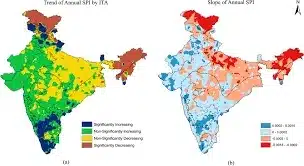
- It is used for estimating wet or dry condition based on precipitation variable.
- The SPI calculation is based on the long-term precipitation record for a particular location and long-term period (longer than 30 years is desirable).
- This index is negative for drought and positive for wet conditions. As the dry or wet conditions become more severe, the index becomes more negative or positive respectively.
- Time scale: It includes timescales of 1, 2, 3, 6, 9, 12, 24, 36, 48, 60 and 72 months.
Key points about India Meteorological Department
- It was established in 1875. It is the National Meteorological Service of the country and the principal government agency in all matters relating to meteorology and allied subjects.
- There are 6 Regional Meteorological Centres, each under a Deputy Director General with headquarters at Mumbai, Chennai, New Delhi, Calcutta, Nagpur and Guwahati.
- Mandate:
- To take meteorological observations and to provide current and forecast meteorological information for optimum operation of weather-sensitive activities like agriculture, irrigation, shipping, aviation, offshore oil explorations, etc.
- To warn against severe weather phenomena like tropical cyclones, norwesters, dust storms, heavy rains and snow, cold and heat waves, etc., which cause destruction of life and property.
- To provide meteorological statistics required for agriculture, water resource management, industries, oil exploration and other nation-building activities.
- To conduct and promote research in meteorology and allied disciplines.
- Nodal ministry: Ministry of Earth Sciences (MoES)
- Headquarter: New Delhi.
Q1: What is Precipitation?
It is any liquid or frozen water that forms in the atmosphere and falls back to the earth. It comes in many forms, like rain, sleet, and snow. Along with evaporation and condensation, precipitation is one of the three major parts of the global water cycle.
Source: Environmental hazards in the North-Eastern States






 Last updated on March, 2026
→ UPSC Final Result 2025 is now out.
→ UPSC has released UPSC Toppers List 2025 with the Civil Services final result on its official website.
→ Anuj Agnihotri secured AIR 1 in the UPSC Civil Services Examination 2025.
→ UPSC Marksheet 2025 is now out.
→ UPSC Notification 2026 & UPSC IFoS Notification 2026 is now out on the official website at upsconline.nic.in.
→ UPSC Calendar 2026 has been released.
→ Check out the latest UPSC Syllabus 2026 here.
→ UPSC Prelims 2026 will be conducted on 24th May, 2026 & UPSC Mains 2026 will be conducted on 21st August 2026.
→ The UPSC Selection Process is of 3 stages-Prelims, Mains and Interview.
→ Prepare effectively with Vajiram & Ravi’s UPSC Prelims Test Series 2026 featuring full-length mock tests, detailed solutions, and performance analysis.
→ Enroll in Vajiram & Ravi’s UPSC Mains Test Series 2026 for structured answer writing practice, expert evaluation, and exam-oriented feedback.
→ Join Vajiram & Ravi’s Best UPSC Mentorship Program for personalized guidance, strategy planning, and one-to-one support from experienced mentors.
→ Shakti Dubey secures AIR 1 in UPSC CSE Exam 2024.
→ Also check Best UPSC Coaching in India