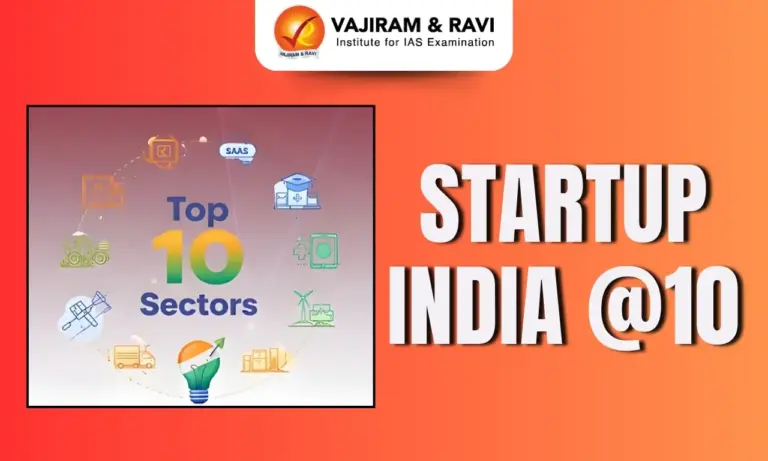
Startup India @10 Latest News
- On January 16, 2025 (National Startup Day), the Prime Minister of India addressed the startup ecosystem on the 10th anniversary of the Startup India scheme, launched on January 16, 2016.
- He highlighted record growth in startup registrations, changing attitudes towards risk-taking, and India’s ambition for global leadership in deep tech and indigenous AI.
The Startup India Scheme
- It is a flagship Government of India initiative, launched in 2016, to foster a robust ecosystem for innovation and entrepreneurship, transforming India into a nation of job creators through support pillars:
- Simplification & Handholding,
- Funding Support, and
- Incubation & Industry-Academia Partnership.
- It offers benefits like tax exemptions, easier compliance, seed funding, and mentorship to eligible startups, promoting economic growth and large-scale job creation.





Key Highlights of Startup India’s Decade-long Journey
- Record growth in startup ecosystem:
- Nearly 44,000 startups registered in 2025 — highest annual addition since inception. India is now the 3rd largest startup ecosystem globally.
- Growth trajectory: Less than 500 startups, and 4 unicorns in 2014. Over 2 lakh DPIIT-recognised startups, and about 125 active unicorns in 2025.
- Impact: Startups → Unicorns → IPOs → creates a virtuous cycle of job creation, and innovation-led growth.
- Cultural shift – Mainstreaming risk-taking:
- Risk-taking is now socially accepted and respected, unlike earlier stigma. Shift from job-seeking mindset to job-creating mindset.
- Expansion of entrepreneurship beyond elite families to middle class and poor – boosting entrepreneurial culture, risk capital, and demographic dividend.
- Government support and funding ecosystem:
- ₹25,000 crore invested via Fund of Funds for Startups (FFS).
- Fund of Funds 2.0 (₹10,000 crore) approved in April 2025 to focus on deep tech sectors (Artificial Intelligence (AI), Machine Learning, Quantum technologies, Defence & Aerospace).
- Objective: To provide patient risk capital due to long gestation periods.
- Strategic focus on indigenous AI and manufacturing:
- PM’s call for indigenous AI solutions developed by Indian talent and hosted on Indian servers (data sovereignty).
- IndiaAI Mission: 38,000+ GPUs onboarded to democratise access to computing power.
- Emphasis on: Manufacturing, global-standard products, and leadership in new technologies (not mere partnerships) – boosting strategic autonomy, economic security, and data sovereignty.
- Inclusivity in the startup revolution:
- Women-led startups: For example, over 45% recognised startups have at least one woman director/partner. India is the 2nd largest ecosystem of women-led startups globally.
- Geographical spread: Rapid rise in tier-2, tier-3 cities and rural areas. Focus on solving local and grassroots problems – promoting inclusive growth, women entrepreneurship, and regional balance.
- Regulatory reforms and ease of doing business:
- Jan Vishwas Act: Decriminalised over 180 provisions – promoting Ease of Doing Business, and trust-based governance.
- Key enablers: Self-certification under multiple laws, simplified mergers and exits, and reduction in Inspector Raj.
- Innovation ecosystem strengthened through Atal Tinkering Labs, hackathons, and incubation support.
- Sectoral breakthroughs enabled by policy support:
- Defence and space: iDEX enabled startup participation in defence procurement. The space sector opened to private players, with about 200 space startups gaining global approvals.
- Drone sector: Removal of outdated rules unlocked innovation.
- Government e-Marketplace (GeM): Nearly 35,000 startups and small businesses are onboarded on GeM, and have received more than 5 lakh orders worth over Rs 50,000 crore, highlighting public procurement reforms.
Challenges and Way Ahead
- Sustaining funding: During global economic uncertainties. Expand access to risk capital and advanced infrastructure (GPUs, labs).
- Bridging deep tech talent and R&D gaps: Strengthen deep tech ecosystems through academia–industry collaboration. Integrate startups with national missions (AI, defence, space, climate tech).
- Ensuring quality scale-up: Enhance domestic manufacturing under startup-led innovation.
- Managing cybersecurity: Ensuring data governance in AI-driven growth.
- Avoiding regional and sectoral concentration: Focus on export-oriented and globally competitive startups.
Conclusion
- As India marks a decade of the Startup India Initiative, the country’s startup ecosystem stands at an inflection point – moving decisively from rapid expansion to sustainable scale and deeper integration with the real economy.
- It represents not merely scale, but structural transformation built on demographic advantage, digital public infrastructure, and a sustained reform agenda.
- As India advances towards a $7.3 trillion economy by 2030 and the broader vision of Viksit Bharat 2047, startups are poised to remain central to the country’s development trajectory.

 Last updated on April, 2026
→ UPSC Final Result 2025 is now out.
→ UPSC has released UPSC Toppers List 2025 with the Civil Services final result on its official website.
→ Anuj Agnihotri secured AIR 1 in the UPSC Civil Services Examination 2025.
→ UPSC Marksheet 2025 is now out.
→ UPSC Notification 2026 & UPSC IFoS Notification 2026 is now out on the official website at upsconline.nic.in.
→ UPSC Calendar 2026 has been released.
→ Check out the latest UPSC Syllabus 2026 here.
→ UPSC Prelims 2026 will be conducted on 24th May, 2026 & UPSC Mains 2026 will be conducted on 21st August 2026.
→ The UPSC Selection Process is of 3 stages-Prelims, Mains and Interview.
→ Prepare effectively with Vajiram & Ravi’s UPSC Prelims Test Series 2026 featuring full-length mock tests, detailed solutions, and performance analysis.
→ Enroll in Vajiram & Ravi’s UPSC Mains Test Series 2026 for structured answer writing practice, expert evaluation, and exam-oriented feedback.
→ Join Vajiram & Ravi’s Best UPSC Mentorship Program for personalized guidance, strategy planning, and one-to-one support from experienced mentors.
→ Shakti Dubey secures AIR 1 in UPSC CSE Exam 2024.
→ Also check Best UPSC Coaching in India
Startup India @10 FAQs
Q1. How has the Startup India scheme transformed India’s entrepreneurial ecosystem over the last decade?+
Q2. Why is the government focusing on deep-tech startups under the Fund of Funds 2.0?+
Q3. What is the significance of indigenous AI development for India’s economic and strategic security?+
Q4. How has regulatory reform contributed to the success of India’s startup ecosystem?+
Q5. What is the role of inclusivity in strengthening India’s startup revolution?+
Tags: mains articles startup india @10 upsc current affairs upsc mains current affairs