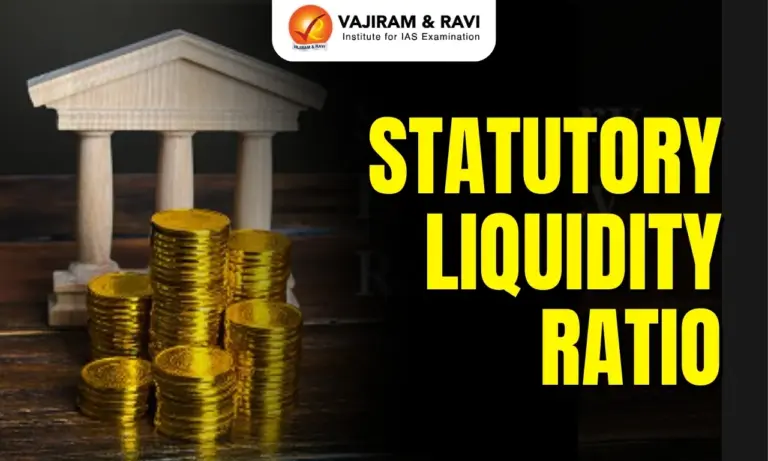
The Statutory Liquidity Ratio (SLR) is the minimum percentage of a commercial bank’s deposits that must be maintained in the form of cash, gold, or government-approved securities. It is mandated by the Reserve Bank of India (RBI) to regulate liquidity and ensure financial stability. The main objectives of SLR are to control credit flow, manage inflation, and ensure the solvency of banks. Its major components include liquid assets and Net Demand and Time Liabilities (NDTL) of banks.
What is Statutory Liquidity Ratio?
The Statutory Liquidity Ratio (SLR) is the minimum percentage of a bank’s Net Demand and Time Liabilities (NDTL) that must be maintained in the form of liquid assets such as cash, gold, or government securities. It is prescribed by the Reserve Bank of India (RBI) as a tool of monetary policy. Unlike CRR, SLR is maintained by banks with themselves and not with the RBI. SLR helps control credit growth, ensure bank solvency, and maintain liquidity in the economy.
Statutory Liquidity Ratio (SLR) Objectives
The Statutory Liquidity Ratio is maintained to regulate the lending capacity of banks and ensure financial stability in the economy. By mandating banks to hold a portion of deposits in liquid assets, RBI controls credit flow and inflation.
- To prevent excessive credit creation and over-lending by banks
- To control inflation by restricting liquidity during inflationary periods
- To encourage banks to invest in government securities
- To ensure solvency and financial stability of banks
- To regulate money supply as a tool of monetary policy





Major Components of Statutory Liquidity Ratio
The Statutory Liquidity Ratio is calculated based on a bank’s Net Demand and Time Liabilities (NDTL) and the liquid assets it holds. These components together determine the minimum liquidity that banks must maintain as prescribed by the RBI.
- Liquid Assets: Assets that can be easily converted into cash, including cash balances, gold, treasury bills, government bonds, government-approved securities, and securities issued under Market Stabilisation Scheme (MSS) and market borrowing programmes.
- Net Demand and Time Liabilities (NDTL): Total liabilities of a bank payable to the public.
- Demand Liabilities: Current deposits, demand drafts, balances in overdue fixed deposits, and the demand portion of savings bank deposits.
- Time Liabilities: Fixed deposits, time portion of savings bank deposits, and staff security deposits.
Difference Between Cash Reserve Ratio (CRR) and Statutory Liquidity Ratio (SLR)
Cash Reserve Ratio and Statutory Liquidity Ratio are quantitative monetary policy tools used by the RBI to control liquidity and credit creation in the banking system. The Difference Between Cash Reserve Ratio (CRR) and Statutory Liquidity Ratio (SLR) have been highlighted below:
| Difference Between Cash Reserve Ratio (CRR) and Statutory Liquidity Ratio (SLR) | ||
| Basis of Difference | Cash Reserve Ratio (CRR) | Statutory Liquidity Ratio (SLR) |
|
Full Form |
Cash Reserve Ratio |
Statutory Liquidity Ratio |
|
Maintained With |
Reserve Bank of India |
Bank itself |
|
Form of Reserve |
Cash only |
Cash, gold, and government securities |
|
Interest Earnings |
No interest earned |
Interest earned on government securities |
|
Objective |
Control liquidity in the banking system |
Control credit expansion and ensure solvency |
|
Effectiveness |
More effective liquidity control tool |
Relatively less effective than CRR |
|
Legal Provision |
RBI Act, 1934 |
Banking Regulation Act, 1949 |

 Last updated on March, 2026
→ UPSC Final Result 2025 is now out.
→ UPSC has released UPSC Toppers List 2025 with the Civil Services final result on its official website.
→ Anuj Agnihotri secured AIR 1 in the UPSC Civil Services Examination 2025.
→ UPSC Marksheet 2025 is now out.
→ UPSC Notification 2026 & UPSC IFoS Notification 2026 is now out on the official website at upsconline.nic.in.
→ UPSC Calendar 2026 has been released.
→ Check out the latest UPSC Syllabus 2026 here.
→ UPSC Prelims 2026 will be conducted on 24th May, 2026 & UPSC Mains 2026 will be conducted on 21st August 2026.
→ The UPSC Selection Process is of 3 stages-Prelims, Mains and Interview.
→ Prepare effectively with Vajiram & Ravi’s UPSC Prelims Test Series 2026 featuring full-length mock tests, detailed solutions, and performance analysis.
→ Enroll in Vajiram & Ravi’s UPSC Mains Test Series 2026 for structured answer writing practice, expert evaluation, and exam-oriented feedback.
→ Join Vajiram & Ravi’s Best UPSC Mentorship Program for personalized guidance, strategy planning, and one-to-one support from experienced mentors.
→ Shakti Dubey secures AIR 1 in UPSC CSE Exam 2024.
→ Also check Best UPSC Coaching in India
Statutory Liquidity Ratio FAQs
Q1. What is Statutory Liquidity Ratio (SLR)?+
Q2. Who decides the SLR in India?+
Q3. How is SLR different from CRR?+
Q4. Which banks are required to maintain SLR?+
Q5. What is the current SLR rate in India?+
Tags: statutory liquidity ratio