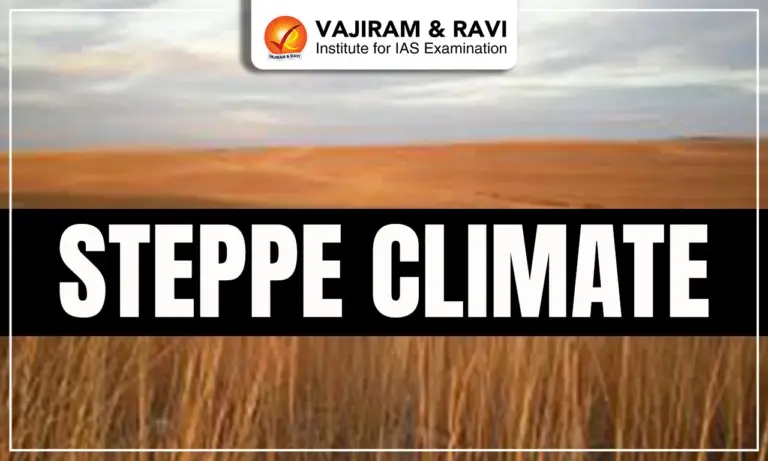
The Steppe Climate represents a type of temperate grassland climate found primarily in the westerly wind belt. Characterized by low precipitation, extreme temperature variations, and vast treeless plains, it supports grasslands that are ideal for pastoralism, nomadic herding, and cereal cultivation. The steppe climate is an essential ecological zone in Eurasia and other continental interiors, often referred to as the “granaries of the world” due to extensive wheat production. In this article, we are going to cover Steppe Climate, its distribution, vegetation and economic relevance.
Steppe Climate Region
The Steppe Climate defines a unique ecological and economic zone characterized by:
- Treeless grasslands with seasonal variations
- Continental temperature extremes and low precipitation
- Vegetation dominated by hardy grasses suitable for grazing
- Economic activities spanning nomadic herding, wheat cultivation, and livestock rearing
From the Eurasian Steppes to the Pampas, these regions play a pivotal role in sustaining livelihoods, national economies, and global food security. Their combination of agricultural productivity and pastoral potential makes the steppe climate both ecologically significant and economically indispensable.
Read About: Equatorial Climate
Steppe Climate Distribution
Steppe climates are typically continental, occurring far from oceanic influences. They are found between 40° and 55° latitude in both hemispheres. Their global distribution includes:
- Eurasian Steppes: Russia, Kazakhstan, Ukraine, and Hungary (Pustaz)
- North American Prairies: United States and southern Canada
- South American Pampas: Argentina and Uruguay
- Southern African Velds: Bushveld in the north and Highveld in the south
- Australian Downs and Canterbury Plains in New Zealand
The defining characteristic of steppe regions is their treeless grasslands, although trees may appear along rivers or in wetter poleward zones where the steppe transitions into wooded landscapes.





Steppe Climate Region Map
Here is a geographical representation of Steppe Climate on the Map:
Steppe Climate Characteristics
Steppe Climate has the following characteristics:
Temperature
- The steppe climate experiences distinct seasonal variations:
- Summers: Warm to hot, often exceeding 30°C.
- Winters: Cold in the northern hemisphere with snow cover lasting several months; mild in the southern hemisphere due to maritime moderation.
- Continentality: Northern Eurasian steppes exhibit extreme annual temperature ranges. For instance, Winnipeg in Canada experiences a range far exceeding that of Pretoria, South Africa.
- Southern hemisphere steppes have mild winters, with temperatures rarely dropping below freezing. Cities like Johannesburg, Buenos Aires, and Mildura exemplify this moderated climate. Oceans play a critical role in tempering temperatures, preventing severe winter extremes.
Precipitation
- Steppe climates receive low to moderate rainfall, typically 25–75 cm annually, which is insufficient for forests but adequate for grasslands. Rainfall patterns vary:
- Summer Rains: Generated by convection over heated continental interiors, contributing to crop growth.
- Winter Precipitation: Minimal, occasionally influenced by westerly depressions.
- Southern Hemisphere Influence: Warm ocean currents enhance rainfall, often exceeding 50 cm annually in regions like Buenos Aires, supporting livestock grazing.
- Some steppe regions adjacent to deserts, such as Australia, face pronounced dry seasons, affecting agricultural and pastoral activities.
Local Winds and Temperature Moderation
- Local winds, such as Chinook winds on the eastern slopes of the Rockies, play a vital role in steppe climates. These warm, dry winds:
- Accelerate snowmelt on pastures
- Increase temperatures rapidly (up to 5°C in 20 minutes)
- Promote early grazing and agricultural activity
- Similar to the Fohn winds of Switzerland, these winds contribute to the economic viability of steppe regions.
Steppe Climate Vegetation
Steppe regions are dominated by grasses, which vary in height and density depending on rainfall and soil fertility:
- Sparse Grasslands: Common in the drier continental interiors; ideal for ranching rather than arable farming.
- Seasonal Changes:
- Summer: Grasses may yellow or brown due to heat and evaporation.
- Autumn: Vegetation withers and enters dormancy; snow cover may appear.
- Spring: Renewal of growth resumes the cycle, supporting livestock grazing.
- Scarcity of Trees: Limited rainfall and harsh winters restrict tree growth. Only along rivers and watercourses do trees like willows, poplars, or alders appear. In wetter poleward areas, steppe transitions into wooded steppes, eventually supporting conifers.
Read About: Tropical Climate
Economic Activities in Steppe Climate Regions
Steppe climates provide ideal conditions for a combination of agriculture and pastoralism.
1. Nomadic Herding
Steppe regions supported nomadic tribes, including Kirghiz, Kazakhs, and Kalmuks, who moved seasonally in search of grass and water for their cattle, sheep, goats, and horses.
- Grazing and animal husbandry remain important for livelihoods.
- Nomadic lifestyles have declined due to modernization but continue in some regions.
2. Extensive Cereal Farming
Steppe regions are renowned for wheat cultivation, benefiting from:
- Flat Terrain: Facilitates mechanized agriculture.
- Seasonal Rainfall: Supports grain development during ripening.
- “Granaries of the World”: Areas like the Eurasian Steppes, Canadian Prairies, and Pampas produce significant portions of global wheat.
Winter Wheat: Suitable for colder regions with snow cover.
Spring Wheat: Suitable for milder climates, such as Canada’s Prairies.
Plant Breeding: Cold-resistant varieties extend cultivation into previously unsuitable northern areas.
3. Pastoral Farming and Ranching
Steppe grasslands are ideal for livestock rearing due to nutritious grasses:
- Cattle, Sheep, Horses, and Pigs: Thrive in temperate conditions.
- Export Potential: Pampas and Great Plains became major beef, mutton, and wool exporters.
- Livestock Improvement: Introduction of alfalfa and European breeds enhanced productivity.
- Industrial Linkages: Large ranches in Pampas connect with meat-packing factories and ports, supporting global trade.
4. Mechanization and Food Security
Mechanized agriculture has transformed steppe regions into major contributors to global food supply:
- Flat plains facilitate ploughing, sowing, and harvesting with machinery.
- Large-scale wheat production supports national food security.
- Grazing and pastoral activities complement agriculture, providing meat, wool, and hides for export and local use.
| Also Check Other Posts | |
| Coastal Regulation Zone | Global Plastic Treaty |
| Nitrogen Cycle | Carbon Cycle |

 Last updated on March, 2026
→ UPSC Final Result 2025 is now out.
→ UPSC has released UPSC Toppers List 2025 with the Civil Services final result on its official website.
→ Anuj Agnihotri secured AIR 1 in the UPSC Civil Services Examination 2025.
→ UPSC Marksheet 2025 is now out.
→ UPSC Notification 2026 & UPSC IFoS Notification 2026 is now out on the official website at upsconline.nic.in.
→ UPSC Calendar 2026 has been released.
→ Check out the latest UPSC Syllabus 2026 here.
→ UPSC Prelims 2026 will be conducted on 24th May, 2026 & UPSC Mains 2026 will be conducted on 21st August 2026.
→ The UPSC Selection Process is of 3 stages-Prelims, Mains and Interview.
→ Prepare effectively with Vajiram & Ravi’s UPSC Prelims Test Series 2026 featuring full-length mock tests, detailed solutions, and performance analysis.
→ Enroll in Vajiram & Ravi’s UPSC Mains Test Series 2026 for structured answer writing practice, expert evaluation, and exam-oriented feedback.
→ Join Vajiram & Ravi’s Best UPSC Mentorship Program for personalized guidance, strategy planning, and one-to-one support from experienced mentors.
→ Shakti Dubey secures AIR 1 in UPSC CSE Exam 2024.
→ Also check Best UPSC Coaching in India
Steppe Climate FAQs
Q1. What is the climate in the steppes?+
Q2. Which country has a steppe climate?+
Q3. What type of climate is the steppe climate in India?+
Q4. Which states in India have Steppe Climate?+
Q5. What are the characteristics of Steppe Climate?+
Tags: steppe climate