Stingless Bees Latest News
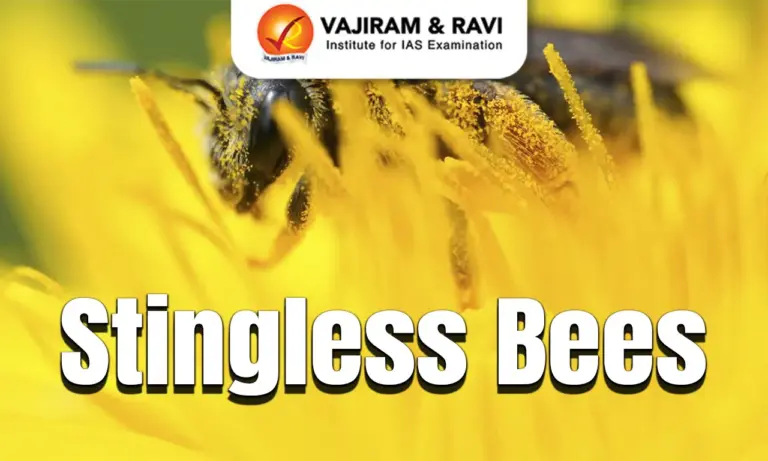
Amazonian stingless bees have become the first insect in the world to be granted legal rights, after two municipalities — Satipo and Nauta — in Peru passed an ordinance earlier this month.
About Stingless Bees
- Stingless Bees are a class of bees which either do not have stingers or have stingers that cannot cause much pain.
- Common genera of stingless bees: Austroplebeia, Melipona, and Tetragonula
- They do possess stingers, but they are too small to be useful in defense. Instead of stinging, stingless bees use their mandibles to bite their attackers.
- Stingless bees are among the planet’s oldest pollinators, with a remarkable concentration of species in the Amazon rainforest.
- Distribution: They are found in tropical regions across the world, and about half of the 500 known species live in the Amazon.
- Africa, Australia, Southeast Asia, and parts of the Americas are the main areas where the stingless bee is found.
- In India, these bees are reported primarily from the northeastern, eastern, and southern Indian States.
- Benefits: Stingless bees can be used for pollination without fear of being stung. They are known for their popular medicinal honey and pollination potential.
- Threats: Deforestation has reduced nesting sites, while pesticide use, climate change and competition from invasive honeybees have further weakened populations.
Source: IE






 Last updated on March, 2026
→ UPSC Final Result 2025 is now out.
→ UPSC has released UPSC Toppers List 2025 with the Civil Services final result on its official website.
→ Anuj Agnihotri secured AIR 1 in the UPSC Civil Services Examination 2025.
→ UPSC Marksheet 2025 is now out.
→ UPSC Notification 2026 & UPSC IFoS Notification 2026 is now out on the official website at upsconline.nic.in.
→ UPSC Calendar 2026 has been released.
→ Check out the latest UPSC Syllabus 2026 here.
→ UPSC Prelims 2026 will be conducted on 24th May, 2026 & UPSC Mains 2026 will be conducted on 21st August 2026.
→ The UPSC Selection Process is of 3 stages-Prelims, Mains and Interview.
→ Prepare effectively with Vajiram & Ravi’s UPSC Prelims Test Series 2026 featuring full-length mock tests, detailed solutions, and performance analysis.
→ Enroll in Vajiram & Ravi’s UPSC Mains Test Series 2026 for structured answer writing practice, expert evaluation, and exam-oriented feedback.
→ Join Vajiram & Ravi’s Best UPSC Mentorship Program for personalized guidance, strategy planning, and one-to-one support from experienced mentors.
→ Shakti Dubey secures AIR 1 in UPSC CSE Exam 2024.
→ Also check Best UPSC Coaching in India
Stingless Bees FAQs
Q1. Where are Stingless Bees primarily found?+
Q2. What is the primary role of Stingless Bees in ecosystems?+
Tags: stingless bees