Strait of Hormuz Disruption Latest News
- The growing conflict involving Iran, the United States, and Israel has disrupted oil and gas movement through the Strait of Hormuz, a key global energy corridor.
- Following US and Israeli strikes on Iran, Tehran retaliated by targeting Gulf countries hosting American military facilities. Iran’s Islamic Revolutionary Guards Corps reportedly sent messages to vessels claiming the strait had been closed, although no formal announcement was made.
- Even without an official blockade, many trading houses, insurers, and shipping companies have suspended operations in the area. Reports suggest that hundreds of oil tankers are currently anchored in Gulf waters, reflecting heightened uncertainty and risk in the region.
Strategic Importance of the Strait
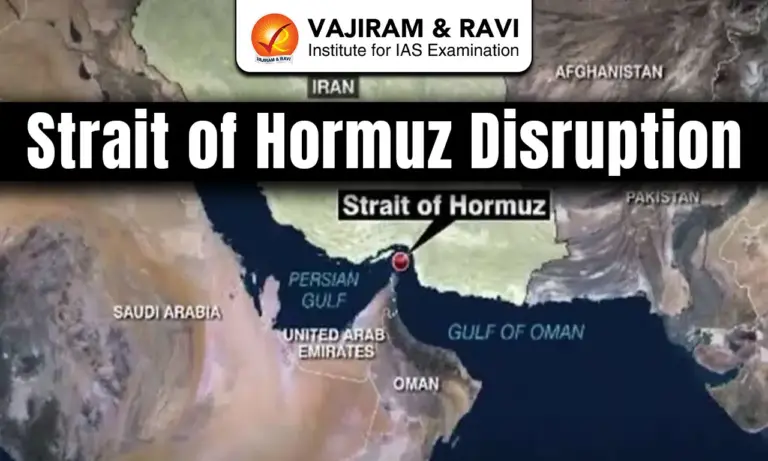
- The Strait of Hormuz is the world’s most critical oil transit chokepoint.
- It connects the Persian Gulf with the Gulf of Oman and handles about one-fifth of global petroleum and LNG trade. Around 15 million barrels of crude pass through it daily.
- Even if alternative Gulf pipelines operate at full capacity, a significant portion of global supply would remain at risk if the strait is closed.





Impact of Strait of Hormuz Disruption on India
- Any suspension or major curtailment of oil and gas flows through the Strait of Hormuz will affect global energy markets, including India, which relies heavily on this route for imports.
- Experts believe the disruption may not last long, but the longer it continues, the greater the impact on prices and supply.
- India is relatively well positioned to manage a short-term shock in crude oil supplies because it can source oil from alternative markets. However, it will likely face higher energy prices.
- The challenge is more serious for liquefied petroleum gas (LPG) and liquefied natural gas (LNG), where India’s dependence on the Strait is higher.
- In these cases, India may struggle both to secure supplies and to manage rising import costs.
India’s Near-Term Options Amid Strait of Hormuz Disruption
- About half of India’s crude oil imports — roughly 2.5–2.7 million barrels per day — pass through the strait. India imports over 88% of its crude oil and depends heavily on West Asia for both oil and gas.
- India is the world’s third-largest oil consumer, making uninterrupted energy flows vital for its economy.
Crude Oil: Short-Term Cushion
- Indian refiners hold more than 10 days of crude inventory and about a week’s worth of fuel stocks.
- India also maintains strategic petroleum reserves that can be tapped in an emergency.
- India can diversify supplies by increasing imports from Russia, the United States, West Africa, and Latin America. Russian cargoes, including those in floating storage, offer flexibility.
- This diversified sourcing strategy reduces the risk of a prolonged crude supply crisis, though prices may rise.
LPG: The Bigger Vulnerability
- India imports 80–85% of its LPG needs, mostly from Gulf suppliers via the Strait of Hormuz. Unlike crude oil, India does not maintain large strategic LPG reserves.
- This makes LPG flows more vulnerable in case of prolonged disruption, as structural buffers are limited.
LNG: Limited Safety Net
- Around 60% of India’s LNG imports pass through the strait. Similar to LPG, there are no strong structural reserves.
- Spot cargo availability for LNG is limited compared to crude oil. If the strait remains closed for long, securing LNG supplies could become difficult.
Likely Duration and Price Impact of Hormuz Disruption
- As tensions between the US and Iran escalated, Brent crude prices rose above $72 per barrel, the highest level since late July last year.
- With further military escalation, the “war premium” in oil prices could increase when markets reopen.
Price Outlook Depends on Conflict Duration
- The future direction of oil prices will depend on how long the conflict continues and whether energy flows through the Strait of Hormuz remain disrupted.
- In a scenario of prolonged regional conflict and sustained supply disruption, oil prices could rise above $100 per barrel.
Why a Full Closure Is Unlikely
- Although Iran has often threatened to close the Strait of Hormuz, it has never done so.
- Gulf energy producers, including Iran itself, rely heavily on uninterrupted exports through the strait for revenue.
- This mutual dependence reduces the likelihood of a long-term, complete shutdown.
Source: IE

 Last updated on April, 2026
→ UPSC Final Result 2025 is now out.
→ UPSC has released UPSC Toppers List 2025 with the Civil Services final result on its official website.
→ Anuj Agnihotri secured AIR 1 in the UPSC Civil Services Examination 2025.
→ UPSC Marksheet 2025 is now out.
→ UPSC Notification 2026 & UPSC IFoS Notification 2026 is now out on the official website at upsconline.nic.in.
→ UPSC Calendar 2026 has been released.
→ Check out the latest UPSC Syllabus 2026 here.
→ UPSC Prelims 2026 will be conducted on 24th May, 2026 & UPSC Mains 2026 will be conducted on 21st August 2026.
→ The UPSC Selection Process is of 3 stages-Prelims, Mains and Interview.
→ Prepare effectively with Vajiram & Ravi’s UPSC Prelims Test Series 2026 featuring full-length mock tests, detailed solutions, and performance analysis.
→ Enroll in Vajiram & Ravi’s UPSC Mains Test Series 2026 for structured answer writing practice, expert evaluation, and exam-oriented feedback.
→ Join Vajiram & Ravi’s Best UPSC Mentorship Program for personalized guidance, strategy planning, and one-to-one support from experienced mentors.
→ Shakti Dubey secures AIR 1 in UPSC CSE Exam 2024.
→ Also check Best UPSC Coaching in India
Strait of Hormuz Disruption FAQs
Q1. Why is Strait of Hormuz disruption important for India?+
Q2. How much global oil trade passes through the Strait of Hormuz?+
Q3. Is India prepared for a Strait of Hormuz disruption?+
Q4. Why are LPG and LNG more vulnerable during Strait of Hormuz disruption?+
Q5. Could oil prices cross $100 due to Strait of Hormuz disruption?+
Tags: mains articles Strait of Hormuz Disruption upsc current affairs upsc mains current affairs