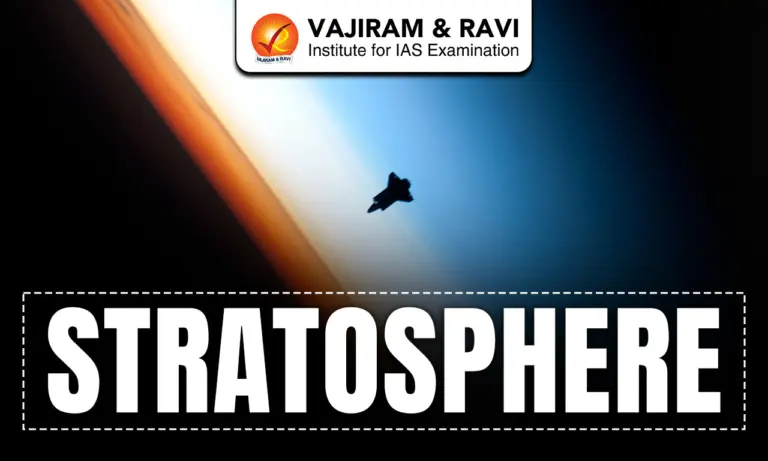
The Stratosphere is the second lowest layer of Earth’s atmosphere. It is situated above the troposphere and below the mesosphere. The term comes from Ancient Greek “strōtós” meaning layer. It is characterized by stratified temperature zones where temperature increases with altitude due to absorption of ultraviolet radiation by the ozone layer, creating a temperature inversion unlike the cooling pattern seen in the troposphere.
Stratosphere Features
The Stratosphere is a stable atmospheric layer with distinct thermal structure, strong winds and vital ozone chemistry that supports life on Earth.
- Location: The Stratosphere lies above the troposphere, starting around 20 km at the equator and extending up to about 50 km near the stratopause.
- Temperature: Temperatures rise from about -51°C near the tropopause to around -15°C near the mesosphere, reaching nearly 270 K at the top due to ozone absorbing ultraviolet radiation.
- Dry and Stable Nature: Air entering the Stratosphere is freeze dried, making it extremely dry with minimal water vapor. This dryness leads to very few clouds and almost no weather phenomena.
- Stratopause: The stratopause marks the upper boundary of the Stratosphere, above which temperature again decreases with altitude as the mesosphere begins.
- Tropopause: The tropopause marks the lower boundary of the Stratosphere, acting as a temperature minimum zone and separating decreasing temperature trends below from increasing trends above.
- Ozone Layer Presence: Around 90% of atmospheric ozone exists here, mainly between 15-35 km. Ozone absorbs harmful UV radiation and converts it into heat, making this layer essential for protecting life on Earth.
- Winds: Stratospheric winds can reach 60 m/s, especially in the Southern polar vortex, with seasonal variations causing extremely low temperatures during polar winters.
- Aviation Significance: Aircraft cruise at 9-12 km in the lower Stratosphere to avoid turbulence, benefiting from low air density and stable conditions that improve fuel efficiency and flight speed.
- Seasonal Variations: Temperatures vary with seasons, with extremely low values during polar winters. Phenomena like quasi-biennial oscillation, sudden stratospheric warming and planetary wave breaking influence weather patterns and cause rapid atmospheric changes at mid latitudes.
- Life: Despite extreme dryness and low pressure, bacterial life has been detected at about 41 km altitude, confirming that the stratosphere is part of the biosphere.
Also Read: Composition and Structure of Atmosphere






 Last updated on March, 2026
→ UPSC Final Result 2025 is now out.
→ UPSC has released UPSC Toppers List 2025 with the Civil Services final result on its official website.
→ Anuj Agnihotri secured AIR 1 in the UPSC Civil Services Examination 2025.
→ UPSC Marksheet 2025 is now out.
→ UPSC Notification 2026 & UPSC IFoS Notification 2026 is now out on the official website at upsconline.nic.in.
→ UPSC Calendar 2026 has been released.
→ Check out the latest UPSC Syllabus 2026 here.
→ UPSC Prelims 2026 will be conducted on 24th May, 2026 & UPSC Mains 2026 will be conducted on 21st August 2026.
→ The UPSC Selection Process is of 3 stages-Prelims, Mains and Interview.
→ Prepare effectively with Vajiram & Ravi’s UPSC Prelims Test Series 2026 featuring full-length mock tests, detailed solutions, and performance analysis.
→ Enroll in Vajiram & Ravi’s UPSC Mains Test Series 2026 for structured answer writing practice, expert evaluation, and exam-oriented feedback.
→ Join Vajiram & Ravi’s Best UPSC Mentorship Program for personalized guidance, strategy planning, and one-to-one support from experienced mentors.
→ Shakti Dubey secures AIR 1 in UPSC CSE Exam 2024.
→ Also check Best UPSC Coaching in India
Stratosphere FAQs
Q1. What is the Stratosphere? +
Q2. Why does temperature increase in the Stratosphere? +
Q3. What is the importance of the ozone layer in the Stratosphere? +
Q4. Why are there no clouds in the Stratosphere? +
Q5. Why do aircraft fly in the Stratosphere? +
Tags: geography stratosphere