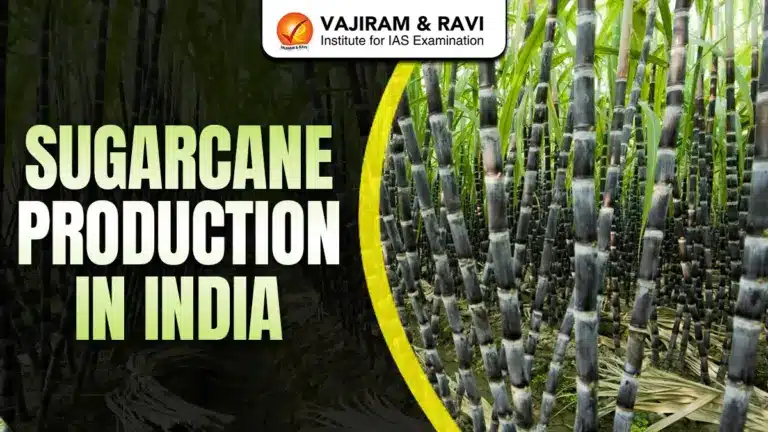
Sugarcane is one of the most important commercial and industrial crops in India. India ranks second in the world after Brazil in sugarcane production. It forms the backbone of the sugar industry and is closely linked with ethanol production, power generation, and rural employment. Nearly 50 million farmers and workers depend directly or indirectly on sugarcane-based activities.
Sugarcane Production in India
India produces around 490–500 million tonnes of sugarcane annually from about 5.5 million hectares of cultivated area. Sugarcane Production in India contributes significantly to agricultural GDP and plays a key role in ensuring energy security through ethanol blending. Its long growing period and multiple uses make it economically valuable but resource-intensive.
Also Read: Rice Cultivation in India
Climatic Requirements for Sugarcane
Sugarcane is a tropical and sub-tropical crop that requires hot, humid conditions during growth and cooler, dry weather during ripening for high sugar accumulation. A long frost-free period with adequate sunlight and moisture is essential for healthy cane development and good sugar recovery.
- Temperature: Prefers 20–30°C for overall growth; 12–14°C during ripening helps increase sucrose content
- Rainfall: Requires 75–150 cm annually, mainly during the growing phase; low rainfall during maturity is desirable
- Sunlight: Needs bright sunshine for efficient photosynthesis and sugar formation
- Humidity: Hot and humid climate supports vegetative growth
- Frost/Cold: Highly sensitive to frost and prolonged low temperatures, which reduce yield and damage the crop.
Climate needs at different growth stages:
- Germination/Sprouting: Warm soil conditions, ideally 32–38°C, ensure good sprouting
- Active Growth (Tillering & Elongation): Hot, humid, and rainy conditions promote rapid vegetative growth
- Ripening (Maturity): Cool, dry, sunny days with cool nights are ideal for maximum sugar (sucrose) accumulation





Cropping Seasons of Sugarcane in India
Sugarcane is mainly grown in Autumn, Spring, Adsali (Preseasonal), and Eksali seasons. North India largely follows autumn and spring planting, while southern states practice long-duration crops.
| Cropping Season and Varieties of Sugarcane | ||||
| Cropping Season | Planting Months | Major Regions | Crop Duration | Features |
|
Autumn |
October–November |
North India |
12 months |
Slow growth in winter, rapid growth in spring; higher yield |
|
Spring |
February–March (sometimes up to April–May) |
North India |
6–8 months |
Shorter duration; delayed planting reduces yield |
|
Adsali / Preseasonal |
July–August |
South India |
15–18 months |
Long-duration crop; higher biomass and yield |
|
Eksali |
January–February |
South India |
12 months |
One-year crop, widely practiced |
Also Read: Wheat Cultivation in India
Varieties of Sugarcane in India
India grows a wide range of sugarcane varieties suited for high yield, sugar recovery, and jaggery production. Selection depends on climate, soil, and end use.
| Varieties of Sugarcane in India | ||
| Category | Major Varieties | Characteristics |
|
General / High Yield |
Co 86032 (Nayana), Co 0238 (Karan 4), Co 94012, Co 8014 |
High productivity, good sugar recovery |
|
Jaggery (Gur) Production |
CoG 6, Co 0212, Co 06022, Co 11015 |
Higher sucrose content, good for gur making |
|
Early Season (Dec–Jan) |
CoC 25, CoG 6, Co 09004 |
Early maturity, suitable for short seasons |
|
Mid–Late Season (Feb–Mar) |
Co 86032, Co 06030, Co 0212 |
Longer growth period, higher yields |
Method of Cultivation of Sugarcane in India
Sugarcane cultivation in India involves a series of well-defined stages, from land preparation to harvesting, and combines traditional practices with modern techniques.
- Land preparation: Fields are deeply ploughed 2–3 times and leveled to make the soil loose and well-aerated. Proper drainage is ensured to avoid waterlogging, which is harmful to sugarcane roots.
- Seed material selection: Healthy, disease-free cane setts are selected from approved varieties. Traditionally, 2–3 bud setts are used, requiring a large quantity of seed cane.
- Bud chip settlings method: Single buds are removed from cane and raised in a nursery. These settlings are later transplanted into the main field, leading to substantial saving in seed material, uniform crop stand, and better germination.
- Tissue culture planting: Sugarcane can also be cultivated using settlings prepared from tissue culture, which are genetically uniform and disease-free, resulting in higher yield and better sugar recovery.
- Planting methods: Furrow method is most common in irrigated areas; trench and ring pit methods are used in high rainfall or water-scarce regions to improve moisture use and root growth.
- Spacing and planting depth: Proper row spacing allows better sunlight penetration, aeration, and nutrient absorption, leading to healthier crop growth.
- Irrigation management: Sugarcane requires frequent irrigation, especially during tillering and elongation stages. Drip irrigation is increasingly adopted to save water and improve efficiency.
- Nutrient management: Adequate application of organic manure, nitrogen, phosphorus, and potassium is essential for sustained growth and high yield.
- Harvesting: The crop is harvested at full maturity when sugar content is highest, usually 10–18 months after planting, depending on the variety and season.
Major Sugarcane Producing States in India
Sugarcane cultivation in India is mainly concentrated in the Northern and Southern belts due to suitable climate, fertile soils, and irrigation facilities. Uttar Pradesh is the largest producer by area, while Maharashtra, Karnataka, and Tamil Nadu are leading producers with higher productivity.
| Major Sugarcane Producing States in India | ||
| Region / Belt | State | Features |
|
Northern Belt |
Uttar Pradesh |
Largest producer in India; maximum area under sugarcane; fertile alluvial soil and canal irrigation |
|
Bihar |
Important eastern producer; revival of sugar mills; expanding cultivated area |
|
|
Punjab |
High yield due to intensive farming and assured irrigation |
|
|
Haryana |
Good productivity; well-developed irrigation facilities |
|
|
Southern Belt |
Maharashtra |
High productivity; strong cooperative sugar industry; large number of sugar mills |
|
Karnataka |
Modern sugar mills; improved irrigation and technology adoption |
|
|
Tamil Nadu |
Highest productivity per hectare; favorable climate and efficient water use |
|
|
Andhra Pradesh |
Cultivation in irrigated and delta regions |
|
|
Telangana |
Growing production with command-area irrigation |
|
|
Western Belt |
Gujarat |
Efficient sugar cooperatives; high sugar recovery rates |
Economic Importance of Sugarcane in India
- Sugarcane is one of India’s most important commercial and industrial crops, contributing significantly to the agricultural economy.
- It supports the sugar industry, which is among the largest agro-based industries and has strong linkages with transport, packaging, and marketing sectors.
- The crop provides direct livelihood to millions of farmers and employment to workers in sugar mills, distilleries, and power plants.
- Sugarcane is the main raw material for ethanol production, playing a crucial role in the ethanol blending programme and helping reduce crude oil imports.
- Bagasse, a by-product of sugarcane, is widely used for electricity generation, promoting renewable and clean energy.
- Molasses derived from sugarcane supports the alcohol, pharmaceutical, and chemical industries.
- Production of jaggery (gur) and khandsari supports rural and small-scale industries and provides income to local farmers.
- The sugarcane sector encourages the growth of cooperative institutions, especially in states like Maharashtra and Gujarat.
- Sugar exports and ethanol-related products contribute to foreign exchange earnings.
- Overall, sugarcane cultivation promotes rural development, industrial growth, and energy security in India.
Also Read: Millets in India
Government Policies and Support Mechanisms
- Fair and Remunerative Price (FRP): The government fixes FRP annually to protect farmers from price fluctuations; it is linked to sugar recovery rates, ensuring better returns for higher-quality cane.
- State Advised Price (SAP): States like Uttar Pradesh announce SAP, which is often higher than FRP, to provide additional income support to farmers.
- Ethanol Blending Programme (EBP): Promotes diversion of sugarcane and molasses for ethanol; blending targets have increased steadily, helping reduce surplus sugar and saving foreign exchange on fuel imports.
- Interest Subvention Scheme: Provides subsidized loans to sugar mills to clear cane arrears, improving timely payments to farmers.
- Buffer Stock Scheme: The government supports maintenance of buffer stock to stabilize sugar prices during surplus production years.
- Export Assistance Measures: Export incentives and policy support help dispose of excess sugar in international markets and prevent domestic price crashes.
- Support for Ethanol Distilleries: Financial assistance is provided to set up and expand ethanol production capacity from sugarcane-based feedstock.
Fair and Remunerative Price (FRP)
- The Fair and Remunerative Price (FRP) for sugarcane is fixed every year by the Union government (Cabinet Committee on Economic Affairs (CCEA) on the basis of recommendations of the Commission for Agricultural Costs and Prices (CACP) before the start of the crushing season.
- While determining FRP, factors such as cost of production of sugarcane, return to farmers, domestic and international sugar prices, demand–supply situation, and inter-crop price parity are considered.
- Sugar recovery rate is an important parameter; higher recovery attracts a premium over the base FRP, encouraging quality production.
- The final FRP is notified under the Sugarcane (Control) Order, making it mandatory for sugar mills to pay farmers at least this price.
- The FRP acts as a minimum guaranteed price, protecting farmers from market volatility and ensuring stable income.
Challenges in Sugarcane Production in India
- High water requirement: Sugarcane is a water-intensive crop, leading to over-extraction of groundwater, especially in water-stressed regions.
- Delayed payment to farmers: Financial stress in sugar mills often results in cane arrears, affecting farmers’ income security.
- Low mechanisation: Manual harvesting dominates, increasing labour costs and reducing efficiency.
- Pests and diseases: Attacks such as red rot, borers, and wilt reduce yield and sugar recovery.
- Rising input costs: High expenditure on seeds, fertilisers, labour, and irrigation lowers profitability.
- Price volatility: Cyclical surplus and deficit in sugar production cause unstable prices.
- Environmental concerns: Excessive use of water and fertilisers degrades soil health and ecosystems.
- Climate variability: Irregular rainfall and temperature extremes affect productivity and crop quality.
Way Forward
- Promote water-efficient irrigation: Expanding drip irrigation can reduce water use in sugarcane cultivation by 30–40% while maintaining or increasing yields, as seen in states like Maharashtra.
- Encourage crop diversification: In water-stressed regions, shifting part of the area from sugarcane to less water-intensive crops can reduce pressure on groundwater.
- Strengthen ethanol production: Achieving the 20% ethanol blending (E20) target will absorb surplus sugarcane, stabilize prices, and save billions in fuel import costs.
- Improve mechanization: Increasing the use of mechanical harvesters can reduce labor costs and improve efficiency, especially in large farms.
- Develop climate-resilient varieties: Investment in research can produce drought- and disease-resistant sugarcane varieties to cope with climate variability.
- Ensure timely payments: Financial reforms and better mill management can help clear cane arrears, improving farmer income security.
UPSC CSE Prelims PYQs
Q.1 The Fair and Remunerative Price (FRP) of sugarcane is approved by the (2015)
(a) Cabinet Committee on Economic Affairs
(b) Commission for Agricultural Costs and Prices
(c) Directorate of Marketing and Inspection, Ministry of Agriculture
(d) Agricultural Produce Market Committee
Ans: (a)
Q.2 With reference to the current trends in the cultivation of sugarcane in India, consider the following statements: (2020)
- A substantial saving in seed material is made when ‘bud chip settlings’ are raised in a nurse and transplanted in the main field.
- When direct planting of setts is done, the germination percentage is better with single-budded setts as compared to setts with many buds.
- If bad weather conditions prevail when setts are directly planted, single-budded setts have better survival as compared to large setts
- Sugarcane can be cultivated using settlings prepared from tissue culture.
Which of the statements given above is/are correct?
(a) 1 and 2 only
(b) 3 only
(c) 1 and 4 only
(d) 2, 3 and 4 only
Ans: (c)

 Last updated on March, 2026
→ UPSC Final Result 2025 is now out.
→ UPSC has released UPSC Toppers List 2025 with the Civil Services final result on its official website.
→ Anuj Agnihotri secured AIR 1 in the UPSC Civil Services Examination 2025.
→ UPSC Marksheet 2025 is now out.
→ UPSC Notification 2026 & UPSC IFoS Notification 2026 is now out on the official website at upsconline.nic.in.
→ UPSC Calendar 2026 has been released.
→ Check out the latest UPSC Syllabus 2026 here.
→ UPSC Prelims 2026 will be conducted on 24th May, 2026 & UPSC Mains 2026 will be conducted on 21st August 2026.
→ The UPSC Selection Process is of 3 stages-Prelims, Mains and Interview.
→ Prepare effectively with Vajiram & Ravi’s UPSC Prelims Test Series 2026 featuring full-length mock tests, detailed solutions, and performance analysis.
→ Enroll in Vajiram & Ravi’s UPSC Mains Test Series 2026 for structured answer writing practice, expert evaluation, and exam-oriented feedback.
→ Join Vajiram & Ravi’s Best UPSC Mentorship Program for personalized guidance, strategy planning, and one-to-one support from experienced mentors.
→ Shakti Dubey secures AIR 1 in UPSC CSE Exam 2024.
→ Also check Best UPSC Coaching in India
Sugarcane Production in India FAQs
Q1. What is the position of India in global sugarcane production?+
Q2. How much rainfall is required for sugarcane cultivation?+
Q3. Which state is the largest producer of sugarcane in India?+
Q4. Why is sugarcane considered a water-intensive crop?+
Q5. What are the main by-products of sugarcane?+
Tags: sugarcane production in india