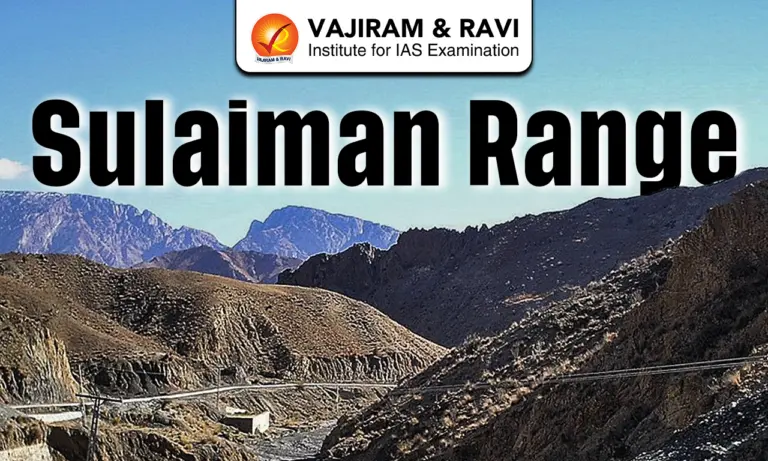
The Sulaiman Range is a major mountain system forming a north-south extension of the southern Hindu Kush in western Pakistan and eastern Afghanistan. It marks the eastern edge of the Iranian plateau and spans about 6,475 km². It stretches from Kandahar, Zabul and Paktia to southwestern Punjab. It separates the Indus plains from highlands and plays a key role in regional geography, climate and tectonic structure.
Sulaiman Range Features
The Sulaiman Range is a structurally complex mountain belt with significant geographical, geological and climatic importance across Pakistan and Afghanistan.
- Location: The Sulaiman Range is located in western Pakistan and eastern Afghanistan, extending across Kandahar, Zabul and Paktia provinces into Waziristan, Kurram, northern Balochistan and southwestern Punjab near the Indus River.
- Extent: The range stretches about 280 miles (450 km) from the Gomal Pass in Khyber Pakhtunkhwa to near Jacobabad in Sindh, further extending into southwestern Punjab along the Indus River.
- Boundary Formation: It forms the eastern boundary of the Iranian plateau, with the Indus River plains to the east and Central Hindu Kush highlands rising up to 3,383 m in the north.
- Major Peaks: The highest peak is Zarghun Ghar at 3,578 m near Quetta, followed by Takht-e-Sulaiman (3,487 m) and Khilafat Hill (3,475 m) in Ziarat District.
- Takht-e-Sulaiman: It is located near Darazinda, this twin-peaked mountain is historically important and associated with cultural and legendary references, making it a prominent landmark of the range.
- Geological Formation: The range formed around 30 million years ago due to the collision of the Indian Plate with the Eurasian Plate, creating a fold and thrust belt with complex fault systems.
- Tectonic Features: It includes stacked thrust faults and imbricate rock formations, capable of generating doublet earthquakes such as the 1997 Harnai earthquake with magnitudes 7.1 and 6.8.
- Climate Influence: The range acts as a natural barrier blocking moist winds from the Indian Ocean, leading to arid conditions in southern and central Afghanistan while supporting contrasting environments near the Indus basin.
- River Systems: Important rivers include the Gomal River flowing into the Indus and the Dori River draining southwest into the Helmand River through tributaries of the Arghandab system.
- Vegetation Patterns: Northern areas have juniper and edible pines, central parts contain olives, while southern sections remain sparsely vegetated due to arid climatic conditions.
- Mountain Passes: Key passes include Ghat, Zao, Chuhar Khel Dhana and Sakhi Sarwar, while Fort Munro at 1,921 m serves as an important hill station in the southern region.






 Last updated on March, 2026
→ UPSC Final Result 2025 is now out.
→ UPSC has released UPSC Toppers List 2025 with the Civil Services final result on its official website.
→ Anuj Agnihotri secured AIR 1 in the UPSC Civil Services Examination 2025.
→ UPSC Marksheet 2025 is now out.
→ UPSC Notification 2026 & UPSC IFoS Notification 2026 is now out on the official website at upsconline.nic.in.
→ UPSC Calendar 2026 has been released.
→ Check out the latest UPSC Syllabus 2026 here.
→ UPSC Prelims 2026 will be conducted on 24th May, 2026 & UPSC Mains 2026 will be conducted on 21st August 2026.
→ The UPSC Selection Process is of 3 stages-Prelims, Mains and Interview.
→ Prepare effectively with Vajiram & Ravi’s UPSC Prelims Test Series 2026 featuring full-length mock tests, detailed solutions, and performance analysis.
→ Enroll in Vajiram & Ravi’s UPSC Mains Test Series 2026 for structured answer writing practice, expert evaluation, and exam-oriented feedback.
→ Join Vajiram & Ravi’s Best UPSC Mentorship Program for personalized guidance, strategy planning, and one-to-one support from experienced mentors.
→ Shakti Dubey secures AIR 1 in UPSC CSE Exam 2024.
→ Also check Best UPSC Coaching in India
Sulaiman Range FAQs
Q1. Where is the Sulaiman Range located?+
Q2. What is the highest peak of the Sulaiman Range?+
Q3. Why is the Sulaiman Range geologically important?+
Q4. How does the Sulaiman Range affect climate?+
Q5. Which rivers originate from the Sulaiman Range?+
Tags: geography geography notes sulaiman range