What’s in today’s article?
- Why in News?
- About the demand for grants
- News Summary
Why in News?
- The Government of India recently sought an additional ₹3 lakh-plus crore as supplementary demands for grants for 2022-23.
About the demand for grants:
Definition of demand of grants:
- Demand for grants are estimates of expenditure from the Consolidated Fund of India that are included in the annual financial statement (Budget) and must be voted on in the Lok Sabha.
- These grants are submitted in pursuance of Article 113 (Procedure in Parliament with respect to estimates) of the Indian Constitution.
Description of demand of grants:
- It includes provisions with respect to revenue expenditure, capital expenditure, grants to State and UT governments together with loans and advances.
- In general, one demand for grant is submitted for each ministry or department. However, multiple demands are provided for large ministries and departments.
Types of demand for grants:
- Article 115 of the Indian Constitution provides for Supplementary, additional or excess grants.
- Supplementary grants: The President shall cause to be laid before both Houses of Parliament a demand, if the amount authorized under Article 114 (Appropriation Bills) is found to be insufficient for the purposes.
- Additional grants: When a need has arisen for additional expenditure upon some new service not contemplated in the Budget, the President shall cause to be laid before both Houses of Parliament such demand.
- Excess grants: Similarly, if any money has been spent on any service in excess of the amount granted for that service, the President shall cause to be laid before both Houses of Parliament showing a demand for excess grants.





What is the difference between supplementary and excess grants?
- The Supplementary grants are presented to and passed by the House before the end of the financial year and no discussion can be raised on the original grants.
- While the demands for excess grants are made after the expenditure has actually been incurred and after the financial year to which it relates and members can point out how money has been spent unnecessarily.
- The Comptroller and Auditor General (CAG) of India bring such excesses to the notice of the Parliament.
- The Public Accounts Committee (PAC) examines these excesses and gives recommendations to the Parliament.
- Example: During the Covid-19 pandemic, the government has sought Parliamentary approval for a supplementary grant of ₹2.35 lakh crore for 2020-21, to meet additional expenditures on –
- Pradhan Mantri Garib Kalyan Yojana,
- Aatmanirbhar Bharat stimulus package,
- Grants-in-aid for the State Disaster Response Funds,
- Recapitalization of public sector banks etc.
News Summary:
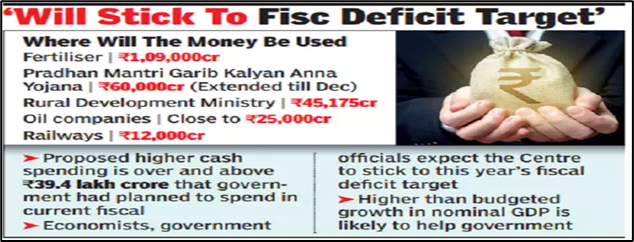
Image Caption: Plan to use supplementary grants
- The cost of the war in Ukraine is showing its impact on the Centre’s budget as the subsidy bill has shot up significantly.
- The government has sought additional grants primarily to fund a higher subsidy bill on items such as fertilizers, food and LPG, with about 10% of the sum to further ramp up capital expenditure in sectors like roads and railways.
- While the Finance Ministry has presented to Parliament an additional gross expenditure plan of about 4.36 lakh crore, the net cash outgo is estimated to be 3.26 lakh crore, with greater receipts and savings from existing outlays totaling 1.1 lakh crore.
- According to some experts, with tax revenues projected to be higher than the Budget figure and savings likely under other heads, the supplementary demands are not going to result in a major breach of the fiscal deficit target (6.4% of GDP).
- What is also expected to help the Centre is higher than budgeted growth in nominal GDP.
Q1) What does Comptroller and Auditor General (CAG) do?
Article 149 of the Constitution provides that the Comptroller and Auditor General of India who audits receipts and expenditure of the Union and each State and the Union Territory Governments.
Q2) What are the supplementary grants?
The additional grant required to meet the required expenditure of the government is called Supplementary Grants. When grants, authorised by the Parliament, fall short of the required expenditure, an estimate is presented before the Parliament for Supplementary or Additional grants.

 Last updated on March, 2026
→ UPSC Final Result 2025 is now out.
→ UPSC has released UPSC Toppers List 2025 with the Civil Services final result on its official website.
→ Anuj Agnihotri secured AIR 1 in the UPSC Civil Services Examination 2025.
→ UPSC Marksheet 2025 is now out.
→ UPSC Notification 2026 & UPSC IFoS Notification 2026 is now out on the official website at upsconline.nic.in.
→ UPSC Calendar 2026 has been released.
→ Check out the latest UPSC Syllabus 2026 here.
→ UPSC Prelims 2026 will be conducted on 24th May, 2026 & UPSC Mains 2026 will be conducted on 21st August 2026.
→ The UPSC Selection Process is of 3 stages-Prelims, Mains and Interview.
→ Prepare effectively with Vajiram & Ravi’s UPSC Prelims Test Series 2026 featuring full-length mock tests, detailed solutions, and performance analysis.
→ Enroll in Vajiram & Ravi’s UPSC Mains Test Series 2026 for structured answer writing practice, expert evaluation, and exam-oriented feedback.
→ Join Vajiram & Ravi’s Best UPSC Mentorship Program for personalized guidance, strategy planning, and one-to-one support from experienced mentors.
→ Shakti Dubey secures AIR 1 in UPSC CSE Exam 2024.
→ Also check Best UPSC Coaching in India