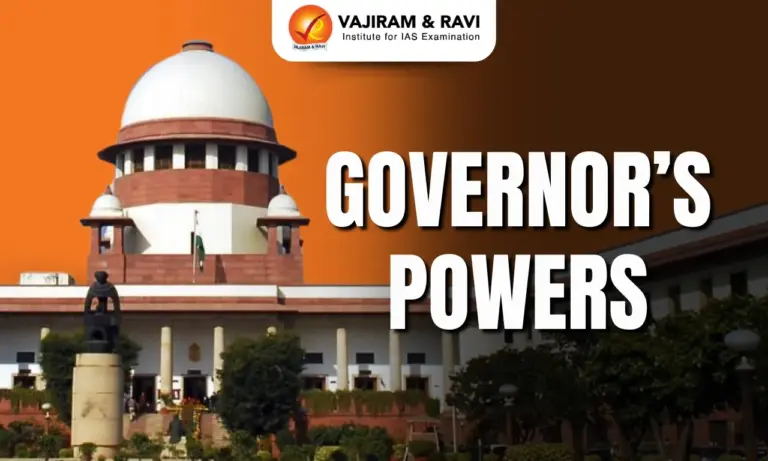
Governor’s Powers Latest News
- The Supreme Court ruled that Governors cannot hold on to state legislature Bills indefinitely, emphasising that cooperative federalism requires constructive engagement with elected governments, not obstruction.
- However, the Constitution Bench also held that courts cannot impose fixed timelines on Governors or the President for granting assent, nor can they create a doctrine of “deemed assent” or force the President to seek judicial advice on pending Bills.
- The five-judge Bench—headed by Chief Justice B R Gavai—gave this opinion on a presidential reference asking whether constitutional courts could set deadlines for action under Articles 200 and 201, which deal with gubernatorial and presidential assent to Bills.
Background of the Presidential Reference: Why the Issue Reached the Supreme Court
- President Droupadi Murmu invoked Article 143(1) to seek the Supreme Court’s advice after controversy arose over delays by Governors and the President in acting on state Bills.
- The trigger was an April 8 judgment in a Tamil Nadu case, where a two-judge Bench laid down strict timelines for Governors and the President to decide on Bills.
- It also used Article 142 and declared 10 Tamil Nadu Bills as having received “deemed assent” because the Governor had not acted for long periods.
- This unprecedented move raised constitutional concerns.
- To resolve the ambiguity, the President submitted a five-page reference with 14 key questions.
- These questions asked:
- whether courts can impose deadlines on constitutional authorities,
- whether “deemed assent” is valid, and
- what limits govern gubernatorial and presidential powers under Articles 200 and 201.





Supreme Court’s Stand on 14 Key Questions on Governor–President Powers
- Governor’s Options on Bills Under Article 200 – The Court held that a Governor has only three options: Grant assent; Reserve the Bill for the President. Withhold assent by returning the Bill for reconsideration. There is no power to withhold assent indefinitely.
- Article 200 – Governor’s Assent to State Bills
- Governor’s Discretion Under Article 200 – The Governor is not bound by the Cabinet’s advice when deciding on assent, return, or reservation of Bills. This function involves independent constitutional discretion.
- Justiciability of Governor’s Actions – Courts cannot review the merits of the Governor’s decision, but prolonged, unexplained inaction is justiciable. The Court may direct the Governor to act.
- Article 361 Immunity Not Absolute – Article 361 protects the individual Governor, not the institutional office. Immunity cannot be used to justify indefinite delays.
- Article 361 (Immunity of President and Governors) – Provides personal immunity to the President and Governors from court proceedings during their term, ensuring unhindered functioning in their constitutional roles.
- No Court-Imposed Timelines on Governor – Courts cannot prescribe deadlines for Governors to act on Bills. Article 200’s phrase “as soon as possible” does not permit fixed judicial timelines.
- President’s Discretion Under Article 201 – The President’s merit-based decision on assent or withholding assent to state Bills is not open to judicial review.
- No Timelines for President Either – Courts cannot fix time limits for the President under Article 201.
- Article 201 – President’s Assent to Reserved Bills
- President Not Required to Seek SC Opinion – The President need not consult the Supreme Court under Article 143 whenever a Bill is reserved for consideration.
- Article 143 (Presidential Reference to Supreme Court) – Allows the President to seek the Supreme Court’s advisory opinion on significant questions of law or fact. The Court’s advice is not binding; the President may accept or reject it.
- Courts Cannot Review Bills Before They Become Law – Judicial review applies only to laws, not Bills. Courts cannot examine the content or validity of a pending Bill.
- Article 142 Cannot Substitute Constitutional Powers – The Supreme Court cannot use Article 142 to create “deemed assent” or otherwise replace the Governor/President’s constitutional role.
- No Law Without Governor’s/President’s Assent – A Bill cannot become law unless the Governor or President formally grants assent.
- No Answer on Mandatory Referral Under Article 145(3) – The Court declined to answer whether all issues requiring constitutional interpretation must first be tested under Article 145(3).
- Article 145(3) (Constitution Bench Requirement) – Mandates that a Bench of at least five judges must hear cases involving substantial questions of constitutional interpretation or any Presidential Reference under Article 143.
- Scope of Article 142 – The Court refused a broad interpretation but reiterated that Article 142 cannot override the Constitution, especially requirements like legislative assent.
- Article 142 (Complete Justice Provision) – Empowers the Supreme Court to issue any order necessary to ensure complete justice in cases before it.
- On Article 131 Jurisdiction – The Court declined to answer whether Article 131 is the exclusive route for resolving Centre–State disputes.
- Article 131 (Centre–State Disputes) – Grants the Supreme Court exclusive original jurisdiction to adjudicate legal disputes between the Union and States or among States themselves.
- No Judicial Substitution of Executive Power – Reaffirming earlier answers, the Court clarified that judicial powers cannot replace or replicate constitutionally assigned executive functions.

 Last updated on March, 2026
→ UPSC Final Result 2025 is now out.
→ UPSC has released UPSC Toppers List 2025 with the Civil Services final result on its official website.
→ Anuj Agnihotri secured AIR 1 in the UPSC Civil Services Examination 2025.
→ UPSC Marksheet 2025 is now out.
→ UPSC Notification 2026 & UPSC IFoS Notification 2026 is now out on the official website at upsconline.nic.in.
→ UPSC Calendar 2026 has been released.
→ Check out the latest UPSC Syllabus 2026 here.
→ UPSC Prelims 2026 will be conducted on 24th May, 2026 & UPSC Mains 2026 will be conducted on 21st August 2026.
→ The UPSC Selection Process is of 3 stages-Prelims, Mains and Interview.
→ Prepare effectively with Vajiram & Ravi’s UPSC Prelims Test Series 2026 featuring full-length mock tests, detailed solutions, and performance analysis.
→ Enroll in Vajiram & Ravi’s UPSC Mains Test Series 2026 for structured answer writing practice, expert evaluation, and exam-oriented feedback.
→ Join Vajiram & Ravi’s Best UPSC Mentorship Program for personalized guidance, strategy planning, and one-to-one support from experienced mentors.
→ Shakti Dubey secures AIR 1 in UPSC CSE Exam 2024.
→ Also check Best UPSC Coaching in India
Governor’s Powers FAQs
Q1. What did the Supreme Court say about Governors delaying Bills?+
Q2. Can courts impose fixed timelines on Governors or the President?+
Q3. Is “deemed assent” constitutionally valid?+
Q4. Can courts review the Governor’s or President’s decisions?+
Q5. Is the Governor bound by the Council of Ministers while giving assent?+
Tags: Governor’s powers mains articles upsc current affairs upsc mains current affairs