Pollution Control Boards Environmental Compensation Latest News
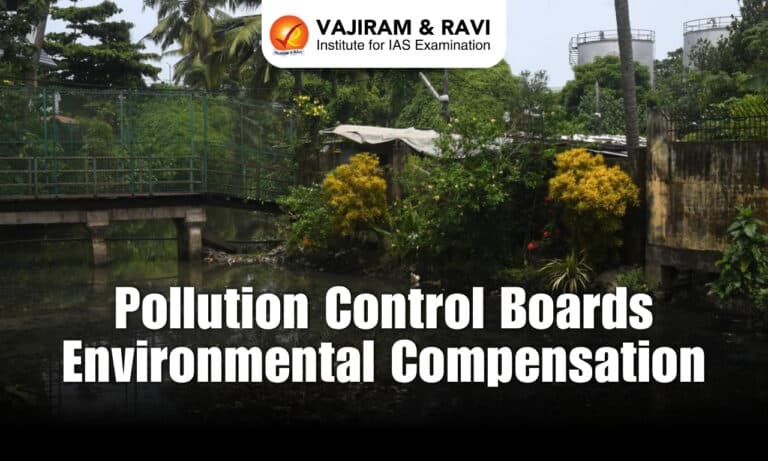
- The Supreme Court ruled that Pollution Control Boards (PCBs) are empowered to impose environmental compensation on polluting entities as part of their statutory mandate under the Water Act and Air Act.
- A bench comprising Justices PS Narasimha and Manoj Misra clarified that PCBs can demand restitutionary or compensatory damages through fixed monetary sums or bank guarantees as preventive measures against potential environmental harm.
Case Background
- The Delhi Pollution Control Committee (DPCC) challenged a 2012 Delhi High Court ruling.
- The High Court had cancelled DPCC’s notices that asked for monetary guarantees and compensation from properties without valid environmental consents.
- The High Court said only courts could impose such penalties.
- However, the Supreme Court overturned this decision. It ruled that DPCC has the authority to demand compensation as part of its regulatory powers to protect the environment.





PCBs’ Statutory Authority to Levy Compensation
- The Supreme Court expanded the powers of PCBs, affirming their authority to impose and collect restitutionary and compensatory damages for restoring polluted air and water bodies.
- The judgment clarified that PCBs can demand fixed sums of money or bank guarantees as ex-ante preventive measures under Sections 33A (Water Act, 1974) and 31A (Air Act, 1981).
Scope and Limits of Compensation Powers
- The Court cautioned that such compensation cannot be levied for every statutory violation.
- It is applicable only when actual environmental damage has occurred or is imminent.
- The Court directed that these powers must be exercised only after framing subordinate legislation (rules and regulations) under both Acts.
- These rules must ensure adherence to principles of natural justice, providing a fair process before imposing compensatory measures.
Jurisprudence Backing the Ruling
- The judgment drew on landmark cases like Vellore Citizens Welfare Forum (1996) and Indian Council for Enviro-Legal Action (1996).
- The judgements in these cases emphasized environmental restitution as a constitutional and statutory obligation, distinct from punitive sanctions.
Principles Laid Down by the Court
- The Court established key principles guiding PCBs:
- Distinction Between Remedial and Punitive Measures: Restitutionary compensation is preventive/remedial, not punitive. Fines or imprisonment are punitive and require judicial procedures.
- Non-Punitive Nature of Compensation Orders: Monetary compensation for environmental damage is not punitive if imposed under regulatory powers.
- Polluter Pays Principle: This principle is part of Indian law and applies when:
- Environmental thresholds are breached, causing damage.
- Environmental damage occurs even if thresholds are not breached.
- Potential environmental risks are identified, irrespective of breaches.
- Duty of Preventive Action: PCBs must act proactively (ex-ante), even without proven damage, using their powers under Sections 33A and 31A to avert potential environmental harm.
Broad Mandate and Regulatory Responsibilities
- The Apex Court highlighted that PCBs possess expansive regulatory powers under the Water and Air Acts, including authority to shut down industries, stop essential services, and issue remedial directions to prevent and control pollution.
- These powers come with enormous responsibilities to uphold environmental protection.
- It linked the PCBs’ duties to the State’s constitutional obligations under Article 51A (Fundamental Duties), particularly in the context of the climate crisis, stressing that water and air protection is of utmost significance.
Strengthening Remedial Jurisprudence
- The Court observed that the expansion of fundamental rights, including the right to a clean environment, must be matched by robust remedial powers.
- Merely issuing injunctions or compensatory orders is inadequate; restitutionary measures ensuring ecosystem restoration must become a key component of environmental regulation and enforcement.

 Last updated on March, 2026
→ UPSC Final Result 2025 is now out.
→ UPSC has released UPSC Toppers List 2025 with the Civil Services final result on its official website.
→ Anuj Agnihotri secured AIR 1 in the UPSC Civil Services Examination 2025.
→ UPSC Marksheet 2025 is now out.
→ UPSC Notification 2026 & UPSC IFoS Notification 2026 is now out on the official website at upsconline.nic.in.
→ UPSC Calendar 2026 has been released.
→ Check out the latest UPSC Syllabus 2026 here.
→ UPSC Prelims 2026 will be conducted on 24th May, 2026 & UPSC Mains 2026 will be conducted on 21st August 2026.
→ The UPSC Selection Process is of 3 stages-Prelims, Mains and Interview.
→ Prepare effectively with Vajiram & Ravi’s UPSC Prelims Test Series 2026 featuring full-length mock tests, detailed solutions, and performance analysis.
→ Enroll in Vajiram & Ravi’s UPSC Mains Test Series 2026 for structured answer writing practice, expert evaluation, and exam-oriented feedback.
→ Join Vajiram & Ravi’s Best UPSC Mentorship Program for personalized guidance, strategy planning, and one-to-one support from experienced mentors.
→ Shakti Dubey secures AIR 1 in UPSC CSE Exam 2024.
→ Also check Best UPSC Coaching in India
Pollution Control Boards Environmental Compensation FAQs
Q1. What powers did the Supreme Court grant Pollution Control Boards? +
Q2. When can Pollution Control Boards demand compensation?+
Q3. What principle supports environmental compensation?+
Q4. Are compensation orders punitive?+
Q5. What safeguards did the Court mandate for compensation orders?+
Tags: mains articles pollution control boards environmental compensation upsc current affairs upsc mains current affairs