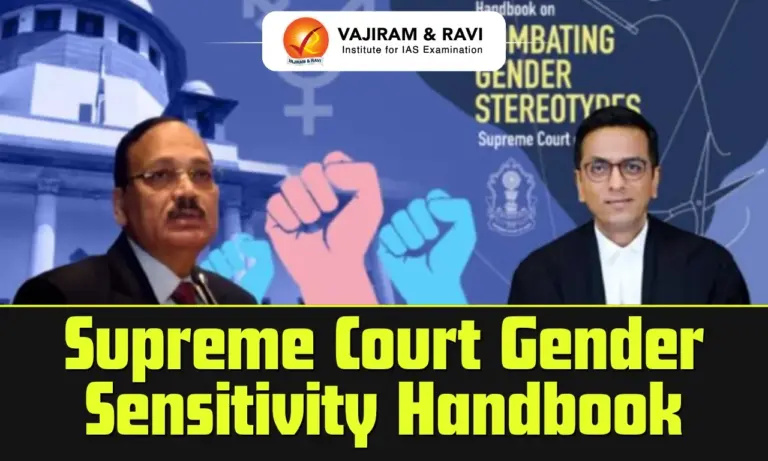
Supreme Court Gender Sensitivity Handbook Latest News
- Recently, the Supreme Court has released a new report, “Judgments and Gender: Sensitivity and Compassion in Writing Judgments“.
- It replaces the 2023 “Handbook on Combating Gender Stereotypes” issued during CJI D.Y. Chandrachud’s tenure. The new document shifts focus from correcting judicial language to reforming how courts treat victims and witnesses.
Background: Why a New Report Was Needed
- The trigger goes back to a March 2025 Allahabad High Court verdict.
- The court had ruled that acts like grabbing a woman’s breasts and loosening her pyjama string amounted only to “preparation” to commit rape, not “attempt” to rape.
- The Supreme Court took suo motu cognisance and set aside this judgment in February 2026.
- During the hearings, CJI Surya Kant questioned whether the 2023 handbook had actually helped prevent such insensitive rulings. He called it “too Harvard-oriented,” meaning too elite and theoretical for India’s ground realities.
- He said merely issuing a handbook to “sermonise” High Court judges served no purpose.
- The Court then directed the National Judicial Academy (NJA), Bhopal, to form an expert committee for practical guidelines.


Origin and Authorship of the New Handbook
- 2023 Handbook: Conceptualised during the COVID-19 pandemic by then CJI Chandrachud, prepared by the Social Justice Sub-Committee and the e-Committee of the Supreme Court.
- 2026 Report: Emerged from a suo motu writ petition after the Court noted a lack of “compassion and empathy” in the Allahabad High Court judgment. A five-member Committee of Experts, chaired by former Supreme Court judge Justice Aniruddha Bose (Director, NJA), including academics and social workers, drafted it.
Key Difference in Approach
- The 2023 handbook focused on identifying and replacing patriarchal language in judgments — a cognitive and linguistic reform.
- The 2026 report goes further. It targets actual courtroom behaviour and procedure, introducing what it calls “Compassionate Court Practices.”
- It argues judges need an “Emotional Quotient” alongside their “Intelligence Quotient” to handle cases involving crimes against women.
Methodology
- The 2023 handbook relied on doctrinal research, drawing on existing Supreme Court precedents that had already rejected gender stereotypes.
- The 2026 report is based on empirical research — analysis of 125 trial court judgments and a stakeholder questionnaire involving judges, victims, and witnesses.
- This survey found that 80.7% of respondents were unaware of the Witness Protection Scheme, 2018, directly shaping its recommendations.
Linguistic Reform: Two Different Targets
- Both handbooks provide glossaries of terms to avoid, but their focus differs:
- 2023 Handbook replaced stereotype-promoting terms:
- “Adulteress” → “woman who engaged in relations outside marriage”
- “Housewife” → “Homemaker”
- “Eve teasing” → “Street sexual harassment”
- 2026 Report replaced moralistic and dramatic courtroom phrases:
- “Body of women as playground” → “Violated bodily autonomy”
- “Destroys the very soul of a helpless woman” → “Caused severe trauma to the survivor”
- Avoids terms like “lost her chastity” and “helpless female”
- Explicitly discourages religious or cultural references such as “Where women are honoured, there the gods rejoice”
- Notably, the 2026 report also asks judges to be alert to offensive expressions in local and regional dialects, not just English or foreign legal terms — a first for such guidelines.
- 2023 Handbook replaced stereotype-promoting terms:
Compassionate Court Practices: The Core Innovation
- This is the most significant addition in the 2026 report, aimed at preventing “secondary victimisation.” Key recommendations include:
- Witness as Guest: Treating witnesses with respect so they do not “tremble on getting summons,” avoiding long waits and poor treatment that discourage testimony.
- Legal aid and support persons: Judges must proactively check if victims have legal assistance; if not, direct the District Legal Service Authority (DLSA) to ensure compliance within 48 hours. Support Persons must be available from the FIR stage onward, especially for child victims.
- Pre-trial counselling for victims to reduce anxiety before trial.
- Courtroom environment: Simple courtesies like offering a chair and water; removing unnecessary people from court during sensitive testimony.
- Controlling cross-examination: Judges must not be a “silent spectator” while victims face insulting or intimidating questioning. The report invokes the Bharatiya Sakshya Adhiniyam’s bar on indecent, scandalous, or irrelevant questions, particularly about a survivor’s sexual history.
- Privacy safeguards: In-camera trials, confidentiality of victim identity using initials or pseudonyms, and video-link testimony to avoid direct confrontation with the accused.
- Victim Compensation Scheme, 2018: Its full text is annexed for ready reference — absent in the 2023 version.
Approach to Queer Issues
- Both handbooks support non-binary inclusivity but differ in method:
- The 2023 handbook focused on debunking myths (e.g., that transgender persons cannot be raped) and offered preferred terms like “Intersex” instead of “Hermaphrodite.”
- The 2026 report introduces the SOGIESC framework (Sexual Orientation, Gender Identity, Expression and Sex Characteristics).
- It recognises “Partner” as an inclusive term extending to same-sex relationships, and flags regional terms like Hijra, Jogappa, and Thirunangai as pejorative, recommending “intersex” or “transgender” instead.
- It also includes first-hand testimony from a transgender individual on systemic discrimination faced in the justice system.
Target Audience and Intent
- The 2023 handbook was aimed primarily at judges and the legal community.
- The 2026 report is designed to be understood by laypersons, victims, and children, explicitly avoiding “foreign” legal jargon in favour of simple, accessible language.
Conclusion
- The 2026 report moves judicial reform beyond vocabulary to lived courtroom experience, embedding compassion, privacy, and dignity into trial procedure.
- By grounding guidelines in empirical data and regional realities, it aims to build a more empathetic, victim-centric criminal justice system for India.

 Last updated on Oct, 2026
→ UPSC 2027 Notification will be released on 13 January 2027 at upsconline.nic.in.
→ Asian Games 2026 are being held in Aichi-Nagoya, Japan, from 19 September to 4 October.
→ Check Nobel Prize 2026 Winners List here.
→ Download PIB PRiSM Monthly Magazine 2026 here.
→ Check UPSC Monthly Current Affairs Magazine The Recitals here.
→ Check out the latest UPSC Syllabus here.
→ Download UPSC Model Answers for Mains 2026
→ UPSC Mains Question Paper 2026 is out now for Essay & GS Paper 1, 2, 3 & 4.
→ UPSC Calendar 2027 has been released.
→ Enroll in Vajiram & Ravi’s UPSC Mains Test Series 2027 for structured answer writing practice, expert evaluation, and exam-oriented feedback.
→ Join Vajiram & Ravi’s UPSC Mentorship Program 2027 for personalized guidance, strategy planning, and one-to-one support from experienced mentors.
→ Go through the UPSC Mains Previous Year Papers to enhance your preparation.
→ UPSC has released UPSC Toppers List 2025 with the Civil Services final result on its official website.
→ Also check Best UPSC Coaching in India
Supreme Court Gender Sensitivity Handbook FAQs
Q1. What is the Supreme Court Gender Sensitivity Handbook?+
Q2. How does the Supreme Court Gender Sensitivity Handbook differ from the 2023 handbook?+
Q3. What are compassionate court practices in the Supreme Court Gender Sensitivity Handbook?+
Q4. How does the Supreme Court Gender Sensitivity Handbook address LGBTQIA+ issues?+
Q5. Why is the Supreme Court Gender Sensitivity Handbook significant?+
Tags: mains articles Supreme Court Gender Sensitivity Handbook upsc current affairs upsc mains current affairs