Prevention of Corruption Act Latest News
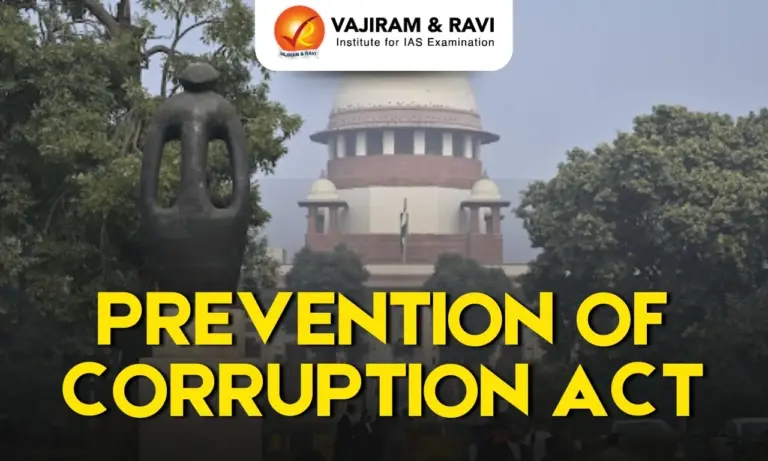
- The Supreme Court of India delivered a split verdict on the constitutional validity of Section 17A of the Prevention of Corruption Act, 1988 (PC Act).
- The provision, introduced through the 2018 Amendment, mandates prior approval/sanction before initiating enquiry or investigation against public servants for decisions taken in the discharge of official duties.
- The challenge was filed by Centre for Public Interest Litigation (CPIL), arguing that the provision shields corruption and undermines accountability.
- Given the divergence of views, the matter has been referred to the Chief Justice of India (CJI) for the constitution of a larger Bench.
What is Section 17A of the PC Act
- It requires prior approval from the competent authority before conducting any inquiry or investigation against a public servant for actions taken in official capacity.
- Objective (as per government):
- Protect honest officers
- Prevent frivolous, vexatious complaints
- Avoid policy paralysis





Divergent Judicial Opinions
- Justice B.V. Nagarathna: (Section 17A is illegal, unequal, arbitrary, and unconstitutional)
- Violates Article 14 (Right to Equality): Protection effectively extends only to higher civil servants involved in decision-making. Classification based on “nature of duties” has no rational nexus with the object of the Act.
- Arbitrary and against Rule of Law: Forecloses even a preliminary enquiry without prior approval. Prevents discovery of truth and shields wrongdoing.
- Contrary to the object of the PC Act: Anti-corruption law aims to detect and punish corruption, not delay or prevent investigation. Provision “protects the corrupt rather than the honest”.
- Policy paralysis argument rejected: Instead of protecting honest officers, Section 17A may embolden mala fide decision-making. Honest officials do not require such statutory protection.
- Justice K.V. Viswanathan: (Section 17A is constitutionally valid [with safeguards])
- Possibility of misuse cannot be equated to unconstitutionality: Striking down the provision would be like “throwing the baby out with the bathwater”.
- Need to prevent policy paralysis: Fear of instant FIRs and coercive investigations may lead to “Play-it-safe syndrome”, administrative inertia.
- Fine balance required: Between protecting officials from mala fide prosecution, and ensuring probity in public life.
- Danger of immediate investigations: Without prior screening, even frivolous complaints could trigger FIRs and arrests. Such a regime would be regressive.
- Independent screening mechanism suggested:
- Approval should depend on recommendations of an independent authority such as Lokpal (at Centre), Lokayukta (in States).
- Lokpal has authority to inquire even against the Prime Minister.
- Independent inquiry into facts should precede sanction.
Key Constitutional and Governance Issues Involved
- Article 14 – Equality Before Law: Whether selective protection to higher officials amounts to hostile discrimination.
- Rule of Law: Does requiring prior approval subordinate investigation to executive discretion?
- Separation of Powers: Extent of executive control over criminal investigation.
- Accountability vs administrative autonomy: Tension between effective governance, and anti-corruption enforcement.
Challenges Highlighted and Way Ahead
- Shielding corruption: Delay or denial of approval may stall investigations indefinitely. Prevent indefinite delays in granting or refusing sanction.
- Executive interference: Sanctioning authority may be influenced by political or bureaucratic considerations. Statutory role for Lokpal/Lokayukta in sanction decisions. Preliminary scrutiny to assess genuineness of complaint.
- Unequal protection: Lower-level officials face immediate scrutiny, higher officials enjoy insulation. Authoritative ruling to resolve constitutional conflict.
- Erosion of public trust: Perception that anti-corruption law favours the powerful. Parliament may revisit Section 17A to align it with constitutional principles, anti-corruption objectives.
Conclusion
- The split verdict on Section 17A of the Prevention of Corruption Act reflects a deeper constitutional dilemma—how to protect honest decision-making without weakening the fight against corruption.
- While one view sees the provision as a shield for the corrupt, the other considers it a necessary safeguard against governance paralysis, subject to independent oversight.
- The final word now rests with a larger Bench of the Supreme Court, whose decision will significantly shape the future of anti-corruption jurisprudence, administrative accountability, and rule of law in India.

 Last updated on April, 2026
→ UPSC Final Result 2025 is now out.
→ UPSC has released UPSC Toppers List 2025 with the Civil Services final result on its official website.
→ Anuj Agnihotri secured AIR 1 in the UPSC Civil Services Examination 2025.
→ UPSC Marksheet 2025 is now out.
→ UPSC Notification 2026 & UPSC IFoS Notification 2026 is now out on the official website at upsconline.nic.in.
→ UPSC Calendar 2026 has been released.
→ Check out the latest UPSC Syllabus 2026 here.
→ UPSC Prelims 2026 will be conducted on 24th May, 2026 & UPSC Mains 2026 will be conducted on 21st August 2026.
→ The UPSC Selection Process is of 3 stages-Prelims, Mains and Interview.
→ Prepare effectively with Vajiram & Ravi’s UPSC Prelims Test Series 2026 featuring full-length mock tests, detailed solutions, and performance analysis.
→ Enroll in Vajiram & Ravi’s UPSC Mains Test Series 2026 for structured answer writing practice, expert evaluation, and exam-oriented feedback.
→ Join Vajiram & Ravi’s Best UPSC Mentorship Program for personalized guidance, strategy planning, and one-to-one support from experienced mentors.
→ Shakti Dubey secures AIR 1 in UPSC CSE Exam 2024.
→ Also check Best UPSC Coaching in India
Prevention of Corruption Act FAQs
Q1. What are the constitutional concerns regarding the Section 17A of the Prevention of Corruption Act, 1988?+
Q2. How does the requirement of prior sanction under Section 17A impact the principle of rule of law?+
Q3. How was ‘policy paralysis’ invoked in the SC’s reasoning on Section 17A of the PC Act?+
Q4. What is the role of independent institutions like Lokpal and Lokayukta in balancing probity in public life?+
Q5. How Article 14 of the Constitution applies to differential protection granted under anti-corruption laws?+
Tags: mains articles prevention of corruption act upsc current affairs upsc mains current affairs