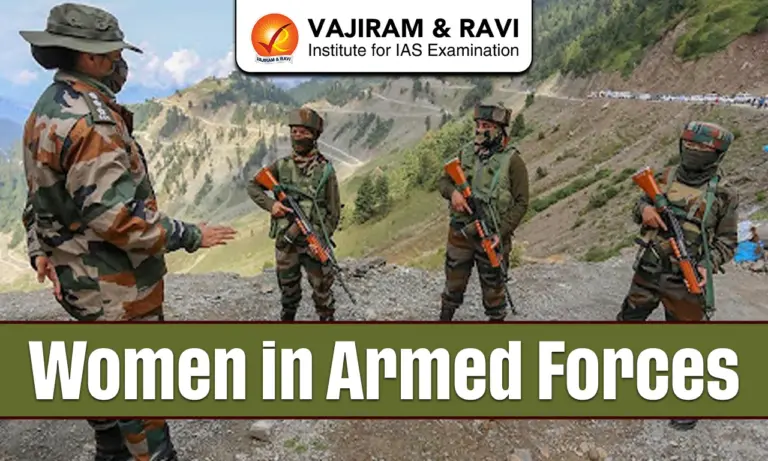
Women in Armed Forces Latest News
- The Supreme Court has upheld permanent commission and pensionary benefits for women officers in the Armed Forces, highlighting systemic gender bias.
Women in the Armed Forces
- Women have been inducted into the Indian Armed Forces primarily through the Short Service Commission (SSC) route.
- Key Features of SSC
- Officers serve for a limited tenure (generally 10-14 years).
- Permanent Commission (PC) allows a full career with pension benefits.
- Historically, women officers had limited access to PCs compared to men.
- Issues Faced by Women Officers
- Limited career progression opportunities.
- Lack of access to command roles and training courses.
- Institutional bias in performance evaluation and promotions.





Permanent Commission and Its Significance
- PC is critical for:
- Long-term career stability in the Armed Forces.
- Eligibility for promotions and leadership roles.
- Pension and post-retirement benefits.
- Denial of PC effectively restricted women officers to short-term service, creating structural inequality.
News Summary
- The Supreme Court delivered a landmark judgment addressing discrimination faced by women Short Service Commission Officers (SSCWOs).
- Recognition of Systemic Bias
- The Court observed that a long-held presumption that women lacked long-term career prospects led to an uneven playing field.
- This assumption adversely affected their chances of obtaining permanent commission.
- Flaws in the Evaluation System
- The Court found that the Annual Confidential Reports (ACRs) of women officers were graded casually.
- Women were often assigned average or lower scores.
- Higher grades were informally reserved for male officers eligible for PC.
- This resulted in a structural disadvantage when women were later evaluated for permanent commission.
- Unequal Opportunity Structure
- The Court noted that women officers were not encouraged for career-enhancing courses.
- They were denied key appointments.
- They had weaker service profiles due to systemic neglect.
- This reflected an “unequal opportunity structure” within the Armed Forces.
Key Directions of the Supreme Court
- Grant of Permanent Commission
- Women officers who met eligibility criteria are entitled to Permanent Commission.
- The Court held that inclusion in the consideration zone is a constitutional obligation, not discretion.
- Pensionary Benefits
- Women officers denied PC but released from service will be deemed to have completed 20 years of service.
- They will receive a pension and consequential benefits.
- No Vacancy Cap Barrier
- The Court rejected the argument of limited vacancies.
- It held that vacancy caps cannot override the need for equality.
- Relief Across Forces
- The judgment extends relief to all three branches of the Indian Armed Forces.
- This ensures uniform application across all branches.
Constitutional and Legal Principles
- The judgment reinforces key constitutional values:
- Equality Before Law
- Article 14 ensures equality before the law.
- Gender-based discrimination in career progression violates this principle.
- Equal Opportunity in Public Employment
- Article 16 guarantees equal opportunity in public employment.
- Denial of PC to women was found inconsistent with this provision.
- Substantive Equality
- The Court emphasised that formal equality is insufficient.
- Structural disadvantages must be addressed to ensure real equality.
Broader Implications
- Institutional Reform
-
- The Armed Forces will need to:
- Reform evaluation systems like ACRs.
- Ensure fair access to training and promotions.
- The Armed Forces will need to:
- Gender Inclusion
- The judgment strengthens the case for:
- Greater inclusion of women in defence services.
- Expansion of roles beyond traditional limitations.
- The judgment strengthens the case for:
- Precedential Value
- The ruling builds upon earlier judgments and sets a precedent for addressing systemic discrimination in institutions.

 Last updated on March, 2026
→ UPSC Final Result 2025 is now out.
→ UPSC has released UPSC Toppers List 2025 with the Civil Services final result on its official website.
→ Anuj Agnihotri secured AIR 1 in the UPSC Civil Services Examination 2025.
→ UPSC Marksheet 2025 is now out.
→ UPSC Notification 2026 & UPSC IFoS Notification 2026 is now out on the official website at upsconline.nic.in.
→ UPSC Calendar 2026 has been released.
→ Check out the latest UPSC Syllabus 2026 here.
→ UPSC Prelims 2026 will be conducted on 24th May, 2026 & UPSC Mains 2026 will be conducted on 21st August 2026.
→ The UPSC Selection Process is of 3 stages-Prelims, Mains and Interview.
→ Prepare effectively with Vajiram & Ravi’s UPSC Prelims Test Series 2026 featuring full-length mock tests, detailed solutions, and performance analysis.
→ Enroll in Vajiram & Ravi’s UPSC Mains Test Series 2026 for structured answer writing practice, expert evaluation, and exam-oriented feedback.
→ Join Vajiram & Ravi’s Best UPSC Mentorship Program for personalized guidance, strategy planning, and one-to-one support from experienced mentors.
→ Shakti Dubey secures AIR 1 in UPSC CSE Exam 2024.
→ Also check Best UPSC Coaching in India
Women in Armed Forces FAQs
Q1. What did the Supreme Court rule regarding women officers?+
Q2. What key issue did the Court identify?+
Q3. What relief was given to women officers who left service?+
Q4. How did the Court address vacancy limitations?+
Q5. Which constitutional principles were reinforced?+
Tags: mains articles upsc current affairs upsc mains current affairs women in armed forces