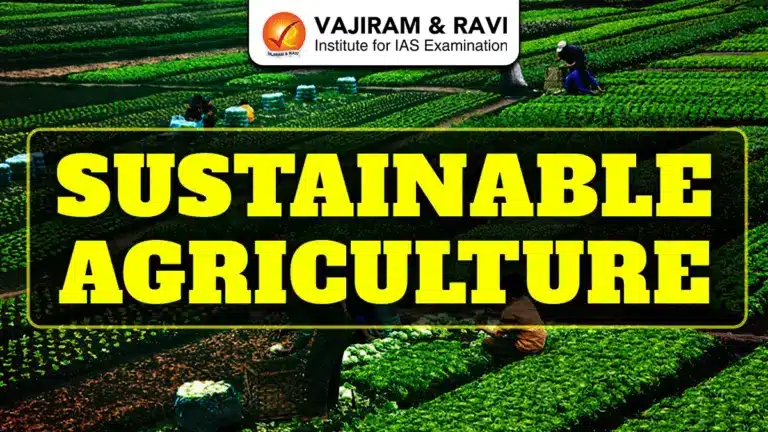
Sustainable Agriculture refers to farming systems that meet present food and fiber needs without reducing the ability of future generations to meet their own needs. The concept gained global recognition after the Brundtland Report of 1987 and focuses on conserving soil, water, biodiversity and ecosystem services. Agriculture contributes nearly one third of global anthropogenic greenhouse gas emissions and is a major driver of land degradation, water pollution and biodiversity loss. Sustainable Farming promotes environment friendly practices such as crop rotation, agroforestry, mixed farming and reduced chemical use to balance productivity, environmental protection and farmer livelihoods under changing climatic conditions.
Sustainable Agriculture in India
Sustainable Agriculture in India has emerged as a response to soil degradation, groundwater depletion, climate variability and rising input costs caused by intensive farming practices. Indian agriculture supports nearly 42% of the workforce and depends heavily on natural resources, making sustainability critical for food security. Overuse of chemical fertilizers, HYV seeds and irrigation has degraded soil health and reduced resilience. Sustainable approaches like Organic Farming, Zero Budget Natural Farming, Agroforestry and System of Rice Intensification aim to improve soil fertility, conserve water and stabilize farmer incomes while ensuring long term productivity and ecological balance.
Sustainable Agriculture Practice
Sustainable Agriculture Methods include diverse farming techniques that conserve resources, reduce environmental harm and maintain productivity over time.
- Crop Rotation: Systematic cultivation of different crops in succession maintains soil nutrients, reduces pest cycles, lowers disease incidence and minimizes fertilizer dependence, especially when legumes are included to biologically fix atmospheric nitrogen.
- Organic Farming: Organic farming avoids synthetic fertilizers and pesticides, relying on crop residues, animal manure, compost and biological pest control to enhance soil health and reduce chemical pollution.
- Agroforestry: Integration of trees with crops or livestock improves carbon sequestration, enhances biodiversity, reduces soil erosion and provides additional income through timber, fruits and fodder.
- Zero Budget Natural Farming: Promoted initially in Andhra Pradesh, this approach uses natural inputs like cow based formulations, eliminating purchased chemicals and credit dependence while improving soil microbial activity.
- System of Rice Intensification: SRI increases rice yields using younger seedlings, wider spacing and less water, reducing irrigation demand while improving root growth and soil aeration.
- Integrated Pest Management: IPM emphasizes pest prevention through crop rotation, biological control agents and natural predators, reducing reliance on chemical pesticides and lowering production costs.
- Conservation Agriculture: This method minimizes tillage, maintains permanent soil cover and promotes crop diversification to reduce erosion, improve soil moisture retention and enhance long term productivity.





Sustainable Agriculture Significance
Sustainable Agriculture plays a vital role in balancing food production with environmental protection and social equity.
- Environmental Conservation: Sustainable practices reduce soil erosion, conserve groundwater, prevent water pollution and protect biodiversity while maintaining ecosystem services critical for long term agricultural productivity.
- Climate Change Mitigation: Sustainable food systems lower greenhouse gas emissions, enhance carbon sequestration through soil and trees and improve resilience to climate variability and extreme weather events.
- Food Security: By improving soil health and water efficiency, Sustainable Agriculture supports stable crop yields and nutritional security for a growing population under changing environmental conditions.
- Economic Viability: Reduced dependence on costly chemical inputs lowers production expenses, stabilizes farmer incomes and improves long term profitability, especially for small and marginal farmers.
- Social Equity: Sustainable Agriculture promotes fair wages, safer working conditions, community participation and equitable access to nutritious food while strengthening rural livelihoods.
Sustainable Agriculture Government Initiatives
India has implemented several policy measures and programs to promote Sustainable Farming Practices nationwide. The list of major government initiatives has been given below:
- Paramparagat Krishi Vikas Yojana: PKVY promotes certified organic farming through cluster based approaches, reducing chemical use and encouraging traditional sustainable practices among farmer groups.
- National Mission on Sustainable Agriculture: Launched under the National Action Plan on Climate Change, this mission focuses on rainfed area development, soil health management, water use efficiency, climate resilient farming and integrated farming systems.
- Sub Mission on Agroforestry: SMAF supports integration of trees with crops and livestock, enhancing carbon sequestration, farm diversification, biodiversity conservation and additional income through timber and non timber forest products.
- Rashtriya Krishi Vikas Yojana: RKVY provides flexible financial assistance to states for Sustainable Agriculture projects, innovation, infrastructure development and adoption of modern eco friendly farming practices.
- Mission Organic Value Chain Development for North Eastern Region: MOVCDNER focuses on organic production, certification, processing and marketing in the North Eastern states to strengthen sustainable value chains.
- Network Project on Organic Farming: Implemented by ICAR, this project evaluates performance of organic versus conventionalSustainable Sugarcane Initiative farming systems and develops location specific organic production technologies.
- System of Rice Intensification: SRI promotes higher rice productivity using less water, younger seedlings and improved soil management, enhancing resource efficiency and climate resilience.
- Sustainable Sugarcane Initiative: This initiative encourages use of less water, fewer seeds and efficient nutrient management to improve sugarcane yields while reducing environmental stress.
- Zero Budget Natural Farming Promotion: Supported by several state governments, this approach reduces farmer dependence on external inputs by using natural formulations and locally available resources.
Sustainable Agriculture Challenges
Despite its benefits, Sustainable Agriculture faces multiple economic, technical and structural challenges.
- High Labor Requirement: Practices like organic farming and intercropping require more manual labor, increasing production costs and reducing short term profitability for resource constrained farmers.
- Lower Initial Yields: Transitioning from conventional to sustainable farming often leads to short term yield reductions, raising concerns about food security and farmer income stability.
- Capital Constraints: High initial investment in irrigation systems, organic inputs and infrastructure limits adoption among small and marginal farmers lacking access to credit.
- Market and Storage Issues: Sustainable produce faces marketing challenges due to inadequate certification, price realization issues and higher post harvest losses without proper infrastructure.
- Policy and Awareness Gaps: Limited extension services, weak incentives and lack of awareness hinder widespread adoption of sustainable agricultural practices.
Way Forward:
Addressing existing barriers is essential to scale Sustainable Agriculture effectively across regions.
- Financial Incentives: Direct subsidies, crop insurance and input support can reduce transition risks and encourage farmers to adopt sustainable practices.
- Research and Innovation: Investment in location specific technologies, climate resilient crops and low cost sustainable inputs can improve productivity and adoption rates.
- Extension Services: Strengthening farmer training, digital advisory platforms and field demonstrations can bridge knowledge gaps and improve implementation.
- Market Access: Developing storage facilities, certification systems and consumer awareness can enhance demand and price realization for sustainably produced food.
- Inclusive Policies: Empowering women farmers, promoting land consolidation and enforcing environmental regulations can ensure long term economic, social and ecological sustainability.

 Last updated on March, 2026
→ UPSC Final Result 2025 is now out.
→ UPSC has released UPSC Toppers List 2025 with the Civil Services final result on its official website.
→ Anuj Agnihotri secured AIR 1 in the UPSC Civil Services Examination 2025.
→ UPSC Marksheet 2025 is now out.
→ UPSC Notification 2026 & UPSC IFoS Notification 2026 is now out on the official website at upsconline.nic.in.
→ UPSC Calendar 2026 has been released.
→ Check out the latest UPSC Syllabus 2026 here.
→ UPSC Prelims 2026 will be conducted on 24th May, 2026 & UPSC Mains 2026 will be conducted on 21st August 2026.
→ The UPSC Selection Process is of 3 stages-Prelims, Mains and Interview.
→ Prepare effectively with Vajiram & Ravi’s UPSC Prelims Test Series 2026 featuring full-length mock tests, detailed solutions, and performance analysis.
→ Enroll in Vajiram & Ravi’s UPSC Mains Test Series 2026 for structured answer writing practice, expert evaluation, and exam-oriented feedback.
→ Join Vajiram & Ravi’s Best UPSC Mentorship Program for personalized guidance, strategy planning, and one-to-one support from experienced mentors.
→ Shakti Dubey secures AIR 1 in UPSC CSE Exam 2024.
→ Also check Best UPSC Coaching in India
Sustainable Agriculture FAQs
Q1. What is Sustainable Agriculture?+
Q2. Why is Sustainable Agriculture important for India?+
Q3. Which farming methods are part of Sustainable Agriculture?+
Q4. How does Sustainable Agriculture help climate change mitigation?+
Q5. What are major challenges in adopting Sustainable Agriculture?+
Tags: sustainable agriculture