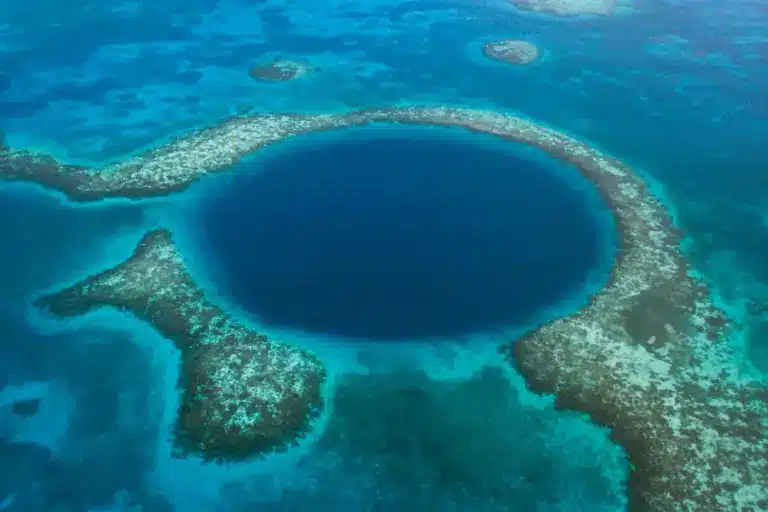
What is a Blue Hole?
- Blue holes are water-filled vertical caverns, or sinkholes, found in coastal regions where the bedrock is made of soluble material, such as limestone, marble, or gypsum.
- They form when water on the surface percolates through the rock, dissolving minerals and widening cracks, which eventually causes the rock to collapse.
- Famous examples include Dean’s Blue Hole in the Bahamas, the Dahab Blue Hole in Egypt, and the Great Blue Hole in Belize.
About Taam Ja’ Blue Hole:
- It is the deepest known underwater sinkhole in the world.
- It sits in Chetumal Bay off the southeast coast of the Yucatan Peninsula in Mexico.
- It extends at least 1,380 feet (420 meters) below sea level.
- It is 390 feet (119 m) deeper than the previous record holder — the 990-foot-deep (301 m) Sansha Yongle Blue Hole, also known as the Dragon Hole, in the South China Sea.
- Spread over an area of 13,660 square meters, the giant, underwater cavern has been named Taam Ja’ which means “deep water” in Mayan.
- The submerged blue hole has a nearly circular shape at its surface with steep sides that form a large conic structure covered by biofilms, sediments, limestone, and gypsum ledges.
Key facts about Yucatan Peninsula:
- It is a northeastern projection of Central America, extending into the Atlantic Ocean.
- The Gulf of Mexicolies on its western and northern sides. The Caribbean Sea lies on its eastern side.
- The northern part of Yucatán is in Mexico. Belize and a part of Guatemala are in the south.
The peninsula is almost wholly composed of beds of coralline and porous limestone rocks.
Q1: What is a Sinkhole?
A sinkhole is a hole in the ground that forms when water dissolves surface rock. Often, this surface rock is limestone, which is easily eroded, or worn away, by the movement of water. Sinkholes also form when the roofs of caves collapse. Sinkholes are often funnel-shaped, with the wide end open at the surface and the narrow end at the bottom of the pool.
Source: Deepest blue hole in the world discovered, with hidden caves and tunnels believed to be inside






 Last updated on March, 2026
→ UPSC Final Result 2025 is now out.
→ UPSC has released UPSC Toppers List 2025 with the Civil Services final result on its official website.
→ Anuj Agnihotri secured AIR 1 in the UPSC Civil Services Examination 2025.
→ UPSC Marksheet 2025 is now out.
→ UPSC Notification 2026 & UPSC IFoS Notification 2026 is now out on the official website at upsconline.nic.in.
→ UPSC Calendar 2026 has been released.
→ Check out the latest UPSC Syllabus 2026 here.
→ UPSC Prelims 2026 will be conducted on 24th May, 2026 & UPSC Mains 2026 will be conducted on 21st August 2026.
→ The UPSC Selection Process is of 3 stages-Prelims, Mains and Interview.
→ Prepare effectively with Vajiram & Ravi’s UPSC Prelims Test Series 2026 featuring full-length mock tests, detailed solutions, and performance analysis.
→ Enroll in Vajiram & Ravi’s UPSC Mains Test Series 2026 for structured answer writing practice, expert evaluation, and exam-oriented feedback.
→ Join Vajiram & Ravi’s Best UPSC Mentorship Program for personalized guidance, strategy planning, and one-to-one support from experienced mentors.
→ Shakti Dubey secures AIR 1 in UPSC CSE Exam 2024.
→ Also check Best UPSC Coaching in India