Child Trafficking Latest News
- India’s response to child trafficking has come under focus following recent judicial directions and data highlighting low conviction rates despite large-scale child rescues.
Understanding Child Trafficking in India
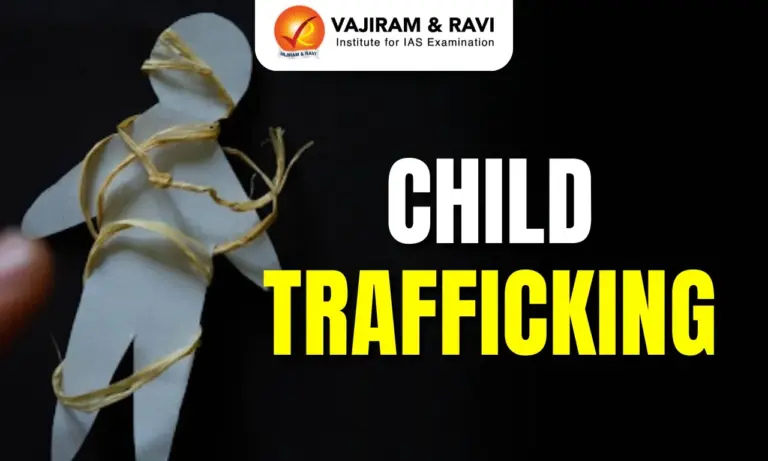
- Child trafficking remains a persistent and grave violation of human rights in India.
- It involves the recruitment, transportation, harbouring or receipt of children for purposes of exploitation, including forced labour, sexual exploitation, slavery, servitude, or organ removal.
- Despite extensive constitutional and statutory safeguards, trafficking networks continue to operate due to socio-economic vulnerabilities and weak enforcement outcomes.
- Official data indicate that thousands of children are rescued every year, yet convictions remain disproportionately low, exposing gaps between law, enforcement, and justice delivery.





International and Domestic Legal Definitions
- At the international level, child trafficking is defined under the Palermo Protocol (2000), which treats any movement or exploitation of a child for exploitative purposes as trafficking, irrespective of consent.
- This principle has been incorporated into India’s domestic legal framework.
- Under the Bharatiya Nyaya Sanhita (BNS), 2023, trafficking is defined broadly to include recruitment, transportation or harbouring through coercion, deception, abuse of power, or inducement for exploitation.
- The law recognises multiple forms of exploitation, including physical, sexual, economic, and organ trafficking, ensuring a comprehensive scope.
Constitutional Protection of Children
- The Constitution of India provides a strong foundation for protecting children against exploitation.
- Article 23 prohibits human trafficking and forced labour, while Article 24 bans employment of children in hazardous industries.
- Additionally, Article 39(e) and (f) directs the State to ensure that children are protected from abuse and are provided conditions of freedom, dignity, and healthy development.
- These constitutional principles impose a positive obligation on the State to prevent exploitation and address the structural conditions that enable trafficking.
Key Legislations Addressing Child Trafficking
- India has enacted multiple sector-specific laws to address different dimensions of child trafficking:
- Bharatiya Nyaya Sanhita, 2023: Criminalises trafficking and the buying and selling of minors.
- Immoral Traffic (Prevention) Act, 1956: Targets trafficking for sexual exploitation.
- Juvenile Justice (Care and Protection of Children) Act, 2015: Focuses on care, rehabilitation, and reintegration of trafficked children.
- Protection of Children from Sexual Offences (POCSO) Act, 2012: Provides stringent punishments for sexual offences against children, including life imprisonment and death penalty in extreme cases.
- The POCSO Act is notable for being gender-neutral and for enabling fast-track courts to ensure speedy trials.
Judicial Interventions and Supreme Court Guidelines
- The judiciary has played a critical role in shaping India’s anti-trafficking response. In landmark judgments, the Supreme Court has recognised trafficking as a violation of the fundamental right to life and dignity.
- Cases such as Vishal Jeet v. Union of India, M.C. Mehta v. State of Tamil Nadu, and Bachpan Bachao Andolan v. Union of India established preventive, rehabilitative, and regulatory principles.
- More recently, the Court has issued strict guidelines emphasising victim-centric approaches, accountability of authorities, and coordinated enforcement.
Structural Challenges in Tackling Child Trafficking
- Despite a robust legal framework, several challenges persist:
- Low conviction rates, which weaken deterrence
- Socio-economic vulnerabilities such as poverty, migration, disasters, and family breakdown
- Misuse of digital platforms for recruitment under the guise of jobs or opportunities
- Fragmented enforcement, due to trafficking networks operating across State boundaries
- Law and order, being a State subject, further complicates coordinated action, making Centre-State cooperation essential.
Way Forward: Strengthening India’s Anti-Trafficking Response
- A multi-dimensional strategy is required to tackle child trafficking effectively.
- This includes improving investigation quality, strengthening rehabilitation mechanisms, enhancing digital surveillance, and ensuring faster trials.
- Most importantly, conviction rates must improve to establish credible deterrence.
- Equally critical is addressing root causes through social protection, education, livelihood support, and awareness programmes.
- A strong institutional partnership between the Union and States is indispensable for disrupting trafficking networks operating across jurisdictions.
Source: TH

 Last updated on April, 2026
→ UPSC Final Result 2025 is now out.
→ UPSC has released UPSC Toppers List 2025 with the Civil Services final result on its official website.
→ Anuj Agnihotri secured AIR 1 in the UPSC Civil Services Examination 2025.
→ UPSC Marksheet 2025 is now out.
→ UPSC Notification 2026 & UPSC IFoS Notification 2026 is now out on the official website at upsconline.nic.in.
→ UPSC Calendar 2026 has been released.
→ Check out the latest UPSC Syllabus 2026 here.
→ UPSC Prelims 2026 will be conducted on 24th May, 2026 & UPSC Mains 2026 will be conducted on 21st August 2026.
→ The UPSC Selection Process is of 3 stages-Prelims, Mains and Interview.
→ Prepare effectively with Vajiram & Ravi’s UPSC Prelims Test Series 2026 featuring full-length mock tests, detailed solutions, and performance analysis.
→ Enroll in Vajiram & Ravi’s UPSC Mains Test Series 2026 for structured answer writing practice, expert evaluation, and exam-oriented feedback.
→ Join Vajiram & Ravi’s Best UPSC Mentorship Program for personalized guidance, strategy planning, and one-to-one support from experienced mentors.
→ Shakti Dubey secures AIR 1 in UPSC CSE Exam 2024.
→ Also check Best UPSC Coaching in India
Child Trafficking FAQs
Q1. What is child trafficking under Indian law?+
Q2. Which law currently defines trafficking in India?+
Q3. How does the Constitution protect children from trafficking?+
Q4. Why are conviction rates low despite large rescues?+
Q5. Why is Centre-State cooperation crucial in tackling trafficking?+
Tags: child trafficking mains articles upsc current affairs upsc mains current affairs