What’s in today’s article?
- Why in News?
- What Safety Norms Apply to Hoardings?
- What Led to Ghatkopar Incident?
- Who is Legally Responsible for the Ghatkopar Incident?
- What Needs to be Done to Avoid Ghatkopar like Incidents?
Why in News?
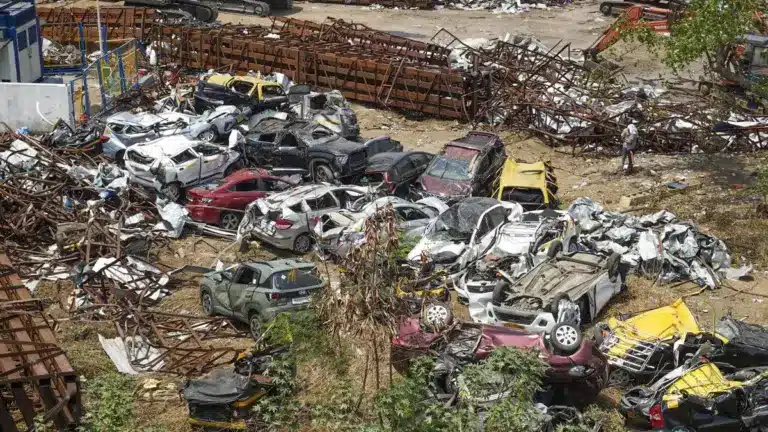
- At least 16 people were killed when a massive 250-tonne advertisement hoarding (on Government Railway Police land) in Mumbai’s Ghatkopar collapsed during a dust storm.
- In the wake of this tragedy, it is important to examine the safety regulations pertaining to hoardings and who is legally responsible for the event.





What Safety Norms Apply to Hoardings?
- Local bodies issue licences for advertisement hoardings.
- In Mumbai’s case,
- The Mumbai Municipal Corporation (MMC) Act 1888 (amended over time) stipulates that written permission of the Municipal Commissioner is needed for erecting such structures.
- The Policy Guidelines for Display of Advertisements 2018 makes structural stability certification from a registered structural engineer a condition for putting up hoardings.
- The policy guidelines also say hoardings existing as of May 1, 2014 should be reinstalled incorporating structural stability requirements.
- From a technical perspective, the Bureau of Indian Standards (BIS) lays out specifications for wind loads on hoardings.
- It gives formulae on how to calculate the force coefficients applicable to these wind-facing structures.
What Led to Ghatkopar Incident?
- The massive hoarding did not meet size norms: But was not brought down by official agencies in spite of being a highly visible hazardous structure.
- Safety norms were apparently liberalised:
- This was done through the Policy Guidelines for Display of Advertisements 2018 to tap the city’s full financial potential.
- Also, the MMC Act 1888 provides some regulatory exemptions to hoardings on railway land.
- Administrative lethargy: The Government Railway Police cited an ongoing dispute with the Corporation for not enforcing the safety laws on hoardings.
- No database of permits available: For example, no database of permits could be located on the BMC website in the hoardings section.
- Extreme weather events: The Ghatkopar disaster demonstrates that extreme weather, such as high winds or a cyclone sweeping a city, quickly exposes the weakest infrastructure links, with deadly consequences.
Who is Legally Responsible for the Ghatkopar Incident?
- The government and the owners of the private structures are legally responsible for the incident.
- The right of passage on a public pathway makes several connected individuals liable for negligence in the Ghatkopar case, including
- The owners of the land,
- The agency that put up the structure and the line officials responsible for enforcement,
- The civic officials and police who witnessed flagrant violation of rules but took no action, etc.
- In 2022, the Delhi HC, after fixing the liability of a public sector bank (BoB), granted compensation in a case where a man was struck by a sign board and the head injury led to his death.
What Needs to be Done to Avoid Ghatkopar like Incidents?
- Governments have to show due diligence to avert harm to citizens from official actions.
- Capacity building of the administrative machinery and reducing corruption at the administrative level is the need of the hour.
- The advent of digital boards has brought with it the possibility of moving displays, opening up avenues for different advertisers to use the same screens to show messages, raising rents for hoardings companies greatly.
- The focus should be on strengthening disaster management practices of municipalities to deal with the fallout in crowded cities.
- In the Mumbai incident, the presence of a petrol pump prevented personnel from using gas cutters, thus reducing the efficiency of disaster management expertise.
- As climate change is becoming a challenge, the city governments need to review conventional ideas on giant outdoor open-sky hoardings put up close to human activity.

 Last updated on March, 2026
→ UPSC Final Result 2025 is now out.
→ UPSC has released UPSC Toppers List 2025 with the Civil Services final result on its official website.
→ Anuj Agnihotri secured AIR 1 in the UPSC Civil Services Examination 2025.
→ UPSC Marksheet 2025 is now out.
→ UPSC Notification 2026 & UPSC IFoS Notification 2026 is now out on the official website at upsconline.nic.in.
→ UPSC Calendar 2026 has been released.
→ Check out the latest UPSC Syllabus 2026 here.
→ UPSC Prelims 2026 will be conducted on 24th May, 2026 & UPSC Mains 2026 will be conducted on 21st August 2026.
→ The UPSC Selection Process is of 3 stages-Prelims, Mains and Interview.
→ Prepare effectively with Vajiram & Ravi’s UPSC Prelims Test Series 2026 featuring full-length mock tests, detailed solutions, and performance analysis.
→ Enroll in Vajiram & Ravi’s UPSC Mains Test Series 2026 for structured answer writing practice, expert evaluation, and exam-oriented feedback.
→ Join Vajiram & Ravi’s Best UPSC Mentorship Program for personalized guidance, strategy planning, and one-to-one support from experienced mentors.
→ Shakti Dubey secures AIR 1 in UPSC CSE Exam 2024.
→ Also check Best UPSC Coaching in India